The Bible passages are taken from the Catholic Daily Lectionary.
Reading 2, Heb 9:24-28
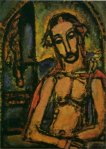
Man of Sorrows: Rouault
24 It is not as though Christ had entered a man-made sanctuary which was a model of the real one; he entered heaven itself, so that he now appears in the presence of God on our behalf. 25 And he does not have to offer himself again and again, as the high priest goes into the sanctuary year after year with the blood that is not his own, 26 or else he would have had to suffer over and over again since the world began. As it is, he has made his appearance once and for all, at the end of the last age, to do away with sin by sacrificing himself. 27 Since human beings die only once, after which comes judgement, 28 so Christ too, having offered himself only once to bear the sin of many, will manifest himself a second time, sin being no more, to those who are waiting for him, to bring them salvation.
The French socio-theologian Rene Girard has written extensively about the way societal “peace” is constructed on a sacrificial model: the human desire to compete leads to extinction, unless someone, saint, sinner, soldier, can be sacrificed to satisfy the blood-lust. Many religions project this lust on to a God who demands satisfaction for the sins and omissions of the people. Girard notes that the God of Jesus is not like this, and that the first Christians interpreted Jesus’ death, not as a sacrifice demanded by God, but as self-sacrifice designed to show forgiveness in the face of a scapegoating religious establishment. Armistice Sunday is a good time to examine our notion of sacrifice: did soldiers, say in the First World War, sacrifice themselves or were they sacrificed by the state, as the price of its own policy? And can the retrospective judgment that a soldier sacrificed his/her life, ever justify the soldier’s primary intention to kill? And, given that readiness for self sacrifice is a precious thing, what safeguards should exist to prevent a state using that gift carelessly, as in Iraq? The doctrine of the “Just War” as developed in the Christian Church, provides four safeguarding tests: 1. Is the evil (which war is designed to combat) truly serious and sustained? 2. Have all other methods of combating it been tried and exhausted? 3. Is there a reasonable chance of such a war succeeding in combating the evil? 4. Are the means by which it is intended to wage war proportionate to the evil? (Would nuking the Taliban be proportionate?) Only if all four are met, should a state think of waging war. In my book, the NATO attack on the Taliban fails on all four counts.
Gospel, Mk 12:38-44
38 In his teaching he said, ‘Beware of the scribes who like to walk about in long robes, to be greeted respectfully in the market squares, 39 to take the front seats in the synagogues and the places of honour at banquets; 40 these are the men who devour the property of widows and for show offer long prayers. The more severe will be the sentence hey receive.’ 41 He sat down opposite the treasury and watched the people putting money into the treasury, and many of the rich put in a great deal. 42 A poor widow came and put in two small coins, the equivalent of a penny. 43 Then he called his disciples and said to them, ‘In truth I tell you, this poor widow has put more in than all who have contributed to the treasury; 44 for they have all put in money they could spare, but she in her poverty has put in everything she possessed, all she had to live on.’
The English translation doesn’t quite get the force of the original Greek in the last line. Mark has Jesus use the Greek word BIO S (as in our BIOLOGY) which means “life” as well as “means of life”. Jesus points out that the widow “gave her whole life.” In other words, Jesus was defining the widow’s action as sacrificial; and he makes her an example of genuine sacrifice: it is not giving up a little of what one possesses; neither is it a suicidal recklessness; it is giving oneself generously, out of love. Of course there are members of armed forces who do this, but how much better if the sacrifice can be made in peace, for the good of civilization. Wilfred Owen’s words in “Strange Meeting” come to mind:
I would have poured my spirit without stint /But not through wounds; not on the cess of war. /Foreheads of men have bled where no wounds were.
 Emmock's Blog