Reading 1, Genesis 3:9-15, 20
9 But the Lord God called to the man. ‘Where are you?’ he asked.
10 ‘I heard the sound of you in the garden,’ he replied. ‘I was afraid because I was naked, so I hid.’
11 ‘Who told you that you were naked?’ he asked. ‘Have you been eating from the tree I forbade you to eat?’
12 The man replied, ‘It was the woman you put with me; she gave me some fruit from the tree, and I ate it.’
13 Then the Lord God said to the woman, ‘Why did you do that?’ The woman replied, ‘The snake tempted me and I ate.’
14 Then the Lord God said to the snake, ‘Because you have done this, Accursed be you of all animals wild and tame! On your belly you will go and on dust you will feed as long as you live. 15 I shall put enmity between you and the woman, and between your offspring and hers; it will bruise your head and you will strike its heel.’
20 The man named his wife ‘Eve’ because she was the mother of all those who live.
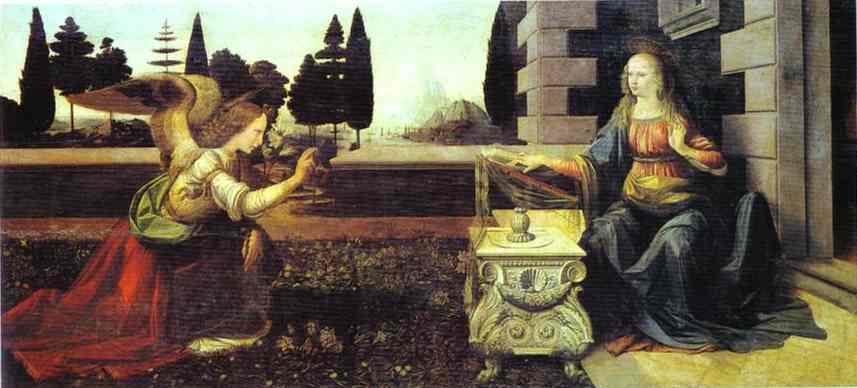
"The Lord is with you!"
Gospel, Luke 1:26-38
26 In the sixth month the angel Gabriel was sent by God to a town in Galilee called Nazareth, 27 to a virgin betrothed to a man named Joseph, of the House of David; and the virgin’s name was Mary. 28 He went in and said to her, ‘Rejoice, you who enjoy God’s favour! The Lord is with you.’
29 She was deeply disturbed by these words and asked herself what this greeting could mean, 30 but the angel said to her, ‘Mary, do not be afraid; you have won God’s favour. 31 Look! You are to conceive in your womb and bear a son, and you must name him Jesus. 32 He will be great and will be called Son of the Most High. The Lord God will give him the throne of his ancestor David; 33 he will rule over the House of Jacob for ever and his reign will have no end.’
34 Mary said to the angel, ‘But how can this come about, since I have no knowledge of man?’
35 The angel answered, ‘The Holy Spirit will come upon you, and the power of the Most High will cover you with its shadow. And so the child will be holy and will be called Son of God. 36 And I tell you this too: your cousin Elizabeth also, in her old age, has conceived a son, and she whom people called barren is now in her sixth month, 37 for nothing is impossible to God.’
38 Mary said, ‘You see before you the Lord’s servant, let it happen to me as you have said.’ And the angel left her.
This is a famous link between Eve, as the mother of fallen humanity, and Mary, as the mother of Jesus and the New Humanity. In truth, there is no theology of fall in the Hebrew writing. There is a recognition of sin, which comes about through the scandalous ability and freedom that God has given to humans. In granting such freedom, God has set creation off on a bumpy ride which, by definition, He cannot control, without taking the freedom back. (“The snake fed the woman/ and the woman fed the man/ and there wouldn’t be an apple/ if it wasn’t in the plan.” Sydney Carter).
St. Paul began a process of re-interpretation of Adam which culminated in Augustine’s view that through their first parents’ sin human beings were deprived of all good in their natures. So on the one hand, there is the picture of an ever more corrupt and corrupting Eve, while on the other, is an ever more desexualised Virgin Mary, who ends up totally removed from natural conception and natural death.
Much that is disgusting and regrettable in Christianity has come from this exaggerated contrast, not least the denial of sexual pleasure, and the elevation of celibacy, which has led to the endemic abuse of children by celibate priests.
The reading from Genesis omits God’s curse on human work and childbirth, which remind us that the subtle author is reinterpreting everyday experiences, like the sweat of work and the pain of labour, not to mention the snake’s absence of legs, as evidence that “in the beginning” it was meant to be different. The real sin of Eve and Adam is the desire to be like God, which of course, they already are. They want this to be their own achievement rather than an original blessing from God.
Mary, on the other hand, receives the original blessing from God’s messenger, and accepts the even more difficult means, by which she is to become the mother of the Messiah. Luke keeps this part of his narrative wonderfully true to the language of the Jewish Bible and only hints at the miracle of Jesus’ conception. He says nothing about Joseph being suspicious of Mary’s pregnancy, nothing about them refraining from marital sex until the child is born- indeed, he doesn’t really rule out Joseph from a human contribution to Jesus’ conception. (All of that is found in Matthew’s account).
Luke’s characterisation of the strong and pious women of an extended family of country people in Galilee, is convincing enough for the reader to accept the commerce of angels without disbelief. The mixture of fierce expectation for their children, with a mystery that goes beyond their understanding, is Luke’s great achievement in his story of Elizabeth and Mary.
 Emmock's Blog