
This blog reflects on the Catholic daily bible readings
Reading 1, Jeremiah 23:5-8
5 Look, the days are coming, the Lord declares, when I shall raise an upright Branch for David; he will reign as king and be wise, doing what is just and upright in the country.
6 In his days Judah will triumph and Israel live in safety. And this is the name he will be called, ‘The Lord-is-our-Saving-Justice.’ ”
7 ‘So, look, the days are coming, the Lord declares, when people will no longer say, “As God lives who brought the Israelites out of Egypt,”
8 but, “As God lives who led back and brought home the offspring of the House of Israel from the land of the north and all the countries to which he had driven them, to live on their own soil.” ‘
Gospel, Matthew 1:18-25
18 This is how Jesus Christ came to be born. His mother Mary was betrothed to Joseph; but before they came to live together she was found to be with child through the Holy Spirit. 19 Her husband Joseph, being an upright man and wanting to spare her disgrace, decided to divorce her informally.20 He had made up his mind to do this when suddenly the angel of the Lord appeared to him in a dream and said, ‘Joseph son of David, do not be afraid to take Mary home as your wife, because she has conceived what is in her by the Holy Spirit. 21 She will give birth to a son and you must name him Jesus, because he is the one who is to save his people from their sins.’
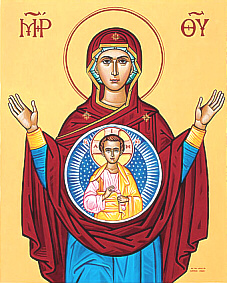
Orthodox image of Mary Theotokos-bearer of God
22 Now all this took place to fulfil what the Lord had spoken through the prophet: 23 Look! the virgin is with child and will give birth to a son whom they will call Immanuel, a name which means ‘God-is-with-us’.
24 When Joseph woke up he did what the angel of the Lord had told him to do: he took his wife to his home; 25 he had not had intercourse with her when she gave birth to a son; and he named him Jesus.
After a succession of Davidic Kings whose name might have been, “Weapons and alliances are our saving justice”, the prophet still has faith that God will provide a true king who will trust in God and administer His justice. Not only that, but the exiled Jews will be gathered from the four corners of the earth and returned to their land. Words like these cheered Jewish people in dark times and also provided a programme for Zionism. The ambiguous story of modern Israel should remind us that ancient prophecy is not an unmixed blessing: a just interpretation is as important as the promise of justice. The original words come from the anguished understanding of the prophet Jeremiah that the world he knows is ending, the nation he loves is being destroyed, but he has hope, beyond destruction, of a new exodus into a national life of justice and peace. Christians who apply the prophecy to Jesus should be careful they do not turn historical hope into religious triviality.
A questionable use of ancient prophecy is seen in Matthew’s story of the birth of Jesus. He takes a prophecy which uses the Hebrew word for “young woman” and insists it says “virgin”. This may be because he was using a Greek translation of the Hebrew which allowed this mistake to arise. Isaiah’s words (Isaiah 7:14) clearly refer to an imminent birth in the royal family of his own time, but like many other prophecies, were directed to a more distant future when they were unfulfilled at the time.
Matthew’s story of Jesus’ birth by a virgin, which he shares with Luke, shows that he is concerned to emphasise and protect the virginal conception of Jesus. On the other hand it’s quite clear he didn’t present Jesus as half-human, half-God. Nevertheless, in spite of Jesus’ impressive male forebears, their inherited seed is sidelined by the action of God. Humanity cannot make a new start in its own resources but only in cooperation with God. Jesus may be adopted into the clan of David but he is not, “of the seed of David.” For an author who leans towards the importance of Jesus’ Jewish heritage, this is a challenging note on which to begin his story.
How we think of Jesus’ as “Son of God” remains important because it affects the related question of how we think of God’s presence in our own lives. Our assumption with regard to the future of the world is that’s it’s all up to us. This is the last day of the Copenhagen Climate Change Conference. Without doubt our actions have been wrong; the assumption that we, unaided, can make them right, may also be wrong.
 Emmock's Blog
[…] Bible Blog 38 December 2009 5 […]