This blog follows the daily bible readings of the Catholic Church
Reading 1, 1 John 5:14-21
14 Our fearlessness towards him consists in this, that if we ask anything in accordance with his will he hears us.
15 And if we know that he listens to whatever we ask him, we know that we already possess whatever we have asked of him.
16 If anyone sees his brother commit a sin that is not a deadly sin, he has only to pray, and God will give life to this brother — provided that it is not a deadly sin. There is sin that leads to death and I am not saying you must pray about that.
17 Every kind of wickedness is sin, but not all sin leads to death.
18 We are well aware that no one who is a child of God sins, because he who was born from God protects him, and the Evil One has no hold over him.
19 We are well aware that we are from God, and the whole world is in the power of the Evil One.
20 We are well aware also that the Son of God has come, and has given us understanding so that we may know the One who is true. We are in the One who is true as we are in his Son, Jesus Christ. He is the true God and this is eternal life. Children, be on your guard against false gods.
Gospel, John 3:22-30
22 After this, Jesus went with his disciples into the Judaean countryside and stayed with them there and baptised.
23 John also was baptising at Aenon near Salim, where there was plenty of water, and people were going there and were being baptised.
24 For John had not yet been put in prison.
25 Now a discussion arose between some of John’s disciples and a Jew about purification,
26 so they went to John and said, ‘Rabbi, the man who was with you on the far side of the Jordan, the man to whom you bore witness, is baptising now, and everyone is going to him.’
27 John replied: ‘No one can have anything except what is given him from heaven.
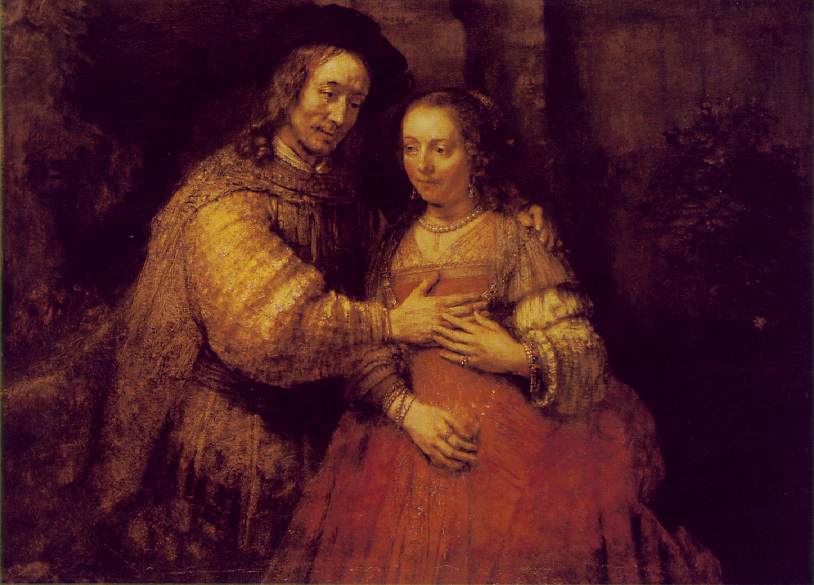
It is the bridegroom who has the bride (Rembrandt)
28 ‘You yourselves can bear me out. I said, “I am not the Christ; I am the one who has been sent to go in front of him.”
29 ‘It is the bridegroom who has the bride; and yet the bridegroom’s friend, who stands there and listens to him, is filled with joy at the bridegroom’s voice. This is the joy I feel, and it is complete.
30 He must grow greater, I must grow less.
There are many difficulties in the passage from John’s letter. The most important are these:
What is a mortal sin? If Jesus is the God-given means by which sins are forgiven, how can any sin be mortal in principle? In any case, who is to be the judge of such a matter? Are we talking about Hitler and Stalin, or are we talking (as I suspect John might be) about teachers whom we have declared false? There may be sins which lead to eternal death but if there are, no human being could know them, only God. (Mark reports Jesus as warning against the “unforgivable sin” of blaspheming the Holy Spirit)
- If children of God never sin, how can a Christian brother need our prayers for his sin?
Sin is a vital topic for Christian teaching, but the teaching of this letter is unclear and unhelpful. Bible scholars have tried to get over these difficulties but I don’t find their explanations convincing.
John the baptiser is depicted in all the gospels as a great prophet who nevertheless recognises the greater calling of Jesus. Here he describes Jesus as the bridegroom (of Israel) and himself as the best man. The bride (The people of Israel) belongs to the bridegroom, but the best man shares the joy of the marriage day. This imagery of bride and groom comes from the Song of Songs, which was interpreted as signifying the love of God and his people Israel. In the Christian tradition the church has been seen as the bride of Christ, as have those making commitment to a religious order. Mystics have addressed Christ as the bridegroom of the soul.
I find this imagery foreign, but just for that reason, helpful in nurturing my own spiritual development.
Words and images which have expressed the faith of Christian people in the past, should be precious to us.
 Emmock's Blog