
This blog reflects on the daily bible readings of the Catholic Church
Reading 1, 1 Sam 9:1-4, 17-19; 10:1a
1 Among the men of Benjamin was a man called Kish son of Abiel, son of Zeror, son of Becorath, son of Aphiah; a Benjaminite and a person of rank.
2 He had a son called Saul, a handsome man in the prime of life. Of all the Israelites there was no one more handsome than he; he stood head and shoulders taller than anyone else.
3 Now since the donkeys belonging to Kish, Saul’s father, had strayed, Kish said to his son Saul, ‘My son, take one of the servants with you and be off; go and look for the donkeys.’
4 They went through the highlands of Ephraim, they went through the territory of Shalishah, and did not find them; they went through the territory of Shaalim but they were not there; they went through the territory of Benjamin and did not find them.
17 When Samuel saw Saul, Yahweh told him, ‘That is the man of whom I said to you, “He is to govern my people.” ‘
18 Saul accosted Samuel in the gateway and said, ‘Tell me, please, where the seer’s house is.’
19 Samuel replied to Saul, ‘I am the seer. Go up ahead of me to the high place. You must eat with me today. Tomorrow, when I let you go, I shall tell you whatever is on your mind.
1 Samuel took a phial of oil and poured it on Saul’s head; he then kissed him and said, ‘Has not Yahweh anointed you as leader of his people Israel? You are the man who is to govern Yahweh’s people and save them from the power of the enemies surrounding them. The sign for you that Yahweh has anointed you as prince of his heritage is this.
Again the lectionary skips most of the story in order to cram Samuel’s choice of Saul as King into a short excerpt. In fact, what is missed out is as important as what has been left in. Saul goes looking for his father’s lost donkeys and finds out from Samuel that he is to lead the “lost donkeys” of Israel, as their king. The original calling of the king is to rescue his people from their enemies, not to claim any particular power for himself and his family. This part of the story is more favourable to the idea of kingship than chapter 8, which saw it as exploitative. Here the Lord, through his prophet, is behind the development of kingship from the beginning. The two viewpoints in the story of the first King of Israel, make it confusing and unrealistic. God is depicted as wavering in his choice of Saul, and eventually as rejecting him in favour of David. The only clear message is that kingship is about obedience to God and care of the people; but that’s not a bad message.
Gospel, Mk 2:13-17
13 He went out again to the shore of the lake; and all the people came to him, and he taught them.
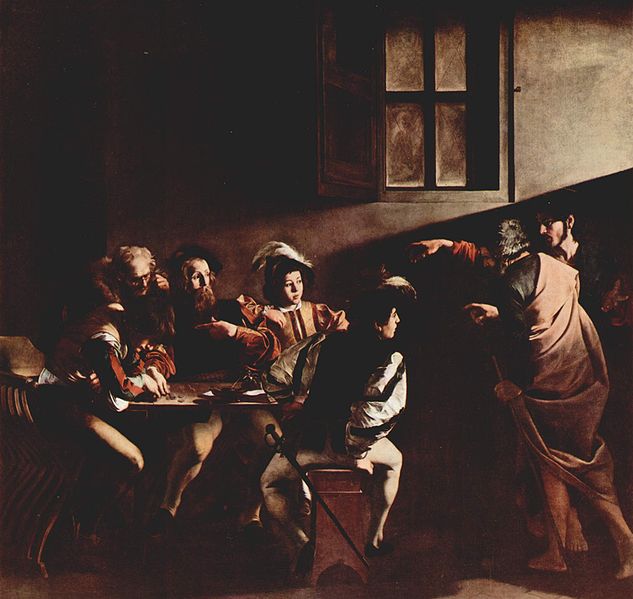
Levi is called to join the barefoot disciples
14 As he was walking along he saw Levi the son of Alphaeus sitting at the tax office, and he said to him, ‘Follow me.’ And he got up and followed him.
15 When Jesus was at dinner in his house, a number of tax collectors and sinners were also sitting at table with Jesus and his disciples; for there were many of them among his followers.
16 When the scribes of the Pharisee party saw him eating with sinners and tax collectors, they said to his disciples, ‘Why does he eat with tax collectors and sinners?’
17 When Jesus heard this he said to them, ‘It is not the healthy who need the doctor, but the sick. I came to call not the upright, but sinners.’
We know that a Christian scribe copying Mark’s gospel, when he came to end of Mark’s verse 17, added the words “to repentance,” because he was uncomfortable with the notion that Jesus called sinners to share his ministry. It looks as if Mark had this to rights however. If Jesus had merely called sinners to repentance, he would certainly not have aroused the suspicion of the Pharisees. No, it was the incorporation of people like Levi in the body of his group that caused offence. Those whom others saw only as hateful collaborators (tax collectors), or low-life (sinners), Jesus saw as people who would learn his way, and communicate it to others. Unlike Samuel, Jesus did not look for the flower of Israel to call to God’s work. He knew that the righteous might too easily confuse the good news of God’s healing, with their own righteousness. Sinners always know that good news began with their own healing.
 Emmock's Blog