
People who use sacred texts have often found ways of selecting passages appropriate to their needs. Disciples of Confucius used a complex system of hexagrams, chosen by lot, to find images and comments suitable to their time, place and situation. In classical and medieval times, the writings of Virgil and Homer were used in a similar way. Sometimes the Bible was accessed by lot or dice or random procedures. The Church responded to the need to select appropriate wisdom from the Bible, by the daily lectionary, a selection of readings for every day in the year, which was originally used in monasteries, but has for some time been used in daily mass in the Catholic Church, and for private devotion in others. Obviously the choice of passages reflects a theology and the Christian calendar, but it also has an arbitrary element. It asks the reader, “Can this wisdom be applied to your soul, your community, your place, today?” This blog follows the daily readings and hopes to uncover some wisdom.
Reading 1, 1 Kings 8:1-7, 9-13
1 Solomon then summoned the elders of Israel to Jerusalem to bring the ark of the covenant of the Lord up from the City of David, that is, Zion.
2 All the men of Israel assembled round King Solomon in the month of Ethanim, at the time of the feast (that is, the seventh month).
3 When all the elders of Israel had arrived, the priests took up the ark
4 and the Tent of Meeting and all the sacred utensils which were in the Tent.
9 There was nothing in the ark except the two stone tablets which Moses had placed in it at Horeb, the tablets of the covenant which the Lord made with the Israelites when they came out of Egypt.
10 Now when the priests came out of the Holy Place, the cloud filled the Temple of the Lord,
11 and because of the cloud the priests could not stay and perform their duties. For the glory of the Lord filled the Temple of the Lord.
12 Then Solomon said: The Lord has chosen to dwell in thick cloud.
13 I have built you a princely dwelling, a residence for you for ever.
Mark 6: 53-56
Having made the crossing, they came to land at Gennesaret and moored there.
54 When they disembarked people at once recognised him,
55 and started hurrying all through the countryside and brought the sick on stretchers to wherever they heard he was.
56 And wherever he went, to village or town or farm, they laid down the sick in the open spaces, begging him to let them touch even the fringe of his cloak. And all those who touched him were saved.
Here we have two different readings of the “glory of God.”
1. Solomon has built a temple, very like those of other Canaanite Gods, but without any divine images, and has brought the Ark of the Covenant, representing the agreement between God and his people, into it. The Hebrew tradition rejects any direct vision of God, but his “glory” the outshining of his majesty, visible, as in the exodus, as a cloud, signals God’s presence. This God, who both conceals and reveals Himself, is to be found in the Jerusalem temple, which is God’s “dwelling and residence” for ever. The priestly tradition of Judaism regulated the religion of the people by insisting that sacrifices to the Lord could only be made in the Temple. This insistence was not always obeyed, and in any case, the Temple cult itself became questionable, and was criticised by the prophets, who said that God desired kindness more than sacrifice. The placing of God’s glory in even the most elevated holy place may lead people away from God’s wisdom.
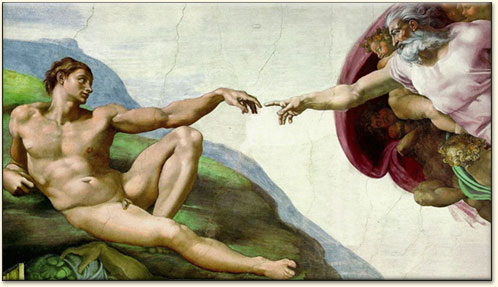
"The glory of God is the living person."
2. The author of Mark’s gospel shows that God’s glory was glimpsed by the Galileans in Jesus, in whom God’s kindness had become accessible. Although “Mark” knew that even this devotion could be ambiguous, he credits these needy people with faith which brings salvation (they were “saved”). St Irenaeus memorably wrote, “The glory of God is the living person.” God’s true majesty, shining out, is not to be seen in any special revelation but in the creation and restoration of his image in men and women. We should interpret the Mark passage in the light of this teaching: Jesus revealed God’s glory in the healing of the sick. There is a clear bias in Christian faith towards tending God’s glory in men and women more than in acts of worship -not that worship is irrelevant, but it derives its relevance from our care of created beings. Without this bias, worship can be a deception, “Take away from me the voice of your songs…. Instead let justice pour down like waters and righteousness as an ever-flowing stream…” (Amos 5:24)
 Emmock's Blog