
This blog continues to follow the daily bible readings of the Catholic Church
Reading 1, Acts 2:14, 22-33
14 Then Peter stood up with the Eleven and addressed them in a loud voice: ‘Men of Judaea, and all you who live in Jerusalem, make no mistake about this, but listen carefully to what I say.
22 ‘Men of Israel, listen to what I am going to say: Jesus the Nazarene was a man commended to you by God by the miracles and portents and signs that God worked through him when he was among you, as you know. 23 This man, who was put into your power by the deliberate intention and foreknowledge of God, you took and had crucified and killed by men outside the Law.
24 But God raised him to life, freeing him from the pangs of Hades; for it was impossible for him to be held in its power since, 25 as David says of him: I kept the Lord before my sight always, for with him at my right hand nothing can shake me.
26 So my heart rejoiced my tongue delighted; my body, too, will rest secure, 27 for you will not abandon me to Hades or allow your holy one to see corruption. 28 You have taught me the way of life, you will fill me with joy in your presence.
29 ‘Brothers, no one can deny that the patriarch David himself is dead and buried: his tomb is still with us. 30 But since he was a prophet, and knew that God had sworn him an oath to make one of his descendants succeed him on the throne, 31 he spoke with foreknowledge about the resurrection of the Christ: he is the one who was not abandoned to Hades, and whose body did not see corruption.
32 God raised this man Jesus to life, and of that we are all witnesses. 33 Now raised to the heights by God’s right hand, he has received from the Father the Holy Spirit, who was promised, and what you see and hear is the outpouring of that Spirit.
Writing maybe 50 years on, Luke tells of the boldness of the first preacher of the Risen Jesus. Peter is depicted as discovering his courage, able both to accuse his compatriots of killing Jesus and to offer them forgiveness in his name. It’s unclear how accurate a picture Luke gives, but his practice as a historian is to present an image of events which remains true to his sources, while carrying his vision of the journey of Christian faith from Jerusalem to Rome. The community he depicts has already reflected on the resurrection of Jesus and found confirmation of its faith in the Jewish Scriptures. It is not certain that the words of Psalm 16, quoted in Peter’s speech, express a belief in resurrection. They may do so, or they may simply express trust in the gift of long life. By Luke’s time of writing, however, the words have become a prophecy of Jesus’ resurrection, which in Luke’s theology is a special stage of God’s work in establishing his kingdom in the world, through Jesus. The next stage is the gift of the Holy Spirit, who creates the community of love and justice, out of which Peter speaks. The Risen Lord is active in and through his community.
Gospel, Mt 28:8-15
8 Filled with awe and great joy the women came quickly away from the tomb and ran to tell his disciples. 9 And suddenly, coming to meet them, was Jesus. ‘Greetings,’ he said. And the women came up to him and, clasping his feet, they did him homage.
10 Then Jesus said to them, ‘Do not be afraid; go and tell my brothers that they must leave for Galilee; there they will see me.’
11 Now while they were on their way, some of the guards went off into the city to tell the chief priests all that had happened. 12 These held a meeting with the elders and, after some discussion, handed a considerable sum of money to the soldiers 13 with these instructions, ‘This is what you must say, “His disciples came during the night and stole him away while we were asleep.” 14 And should the governor come to hear of this, we undertake to put things right with him ourselves and to see that you do not get into trouble.’
15 So they took the money and carried out their instructions, and to this day that is the story among the Jews.
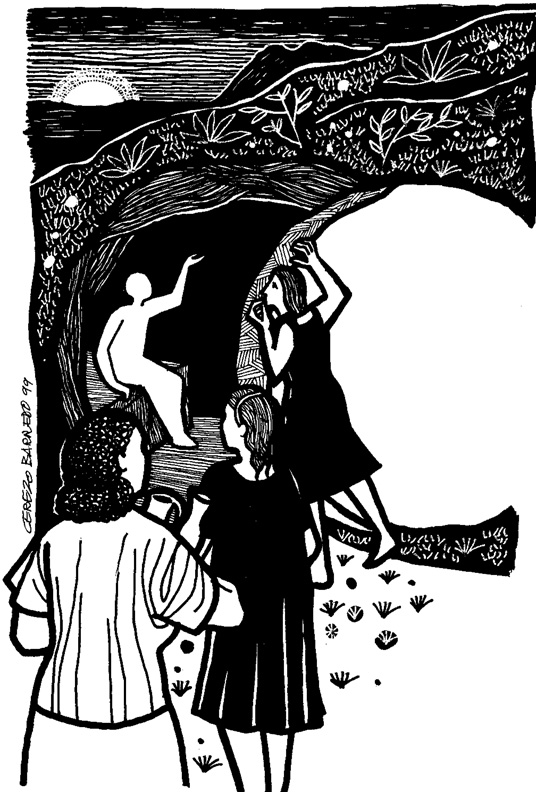
On the threshold of the light
In Matthew we also have a narrative written 50 years at least after the event. The author is depicting the tradition of his church. Jesus appears, alive, to the women, although their testimony would not count in a Jewish court. They touch his feet, proving that the risen Jesus is not immaterial. They are commanded to send the other disciples to Galilee, which is associated with appearances of the risen Lord.
Trying to disentangle the varied gospel witness to the resurrection is futile. All we can do is note the main points the writers want to put on record:
- Jesus was killed on the cross by the Romans at the request of the Jewish leadership.
- He was buried
- His tomb was found empty
- His followers experienced Jesus alive, in bodily form
- He, the Lord Jesus, is alive and is now with God, that is, everywhere.
We can see that item 3 above had already attracted criticism which Matthew attempts to demolish with his story of skulduggery between soldiers and priests.
For all believers from the start, the actual resurrection of Jesus is a past event: no-one says he saw Jesus rising. The empty tomb is an event that can mean what you make it mean. You can say it proves Jesus resurrection. You may say it is an invention which discredits the whole story of Jesus’ resurrection. Or you may remain agnostic about the empty tomb while affirming the bodily resurrection of Jesus, just as you can affirm the bodily resurrection of your parents while knowing that their earthly bodies are in a grave, or dissipated by cremation.
The assurance that believers have about Jesus’ resurrection, is their certain trust in his living presence and his victory over death and evil.
 Emmock's Blog