
This blog comments of the daily bible readings of the Catholic Church
Reading 1, Acts 2:36-41
36 ‘For this reason the whole House of Israel can be certain that the Lord and Christ whom God has made is this Jesus whom you crucified.’
37 Hearing this, they were cut to the heart and said to Peter and the other apostles, ‘What are we to do, brothers?’
38 ‘You must repent,’ Peter answered, ‘and every one of you must be baptised in the name of Jesus Christ for the forgiveness of your sins, and you will receive the gift of the Holy Spirit. 39 The promise that was made is for you and your children and for all those who are far away, for all those whom the Lord our God is calling to himself.’
40 He spoke to them for a long time using many other arguments, and he urged them, ‘Save yourselves from this perverse generation.’
41 They accepted what he said and were baptised. That very day about three thousand were added to their number.
In the folk tales, it’s the youngest, or the idiot, or the most despised who turns out to be the hero or God in disguise. The discovery that the one we have ill-treated and despised is Christ should always cut us to the heart, for to be sure, what we do to the least important we do to him. In the moment described by Luke, Peter’s hearers discover that Jesus was bruised for their own transgressions, and are offered the chance, on condition of repentance, to find that with his wounds, they are healed.
“On condition of repentance”. Tiger Woods the golfer is slightly embarrassing at present because he often speaks of having been a bad person, and of the need to become a better one. This is not the language we are used to. Public figures will normally use the formula, “If I have done anything to offend anyone….” We make mistakes, we mess up, we unwittingly offend, but we do not lie, cheat, steal-we do not sin, because then we might have to acknowledge that we have been bad people, and need to change. The Greek word is metanoia-a change of mind or heart. Our hearts will not change, unless they are cut open by the truth of what we have done or failed to do.
Gospel, Jn 20:11-18

Fra Angelico: Resurrection of Jesus
11 But Mary was standing outside near the tomb, weeping. Then, as she wept, she stooped to look inside, 12 and saw two angels in white sitting where the body of Jesus had been, one at the head, the other at the feet.
13 They said, ‘Woman, why are you weeping?’ ‘They have taken my Lord away,’ she replied, ‘and I don’t know where they have put him.’
14 As she said this she turned round and saw Jesus standing there, though she did not realise that it was Jesus.
15 Jesus said to her, ‘Woman, why are you weeping? Who are you looking for?’ Supposing him to be the gardener, she said, ‘Sir, if you have taken him away, tell me where you have put him, and I will go and remove him.’
16 Jesus said, ‘Mary!’ She turned round then and said to him in Hebrew, ‘Rabbuni!’ — which means Master. 17 Jesus said to her, ‘Do not cling to me, because I have not yet ascended to the Father. But go to the brothers, and tell them: I am ascending to my Father and your Father, to my God and your God.’
18 So Mary of Magdala told the disciples, ‘I have seen the Lord,’ and that he had said these things to her.
In Jewish Law, women were not accepted as equal witnesses to men, yet John’s Gospel presents Mary as the first witness of the resurrection. When the chauvinist churches babble about male priesthood based on (solely) male disciples, they forget the utter failure of the Twelve, and the faithfulness of the women disciples of Jesus.
The gospel characterises Mary of Magdala as one from whom Jesus had cast out seven demons. That is, she had been comprehensively possessed by evil powers and Jesus had liberated her. He had given her a chance to turn her life around and a new vision of who she could be. Jesus’ death would have put all of that in question: the new person she had glimpsed might simply be a pipe dream. Her grief was for Jesus, but also for herself. Risen from the dead, Jesus says her name. This is not merely his loving recognition of her as a dear friend, but his name for the person she would become. In him she can see her own victory. Because He is risen, she also is raised. God too is changed: Jesus’ God, the intimate father, has become the God of all his disciples, through the resurrection which raises them all.
All this is for us and all humanity. We too are meant to hear the risen Jesus. How? By listening carefully to our lives and the lives of others, listening with our souls, which have the unerring ability to detect amidst the babble of voices, the One who calls our name.
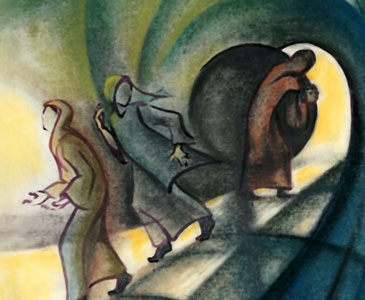
The first witnesses
 Emmock's Blog