
This blog follows the daily bible readings of the Catholic Church
Reading 1, Acts 5:34-42
34 One member of the Sanhedrin, however, a Pharisee called Gamaliel, who was a teacher of the Law respected by the whole people, stood up and asked to have the men taken outside for a time.
35 Then he addressed the Sanhedrin, ‘Men of Israel, be careful how you deal with these people. 36 Some time ago there arose Theudas. He claimed to be someone important, and collected about four hundred followers; but when he was killed, all his followers scattered and that was the end of them. 37 And then there was Judas the Galilean, at the time of the census, who attracted crowds of supporters; but he was killed too, and all his followers dispersed. 38 What I suggest, therefore, is that you leave these men alone and let them go. If this enterprise, this movement of theirs, is of human origin it will break up of its own accord; 39 but if it does in fact come from God you will be unable to destroy them. Take care not to find yourselves fighting against God.’
His advice was accepted; 40 and they had the apostles called in, gave orders for them to be flogged, warned them not to speak in the name of Jesus and released them. 41 And so they left the presence of the Sanhedrin, glad to have had the honour of suffering humiliation for the sake of the name. 42 Every day they went on ceaselessly teaching and proclaiming the good news of Christ Jesus, both in the temple and in private houses.
Luke continues his unsparing portrait of the religious establishment, as it tried to deal with a new movement of faith. Its instinct is to use violent punishment, but it is deflected from this by the teacher, Gamaliel, who counsels patience, as that which is not from God will soon fall apart. When I think of the Lord’s Resistance Army in Africa, or the Bush administration in the USA, I judge Gamaliel’s view as a bit optimistic, but it has the solid virtues of non-violence and patience. The casual brutality of the authorities is shown in their decision to have the apostles flogged before their release. They accept this as suffering for the “name” that is, for the “Lord” who has been raised from humiliation, violence and death. When they preach the good news of Jesus, they are doing by words, what they have already done by their actions
There is of course some idealisation in Luke’s portrait, but it sets out the pattern of a true church for all generations:
- It is called into being by the good news of Jesus, his life, death and resurrection.
- It is a partnership of shared lives, breaking down barriers of power, wealth and ethnicity.
- It is animated by the Holy Spirit, that is, by its experience of the “life of the age to come”, as livable now.
- It is committed to extending its partnership throughout the world, by telling the story of Jesus and living its distinctive community life.
- Its leaders, whom it supports, are those “sent out” with the good news to new people.
- Its faith in the “resurrection of the body and the life everlasting” gives it great vivacity in the life of this world.
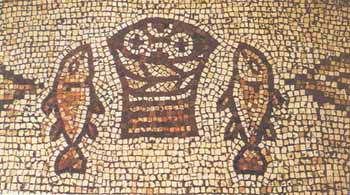
On of the earliest pieces of Christian art 4th-5th century CE
Gospel, John 6:1-15
1 After this, Jesus crossed the Sea of Galilee — or of Tiberias- 2 and a large crowd followed him, impressed by the signs he had done in curing the sick. 3 Jesus climbed the hillside and sat down there with his disciples. 4 The time of the Jewish Passover was near.
5 Looking up, Jesus saw the crowds approaching and said to Philip, ‘Where can we buy some bread for these people to eat?’ 6 He said this only to put Philip to the test; he himself knew exactly what he was going to do.
7 Philip answered, ‘Two hundred denarii would not buy enough to give them a little piece each.’
8 One of his disciples, Andrew, Simon Peter’s brother, said, 9 ‘Here is a small boy with five barley loaves and two fish; but what is that among so many?’
10 Jesus said to them, ‘Make the people sit down.’ There was plenty of grass there, and as many as five thousand men sat down. 11 Then Jesus took the loaves, gave thanks, and distributed them to those who were sitting there; he then did the same with the fish, distributing as much as they wanted.
12 When they had eaten enough he said to the disciples, ‘Pick up the pieces left over, so that nothing is wasted.’
13 So they picked them up and filled twelve large baskets with scraps left over from the meal of five barley loaves. 14 Seeing the sign that he had done, the people said, ‘This is indeed the prophet who is to come into the world.’
15 Jesus, as he realised they were about to come and take him by force and make him king, fled back to the hills alone.
With just a brief mention of the Passover, John hints at the meaning of the feeding of the five thousand: Jesus is the true bread of life because he will be the true Passover sacrifice, giving himself for people. In the detail of the story, however we see how Jesus’ way of giving invites the self-giving of others, even if their resources seem insufficient. The boy’s gift feeds all because it becomes part of the giving of Jesus.
When the crowd misunderstands the nature of his kingship, Jesus refuses their plan and escapes. He will not agree to become one of the earthly powers.
The sacrifice of Jesus and his saints seems very daunting to a fearful believer like me, but maybe I can comfort myself, that the little I give may still help to feed five thousand.
 Emmock's Blog