
This blog follows the daily bible readings of the Catholic Church
Reading 1, 1 Kings 17:7-16
7 But after a while the stream dried up, for the country had had no rain.
8 And then the word of the Lord came to him,
9 ‘Up and go to Zarephath in Sidonia, and stay there. I have ordered a widow there to give you food.’
10 So he went off to Sidon. And when he reached the city gate, there was a widow gathering sticks. Addressing her he said, ‘Please bring a little water in a pitcher for me to drink.’
11 She was on her way to fetch it when he called after her. ‘Please’, he said, ‘bring me a scrap of bread in your hand.’
12 ‘As the Lord your God lives,’ she replied, ‘I have no baked bread, but only a handful of meal in a jar and a little oil in a jug; I am just gathering a stick or two to go and prepare this for myself and my son to eat, and then we shall die.’
13 But Elijah said to her, ‘Do not be afraid, go and do as you have said; but first make a little scone of it for me and bring it to me, and then make some for yourself and for your son.
14 For the God of Israel, says this: Jar of meal shall not be spent, jug of oil shall not be emptied, before the day when God sends rain on the face of the earth.’
15 The woman went and did as Elijah told her and they ate the food, she, himself and her son.
16 The jar of meal was not spent nor the jug of oil emptied, just as Yahweh had foretold through Elijah.
The feasting of the rich speaks of scarcity, while the meagre rations of the poor prophesy plenty. Once again we have the lesson of the manna: God gives enough for each day at a time, to those who trust, and do not try to hoard.
Gospel, Matthew 5:13-16
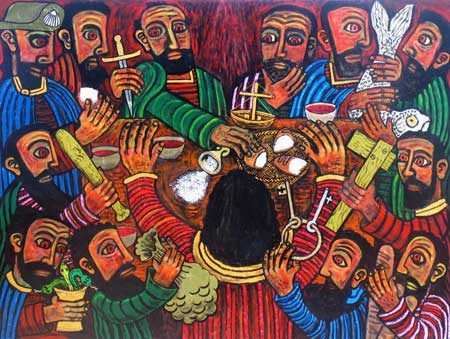
"You are salt for the earth"
13 ‘You are salt for the earth. But if salt loses its taste, what can make it salty again? It is good for nothing, and can only be thrown out to be trampled under people’s feet.
14 ‘You are light for the world. A city built on a hill-top cannot be hidden.
15 No one lights a lamp to put it under a tub; they put it on the lamp-stand where it shines for everyone in the house.
16 In the same way your light must shine in people’s sight, so that, seeing your good works, they may give praise to your Father in heaven.
The salt and the light are two parables with one meaning, but the salt is the more unusual. Scholars have debated the meaning of salt in Jesus’ time and place-was it for preservation of food or fertility of the soil? The modern significance seems more appropriate: salt as a condiment, which makes food tasty. Followers of Jesus are expected to make life tastier. If that isn’t how most people see the church, maybe the church should be asking if it’s their fault or its own.
John’s gospel reports Jesus as claiming, “I have come so that they may have abundant life.”
The rich flavour of Jesus’ living is intended to show up the insipid stuff that we often accept: love is not just stronger than indifference, it is tastier.
 Emmock's Blog