
This blog follows the daily bible readings of the Catholic Church
Reading 1, 1 Kings 18:20-39
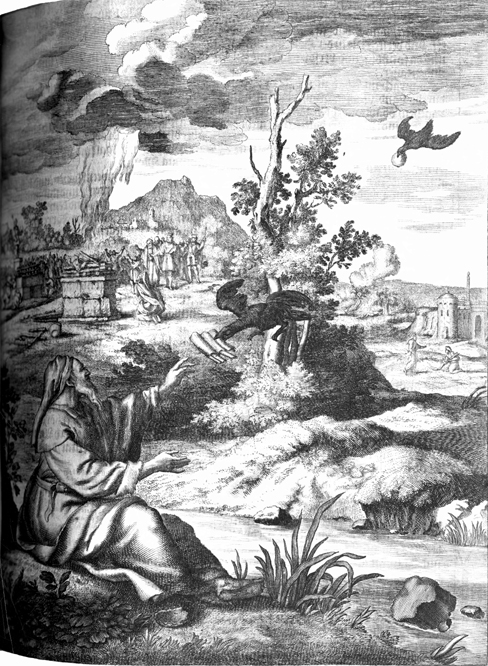
scenes from the life of Elijah 17th c
20 Ahab called all Israel together and assembled the prophets on Mount Carmel.
21 Elijah stepped out in front of all the people. ‘How long’, he said, ‘do you mean to hobble first on one leg then on the other? If the Lord is God, follow him; if Baal, follow him.’ But the people had nothing to say.
22 Elijah then said to them, ‘I, I alone, am left as a prophet of the Lord, while the prophets of Baal are four hundred and fifty.23 Let two bulls be given us; let them choose one for themselves, dismember it but not set fire to it. I in my turn shall prepare the other bull, but not set fire to it. 24 You must call on the name of your god, and I shall call on the name of the Lord; the god who answers with fire, is God indeed.’ The people all answered, ‘Agreed!’
25 Elijah then said to the prophets of Baal, ‘Choose one bull and begin, for there are more of you. Call on the name of your god but light no fire.’
26 They took the bull and prepared it, and from morning to midday they called on the name of Baal. ‘O Baal, answer us!’ they cried, but there was no voice, no answer, as they performed their hobbling dance round the altar which they had made. 27 Midday came, and Elijah mocked them. ‘Call louder,’ he said, ‘for he is a god: he is preoccupied or he is busy, or he has gone on a journey; perhaps he is asleep and needs to be woken up!’
28 So they shouted louder and gashed themselves, as their custom was, with swords and spears until the blood flowed down them. 29 Midday passed, and they ranted on until the time when the offering is presented; but there was no voice, no answer, no sign of attention.
30 Then Elijah said to all the people, ‘Come over to me,’ and all the people came over to him. He repaired the Lord’s altar which had been torn down. 31 Elijah took twelve stones, corresponding to the number of tribes of the sons of Jacob, to whom the word of the Lord had come, ‘Israel is to be your name,’ 32 and built an altar in the name of the Lord. Round the altar he dug a trench of a size to hold two measures of seed. 33 He then arranged the wood, dismembered the bull, and laid it on the wood.
34 Then he said, ‘Fill four jars with water and pour it on the burnt offering and on the wood.’ They did this. He said, ‘Do it a second time;’ they did it a second time. He said, ‘Do it a third time;’ they did it a third time. 35 The water flowed round the altar until even the trench itself was full of water.
36 At the time when the offering is presented, Elijah the prophet stepped forward. ‘Lord, God of Abraham, Isaac and Israel,’ he said, ‘let them know today that you are God in Israel, and that I am your servant, that I have done all these things at your command. 37 Answer me, Lord, answer me, so that this people may know that you, the Lord, are God and are winning back their hearts.’
38 Then the Lord’s fire fell and consumed the burnt offering and the wood and licked up the water in the trench. 39 When all the people saw this they fell on their faces. ‘The Lord is God,’ they cried, ‘the Lord is God!’
The Baal Shem, the great 18th century tsaddiq, once taught:
How do we know that Elijah is the greatest of prophets? We know because when he won the contest on Mount Carmel the people did not hail him, but cried out, “The Lord is great!”
This is one of the great savage stories of Judaism, with its mockery of idolatry. The Israelites believed that sometimes God showed his hand in “mighty deeds” of which this is after all, only a trifling example. The God who made the heavens and earth, and who brought his people from Egypt with a strong hand and a mighty arm, could manage this amount of ignition without trouble.
I do not believe that God intervenes by force in history or nature, but I still find meaning in a story that shows me the one faithful man facing the idolatrous mob and winning. If God is still for me the God who answers with fire, that fire is seen in the prophet’s faith in the invisible God, who cannot be represented by any image other than humanity.

Expressionless expresses God
Faced with the idols of our time, I want to refuse the eager demands of a world saturated in imagery, and show them only on a cross a dead prophet, whose expressionless face expresses the God who answers with fire.
Gospel, Matthew 5:17-19
17 ‘Do not imagine that I have come to abolish the Law or the Prophets. I have come not to abolish but to complete them.
18 In truth I tell you, till heaven and earth disappear, not one dot, not one little stroke, is to disappear from the Law until all its purpose is achieved.
19 Therefore, anyone who infringes even one of the least of these commandments and teaches others to do the same will be considered the least in the kingdom of Heaven; but the person who keeps them and teaches them will be considered great in the kingdom of Heaven.
Matthew, the Christian scribe, notes (and perhaps alters!) some words of Jesus to give us a very different valuation of Torah (Law) from the one we meet in St. Paul, who says, “Through the law I died to the law, that I might live to God.” Matthew presents the whole history of Jesus as fulfilment of Torah, that is, as a perfecting of the Mosaic Covenant which puts it in its true context. Such a fulfilment, to be sure, gives us a point of advantage from which we can find the real intention of Torah, but it does not allow us to reject it.
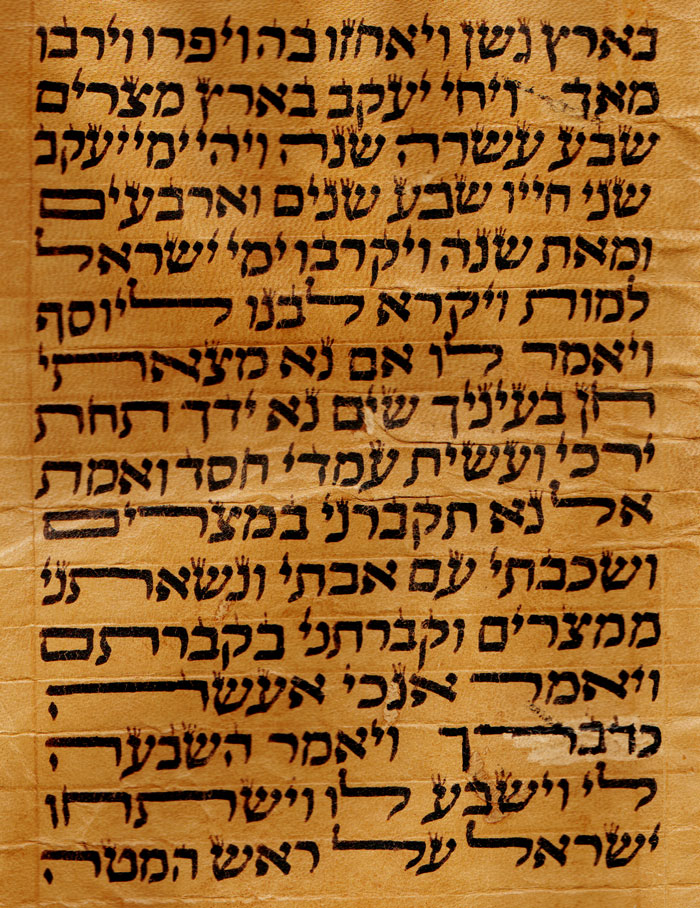
not one jot or little stroke
Paul and Matthew are creative and one-sided, but we ought to listen to them both. A new appreciation of God’s commands might help churches and the societies they serve.
 Emmock's Blog