
This blog follows the daily bible readings of the Catholic Church
Reading 1, 1 Kings 18:41-46
41 Elijah said to Ahab, ‘Go back now, eat and drink; for I hear the approaching sound of rain.’
42 While Ahab went back to eat and drink, Elijah climbed to the top of Carmel and bowed down to the ground, putting his face between his knees. 43 ‘Now go up’, he told his servant, ‘and look out to sea.’ He went up and looked. ‘There is nothing at all,’ he said. Seven times Elijah told him to go back.
44 The seventh time, the servant said, ‘Now there is a cloud, small as a man’s hand, rising from the sea.’ Elijah said, ‘Go and say to Ahab, “Harness the chariot and go down before the rain stops you.” ‘
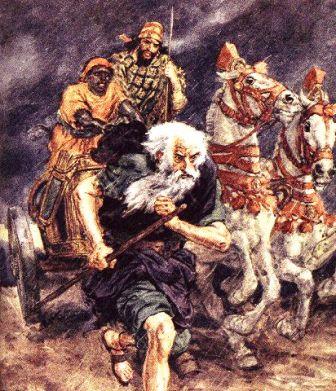
The prophet is always ahead of the king
45 And with that the sky grew dark with cloud and storm, and rain fell in torrents. Ahab mounted his chariot and made for Jezreel. 46 But the hand of Yahweh had come on Elijah and, hitching up his clothes, he ran ahead of Ahab all the way to Jezreel.
The incident is a parable of prophetic insight, which can predict the end of drought, when only a small cloud can be seen out to sea. The message to Ahab is that Elijah is always ahead of the game. The things that cannot be seen by a king, blinded by his power, are clear to the prophet.
The image of the galloping prophet is very striking: in this way too the prophet is ahead of the king.
Clear-sighted people, looking at the arrogant behaviour of B.P. predicted disaster, while its own executives and all associated with oil profit, remained blind. Even President Obama was slow to see danger.
On the other hand, Obama’s early campaigning in the U.S. primaries was a cloud no bigger than a man’s hand, of which hardly anyone but him took account.
Gospel, Matthew 5:20-26
20 ‘For I tell you, if your uprightness does not surpass that of the scribes and Pharisees, you will never get into the kingdom of Heaven.
21 ‘You have heard how it was said to our ancestors, You shall not kill; and if anyone does kill he must answer for it before the court.’ 22 But I say this to you, anyone who is angry with a brother will answer for it before the court; anyone who calls a brother “Fool” will answer for it before the Sanhedrin; and anyone who calls him “Traitor” will answer for it in hell fire. 23 So then, if you are bringing your offering to the altar and there remember that your brother has something against you, 24 leave your offering there before the altar, go and be reconciled with your brother first, and then come back and present your offering.
25 Come to terms with your opponent in good time while you are still on the way to the court with him, or he may hand you over to the judge and the judge to the officer, and you will be thrown into prison. 26 In truth I tell you, you will not get out till you have paid the last penny.
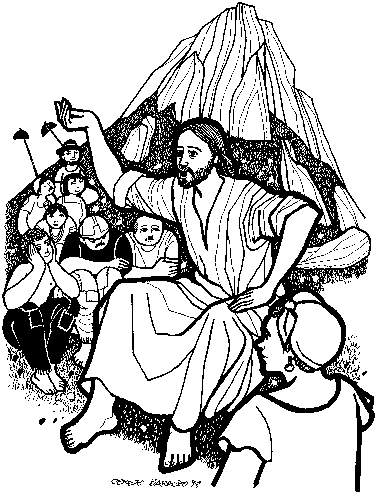
Jesus, the new Moses
These words are part of what is usually called the “Sermon on the Mount.” in which Matthew places Jesus on a hill, as the new Moses, who perfects the Torah, the Law of God.
The whole teaching of the “sermon” reflects Matthew’s view of Jesus as requiring a “greater uprightness” rather than a lesser one. Jesus has come to fulfil the Torah, not to dispense with it.
The “greater uprightness”:
- Goes far beyond what is demanded by the Pharisees;
- Because it is not simply concerned with grave crimes, like murder, but with the roots of grave crimes, like contempt;
- Because it is not satisfied with ritual, like sacrifice, to make things right with God, but demands obedience to the justice of God, like reconciliation with someone you have harmed;
- Because it does not see God as distant but rather as an active opponent of human wickedness. Better to reckon with him now, on the way, that is, in life, rather than waiting till our lives are brought to court, that is, in the great judgement.
If this doesn’t sound much like the Jesus we got in Sunday School, that’s because our tradition has only rarely taken seriously the jewishness of Jesus.
 Emmock's Blog