This blog follows the daily bible readings of the Catholic Church
Reading 1, 1 Kings 19:19-21
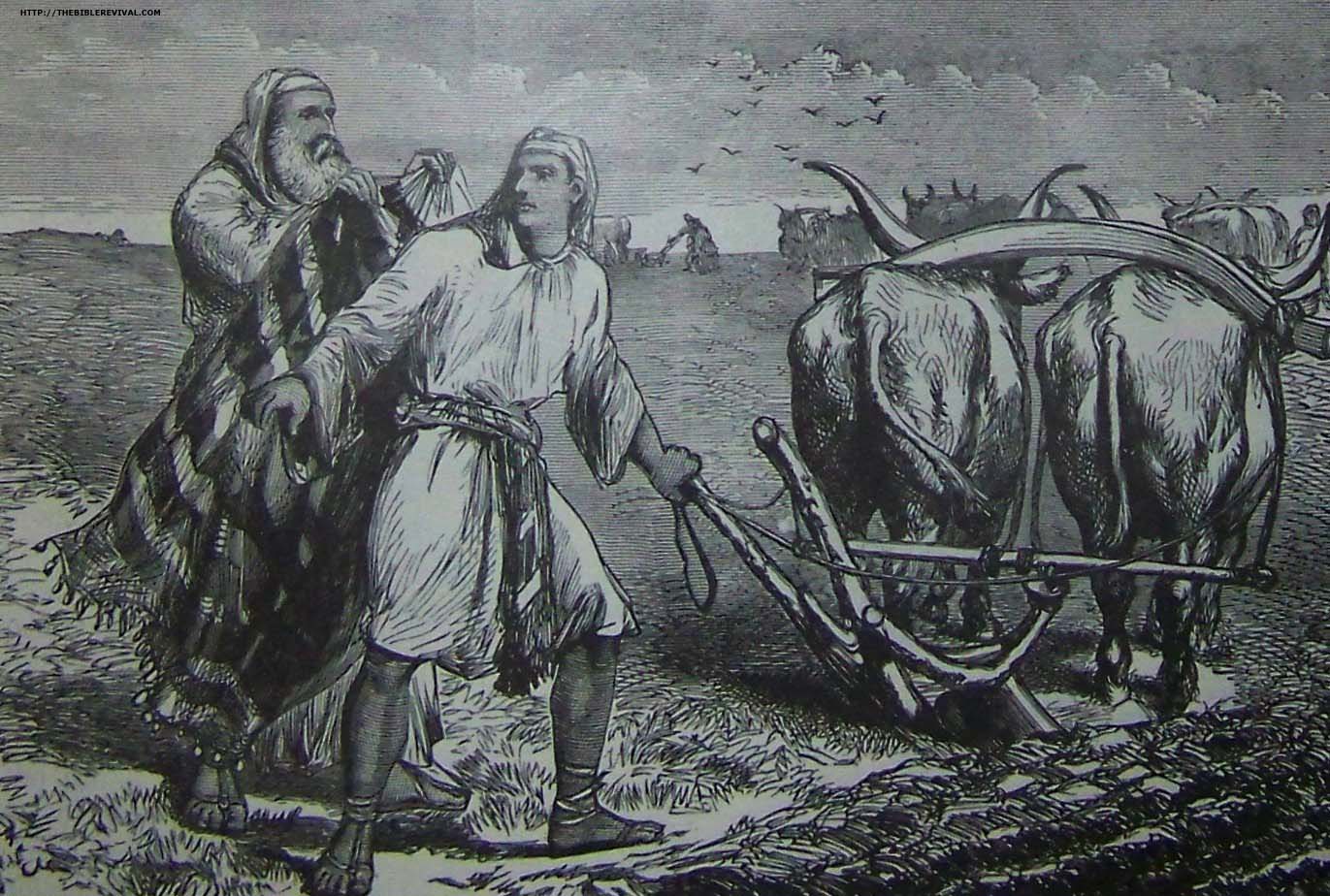
Elijah throwing his cloak over Elisha
19 Leaving there, he came on Elisha son of Shaphat as he was ploughing behind twelve yoke of oxen, he himself being with the twelfth. Elijah passed near to him and threw his cloak over him. 20 Elisha left his oxen and ran after Elijah. ‘Let me kiss my father and mother, then I will follow you,’ he said. Elijah answered, ‘Go, go back; for have I done anything to you?’
21 Elisha turned away, took a yoke of oxen and slaughtered them. He used the oxen’s tackle for cooking the meat, which he gave the people to eat. He then rose and, following Elijah, became his servant.
Gospel, Luke 2:41-51
41 Every year his parents used to go to Jerusalem for the feast of the Passover. 42 When he was twelve years old, they went up for the feast as usual. 43 When the days of the feast were over and they set off home, the boy Jesus stayed behind in Jerusalem without his parents knowing it. 44 They assumed he was somewhere in the party, and it was only after a day’s journey that they went to look for him among their relations and acquaintances. 45 When they failed to find him they went back to Jerusalem looking for him everywhere.
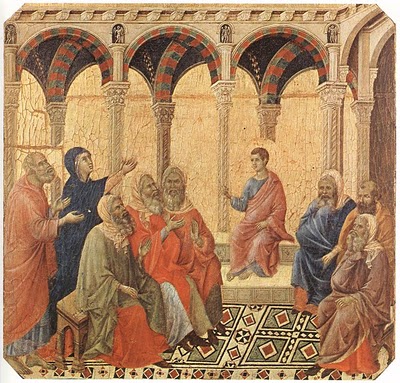
The parents are outside the circle
46 It happened that, three days later, they found him in the Temple, sitting among the teachers, listening to them, and asking them questions; 47 and all those who heard him were astounded at his intelligence and his replies. 48 They were overcome when they saw him, and his mother said to him, ‘My child, why have you done this to us? See how worried your father and I have been, looking for you.’
49 He replied, ‘Why were you looking for me? Did you not know that I must be in my Father’s house?’
50 But they did not understand what he meant. 51 He went down with them then and came to Nazareth and lived under their authority. His mother stored up all these things in her heart.
In a wonderful survey of Biblical Christianity, Reason, Faith and Revolution, Terry Eagleton remarks that the gospel tradition is vehemently opposed to “family values”, presenting the natural family as an obstacle to faith. The Hebrew Bible seems more family- friendly, even although one of its terrible, foundational stories is the offered sacrifice of the first-born, Isaac, to God. In today’s readings, God’s call to Elisha and to Jesus, involves a painful dislocation from the family.
Elijah’s laconic response to Elisha’s request to say farewell to mother and father, is softer than Jesus’ savage, “Let the dead bury the dead” but its lack of sympathy is similar. Wearing the prophet’s cloak will separate Elisha from his family.
Although the custom of Jewish boys becoming “Bar Mitzvah” a son of the Torah, at the age of thirteen years, was not established in Jesus’ time, Luke’s story may reflect familial expectations that the religious education of a male child would become the responsibility of Israel, rather than his own family, at roughly the time of puberty. (And there’s a thought, by the way. Have you ever read a devout reflection on Jesus’ puberty?) Whatever the background, the story is meant to horrify the reader with Jesus’ lack of care for Mary and Joseph, although his subsequent dutifulness is exemplary.
Jesus is depicted as using the phrase “my father’s house” of God’s Temple. This is not only an indication of Jesus’ intimacy with God, but also a reminder that God, the father of all, has allowed his children freedom to make their own lives, and that he will not be overly sympathetic to parents who want to determine the lives of their children.
The Christian tradition down the ages has been more in favour of family life than Jesus reportedly was, but has always insisted that it is not the most important responsibility in life. Indeed, it has warned that if it does become the most important responsibility, it can be demonic and destructive.
Humanity has invented nothing better than the natural family (I include homosexual parents in this description) for the care and education of children. The Christian Church may rightly wish to defend marriage and family life against the dissolving forces of late capitalist society; but it should heed the biblical tradition, that sees it as only one calling, amongst others which may be more important.
 Emmock's Blog