
This blog follows the daily bible readings of the Catholic Church
Reading 1, Hosea 14:2-10
2 Israel, come back to the Lord your God your guilt was the cause of your downfall.
3 Provide yourself with words and come back to the Lord. Say to him, ‘Take all guilt away and give us what is good, instead of bulls we will dedicate to you our lips.
4 Assyria cannot save us, we will not ride horses any more, or say, “Our God!” to our own handiwork, for you are the one in whom orphans find compassion.’
5 I shall cure them of their disloyalty, I shall love them with all my heart, for my anger has turned away from them.
6 I shall fall like dew on Israel, he will bloom like the lily and thrust out roots like the cedar of Lebanon;
7 he will put out new shoots, he will have the beauty of the olive tree and the fragrance of Lebanon.
8 They will come back to live in my shade; they will grow wheat again, they will make the vine flourish, their wine will be as famous as Lebanon’s.
9 What has Ephraim to do with idols any more when I hear him and watch over him? I am like an evergreen cypress, you owe your fruitfulness to me.
10 Let the wise understand these words, let the intelligent grasp their meaning, for the Lord’s ways are straight and the upright will walk in them, but sinners will stumble.
The passage as a whole is full of the imagery of fruitfulness: God is like dew, and shade, and his people take root, put out shoots, bloom and give out fragrance. My own personal saints are people in whom this fruitfulness and beauty of life has been evident; who have drawn goodness from the goodness of God. I want to say, as against all who depict the life of faith as a fearful struggle, that I have seen how human beings blossom in the love and justice of God.
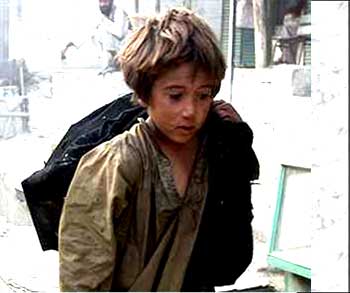
The One in whom orphans find compassion
In the midst of this imagery however there occurs one of the most significant of the names of God: the One in whom orphans find compassion. The commitment of God to the littlest and the least, should never be doubted, nor the anger of God against all who refuse compassion.
Gospel, Matthew 10:16-23
16 Look, I am sending you out like sheep among wolves; so be cunning as snakes and yet innocent as doves. 17 ‘Be prepared for people to hand you over to sanhedrins and scourge you in their synagogues. 18 You will be brought before governors and kings for my sake, as evidence to them and to the gentiles. 19 But when you are handed over, do not worry about how to speak or what to say; what you are to say will be given to you when the time comes, 20 because it is not you who will be speaking; the Spirit of your Father will be speaking in you. 21 ‘Brother will betray brother to death, and a father his child; children will come forward against their parents and have them put to death. 22 You will be universally hated on account of my name; but anyone who stands firm to the end will be saved. 23 If they persecute you in one town, take refuge in the next; and if they persecute you in that, take refuge in another. In truth I tell you, you will not have gone the round of the towns of Israel before the Son of man comes.
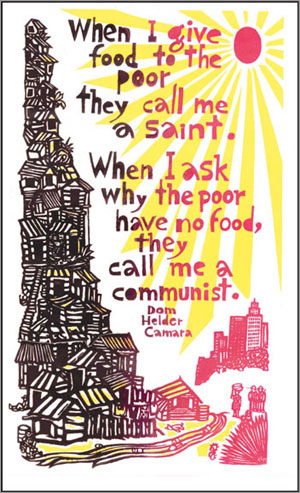
Dom Helder Camara of Brazil, who suffered for the kingdom
In this discourse Jesus is shown predicting violent opposition from the disciples’ own people. Scholars suggest that by the time Matthew was writing his gospel (85 CE), Christians had been expelled from the Jewish synagogues and families split by issues of belief. They suggest that Jesus’ own prophetic words have been infiltrated with the bitterness of that time. Nevertheless, it’s clear that Jesus warned his disciples to expect opposition and persecution, even from their own families.(Those who talk of Christian “Family Values” should take a good look at Jesus’ own utterances about families, few of which are positive.)
Jesus’ certainty that “The Son of man” would come in the lifetimes of his disciples remains a problem for us. The phrase is used in Matthew’s gospel a) of Jesus and his community and b) as here, of the One who will establish the kingdom of heaven. The link between the two uses may be that those who witness and suffer for the kingdom will also be those who will establish it in power. Jesus’ time scale may have been wrong, but the link between the suffering of Jesus and his disciples, and the coming of the kingdom, is the secret of Christian hope.
The risks and harshness of Jesus’ own mission, including his sufferings and death, are very evident in the gospels, as they are also in the life of St. Paul. Clearly the expectations and distinctive values of early Christianity had to be translated into a faith that could be lived by settled communities. Passages like this, however, come to remind comfortable Christians that “here we have no continuing city.”
 Emmock's Blog