This blog follows the daily bible readings of the Catholic Church
Reading 1, Isaiah 38:1-8
1 About then, Hezekiah fell ill and was at the point of death. The prophet Isaiah son of Amoz came and said to him, ‘The Lord says this, “Put your affairs in order, for you are going to die, you will not live.” ‘
2 Hezekiah turned his face to the wall and addressed this prayer to the Lord, 3 ‘Ah, Lord God, remember, I beg you, that I have behaved faithfully and with sincerity of heart in your presence and done what you regard as right.’ And Hezekiah shed many tears.
4 Then the word of the Lord came to Isaiah, 5 ‘Go and say to Hezekiah, “The God of your ancestor David, says this: I have heard your prayer and seen your tears. I shall cure you: in three days’ time you will go up to the Temple of the Lord. I shall add fifteen years to your life. 6 I shall save you and this city from the king of Assyria’s clutches and defend this city for my sake and my servant David’s sake.” ‘
7 ‘Here’, Isaiah replied, ‘is the sign from the Lord that he will do what he has said.
8 Look, I shall make the shadow cast by the declining sun on the steps — the steps to Ahaz’s roof-room-go back ten steps.’ And the sun went back the ten steps by which it had declined.
I’m not sure if this sun-miracle involves the destruction of space-time, but it sounds an improbable feat, and the Lord’s bald announcement to a man that he will die, followed by a change of mind is the sort of thing the NHS gets sued for.

God's change of mind
The story wants to tell us something about Hezekiah’s faithfulness to God being rewarded by God’s faithfulness to him, but for me, at least, it doesn’t work. The faith that God has helped us through an illness is a sincere personal conviction. If however, as here, that conviction is translated into a story about God changing his mind, we wonder what sort of God is being depicted.
Gospel, Matthew 12:1-8
1 At that time Jesus went through the cornfields one Sabbath day. His disciples were hungry and began to pick ears of corn and eat them. 2 The Pharisees noticed it and said to him, ‘Look, your disciples are doing something that is forbidden on the Sabbath.’
3 But he said to them, ‘Have you not read what David did when he and his followers were hungry-4 how he went into the house of God and they ate the loaves of the offering although neither he nor his followers were permitted to eat them, but only the priests? 5 Or again, have you not read in the Law that on the Sabbath day the Temple priests break the Sabbath without committing any fault?
6 Now here, I tell you, is something greater than the Temple.
7 And if you had understood the meaning of the words: Mercy is what pleases me, not sacrifice, you would not have condemned the blameless. 8 For the Son of man is master of the Sabbath.’
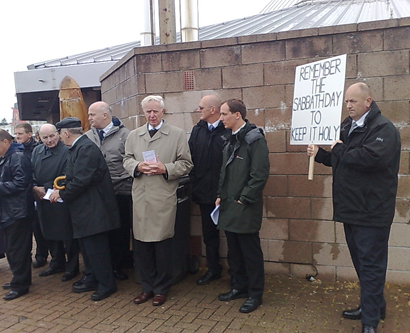
Lord's day Observance
The gospel tradition is united in showing Jesus in trouble with the Lord’s Day Observance Society (Galilee Branch). Jesus defence is threefold. A) King David also broke the Law, because his men were hungry B Priests of the temple work on the Sabbath without fault, and his mission is greater than the temple. C) God wants kindness rather than ritual.
His reference to the Son of Man is the claim that “Jesus and his people” have authority to interpret the Law. This is an important principle for the interpretation of scripture in the church today, preventing scripture becoming an idol which consumes the lives of its devotees. Over against all idolatries, even very pious ones, Jesus commands his followers to make no idols, and to obey God alone.
 Emmock's Blog