
This blog follows the daily bible readings of the Catholic Church
Reading 1, Jeremiah 13:1-11
1 Yahweh said this to me, ‘Go and buy a linen waistcloth and put it round your waist. But do not dip it in water.’ 2 And so, as Yahweh had ordered, I bought a waistcloth and put it round my waist. 3 A second time the word of Yahweh came to me, 4 ‘Take the waistcloth that you have bought and are wearing round your waist. Up, go to the Euphrates and hide it there in a hole in the rock.’
5 So I went and hid it by the Euphrates as Yahweh had ordered me.
6 A long time later, Yahweh said to me, ‘Up, go to the Euphrates and fetch the waistcloth I ordered you to hide there.’ 7 So I went to the Euphrates, and I searched, and I took the waistcloth from the place where I had hidden it. And there was the waistcloth ruined, no use for anything.
8 Then the word of Yahweh was addressed to me as follows,
9 ‘Yahweh says this, “In the same way I shall ruin the pride of Judah, the immense pride of Jerusalem. 10 This evil people, these people who refuse to listen to my words, who follow their own stubborn inclinations and run after other gods, serving and worshipping them — this people will become like this waistcloth, no good for anything. 11 For just as a waistcloth clings to a man’s waist, so I made the whole House of Israel and the whole House of Judah cling to me, Yahweh declares, to be my people, my glory, my honour and my pride. But they have not listened.”

Egyptian waist cloths (as modelled for sale!)
This is a very strange prophetic drama, acted out by Jeremiah. A local wadi bears the name Parat which is similar to the Hebrew for Euphrates, Perat, so we may suppose the action takes place there. The waistcloth stands for the people of Israel, intimately bound to God, but when cast away in exile on the banks of the great river, rotten and useless. The message is clear: Israel’s existence as a people is dependent on her relationship with God. In exile, she will perish. Homely metaphors for the relation of God to his people abound in the books of the prophets: Israel is like a vineyard, an unfaithful wife, a camel in heat, a wine jug, a rape victim, chaff in the wind and so on. These expressions are evidence of the immediacy of prophetic experience of God which has survived through repeated editions of their prophecies. The relationship of God and his people is “felt along the blood”, in Wordsworth’s phrase.
Gospel, Matthew 13:31-35
31 He put another parable before them, ‘The kingdom of Heaven is like a mustard seed which a man took and sowed in his field.32 It is the smallest of all the seeds, but when it has grown it is the biggest of shrubs and becomes a tree, so that the birds of the air can come and shelter in its branches.’
33 He told them another parable, ‘The kingdom of Heaven is like the yeast a woman took and mixed in with three measures of flour till it was leavened all through.’
34 In all this Jesus spoke to the crowds in parables; indeed, he would never speak to them except in parables. 35 This was to fulfil what was spoken by the prophet: I will speak to you in parables, unfold what has been hidden since the foundation of the world.
Jesus is the successor of the prophets in his use of parables. For him also the relationship of God to the people, that is, the kingdom of God, is experienced as similar to ordinary experiences of nature, trade, slave-owning, farming, fishing, estate management and so on.
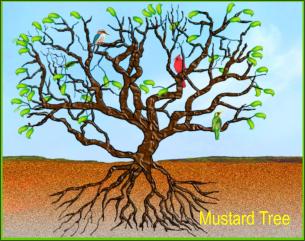
the birds can nest in its branches
In this case for example he is responding to a question about why the kingdom is not more visible. He answers that it is like a mustard seed a tiny thing with the potential to become a sheltering tree. It is of the nature of God’s rule, that because it does not come by force but only by persuasion, it is like the process of natural growth: it takes time, patience and hope. In a culture which is in love with instant results, Jesus parable, which can be applied to social justice, church development, or individual goodness, is useful. It gives body to the hidden process of God’s rule in the world.
 Emmock's Blog