This blog follows the daily bible readings of the Catholic Church
Reading 1, Jeremiah 28:1-17
1 That same year, at the beginning of the reign of Zedekiah king of Judah, in the fifth month of the fourth year, the prophet Hananiah son of Azzur, a Gibeonite, spoke as follows to Jeremiah in the Temple in the presence of the priests and of all the people, 2 ‘The Lord of Hosts, the God of Israel, says this, “I have broken the yoke of the king of Babylon. 3 In exactly two years’ time I shall bring back all the vessels of the Temple which Nebuchadnezzar king of Babylon took away from here and carried off to Babylon. 4 And I shall also bring back Jeconiah son of Jehoiakim, king of Judah and all the exiles of Judah who have gone to Babylon, the Lord declares, for I shall break the yoke of the king of Babylon.” ‘
5 The prophet Jeremiah then replied to the prophet Hananiah in front of the priests and all the people present in the Temple of the Lord.
6 ‘So be it!’ the prophet Jeremiah said, ‘May the Lord do so! May he fulfil the words that you have prophesied and bring all the vessels of the Temple and all the exiles back to this place from Babylon. 7 Listen carefully, however, to this word that I am now going to say for you and all the people to hear: 8 From remote times, the prophets who preceded you and me prophesied war, disaster and plague for many countries and for great kingdoms; 9 the prophet who prophesies peace can be recognised as one truly sent by the Lord only when his word comes true.’
10 The prophet Hananiah then snatched the yoke off the neck of the prophet Jeremiah and broke it. 11 In front of all the people Hananiah then said, ‘The Lord says this, “This is how, in exactly two years’ time, I shall break the yoke of Nebuchadnezzar king of Babylon and take it off the necks of all the nations.” ‘ At this, the prophet Jeremiah went away.
12 After the prophet Hananiah had broken the yoke he had snatched off the prophet Jeremiah’s neck, the word of the Lord came to Jeremiah, 13 ‘Go to Hananiah and tell him this, “The Lord says this: You have broken the wooden yokes only to make iron yokes to replace them! 14 For the God of Israel, says this: An iron yoke is what I now lay on the necks of all these nations to enslave them to Nebuchadnezzar king of Babylon. (They will be enslaved to him; I have even given him the wild animals.)” ‘
15 The prophet Jeremiah said to the prophet Hananiah, ‘Listen carefully, Hananiah: the Lord has not sent you; and thanks to you this people is now relying on what is false.16 And so, the Lord says this, “I am going to send you off the face of the earth: you will die this year (since you have preached rebellion against the Lord.)” ‘
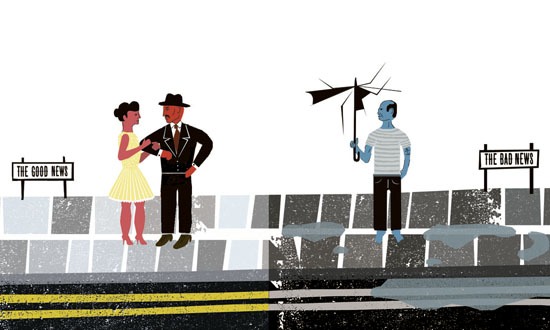
Is the true prophet only on the right side of this picture?
17 The prophet Hananiah died the same year, in the seventh month.
This reminds me of a bit of a Billy Connolly story:
“You shut your face!” they said to him.
And his face was shut.
The false prophet brings good news and is told by the real prophet that authentic prophets only bring bad news. Moreover, because he’s told lies in God’s name, he will die. And he does die.
There are two views of God struggling with each other in this story: a deep and troublesome view that God stands for justice, and exercises judgment even (especially?) on his own people; and a shallow view that God will smite those who betray his truth. The deep view is worth living with. It would be unwise in my opinion, to rely on the shallow view.
Gospel, Matthew 14:13-21
13 When Jesus received this news he withdrew by boat to a lonely place where they could be by themselves. But the crowds heard of this and, leaving the towns, went after him on foot. 14 So as he stepped ashore he saw a large crowd; and he took pity on them and healed their sick. 15 When evening came, the disciples went to him and said, ‘This is a lonely place, and time has slipped by; so send the people away, and they can go to the villages to buy themselves some food.’
16 Jesus replied, ‘There is no need for them to go: give them something to eat yourselves.’ 17 But they answered, ‘All we have with us is five loaves and two fish.’
18 So he said, ‘Bring them here to me.’
19 He gave orders that the people were to sit down on the grass; then he took the five loaves and the two fish, raised his eyes to heaven and said the blessing. And breaking the loaves he handed them to his disciples, who gave them to the crowds.
20 They all ate as much as they wanted, and they collected the scraps left over, twelve baskets full.
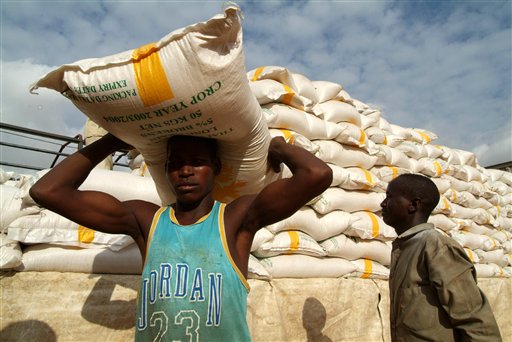
There is enough: we have to see to its distribution
21 Now about five thousand men had eaten, to say nothing of women and children.
People enquire about the nature of this miracle. That’s a mistake. The miracle is that in the presence of Jesus, there is abundant food for all. The economy of scarcity, through which the powers-that-be manage the world, is exposed as a lie. God gives enough for all his children and more. In the Gospel of Mark which Matthew is using as a basis for his own, this story is told in a way that focuses on the teaching of Messiah Jesus. Matthew strips away all references to teaching and messiahship, leaving only a simple narrative focused on the bodily needs of the people: Jesus heals and feeds.
This is a passage which could guide the policy of the church towards famine, as presently in Niger, while also being an announcement of the Gospel.
- God has already given the resources to us, but we think them insufficient.
- Jesus “takes, blesses and breaks”: these Eucharistic actions mime the messianic transformation of all life including our own: we are taken, blessed and broken, as He is.
- We must be organised to receive God’s goodness, not as a mob seeking our own advantage but as a family seated at table.
- Disciples must make sure the distribution happens.
- It becomes clear that there is more than enough.
 Emmock's Blog