This blog follows the daily bible readings of the catholic Church
Reading 1, Ezekiel 1:2-5, 24-28c
2 On the fifth of the month — it was the fifth year of exile for King Jehoiachin-
3 the word of the Lord was addressed to the priest Ezekiel son of Buzi, in Chaldaea by the River Chebar. There the hand of the Lord came on him.
4 I looked; a stormy wind blew from the north, a great cloud with flashing fire and brilliant light round it, and in the middle, in the heart of the fire, a brilliance like that of amber,
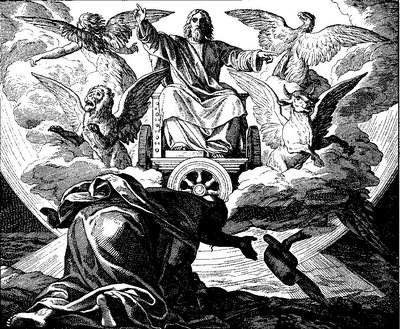
5 and in the middle what seemed to be four living creatures. They looked like this: They were of human form.
Any attempt to visualise it fails: it's a vision in words
24 I also heard the noise of their wings; when they moved, it was like the noise of flood-waters, like the voice of Shaddai, like the noise of a storm, like the noise of an armed camp; and when they halted, they lowered their wings; 25 there was a noise too.
26 Beyond the solid surface above their heads, there was what seemed like a sapphire, in the form of a throne. High above on the form of a throne was a form with the appearance of a human being.
27 I saw a brilliance like amber, like fire, radiating from what appeared to be the waist upwards; and from what appeared to be the waist downwards, I saw what looked like fire, giving a brilliant light all round.
28 The radiance of the encircling light was like the radiance of the bow in the clouds on rainy days. The sight was like the glory of the Lord I looked and fell to the ground, and I heard the voice of someone speaking to me:
2.1. “Son of Man, stand on your feet and I will speak with you.”
The book of Ezekiel is the strange and moving record of the visions of a prophet who spoke to the exiled people in Babylon in the 6th century BCE. The editors of the book have placed, as was customary, the narrative of the prophet’s call from God at its beginning. The extract chosen by the Catholic lectionary misses out most of the vision, which culminates in verses 26-28. The nature of the vision reveals gradually the majesty, mobility, and holiness of Israel’s God, who is not, as perhaps the exiles had imagined, bound to his own territory in Palestine, but is Lord of all the earth and the shepherd of his exiled people. Ezekiel’s experience of God, recounted in the stories of his visions, is intended to break down dull and limited views of God; and to open people’s minds to his transcendent mystery. Even at the climax of the vision Ezekiel does not see God but the glory of the Lord. This phrase in verse 28 is badly translated; more literally it says, “It was the appearance of the likeness of the glory of God.” God himself is thrice distanced-appearance, likeness, glory-from human sight. Faced with this overwhelming holiness Ezekiel falls to the ground, but he is told, “Stand up and I will speak with you.” God’s holiness is not present to make human beings grovel, but to make them stand on their feet, as responsible agents. The first Christian theologian, St. Irenaeus wrote, “The glory of God is the living person.” And indeed, Ezekiel discerns the human form in God.
Gospel, Matthew 17:22-27
22 When they were together in Galilee, Jesus said to them, ‘The Son of man is going to be delivered into the power of men; 23 they will put him to death, and on the third day he will be raised up again.’ And a great sadness came over them.
24 When they reached Capernaum, the collectors of the half-shekel came to Peter and said, ‘Does your master not pay the half-shekel?’ 25 ‘Yes,’ he replied, and went into the house. But before he could speak, Jesus said, ‘Simon, what is your opinion? From whom do earthly kings take toll or tribute? From their sons or from foreigners?’
26 And when he replied, ‘From foreigners,’ Jesus said, ‘Well then, the sons are exempt. 27 However, so that we shall not be the downfall of others, go to the lake and cast a hook; take the first fish that rises, open its mouth and there you will find a shekel; take it and give it to them for me and for yourself.’
In the knowledge that the Son of Man, that is, “Jesus and his people”, will be rejected and killed off, the story of the temple tax (half-shekel) tells us that Jesus and his people are also children of God. The tax was paid yearly for the upkeep of God’s temple. Jesus’ playful parable suggests that God doesn’t require his own children to pay tax. Nevertheless, Jesus advises paying it to avoid giving a bad example to others. In this instance God himself provides the tax by means of a fish, which will have a “shekel in its mouth” when Peter sells it. The point of the story is not that Jesus and his people are exempt from a religious tax, but that they are God’s children.

folklore style
The folk story style of this narrative, which depicts Jesus in the role of “trickster”, reminds us of the story-telling origins of the gospels, and also of ways of viewing Jesus which serious piety easily loses.
 Emmock's Blog