
This blog follows the daily bible readings of the Catholic Church
Reading 1, 1 Corinthians 3:18-23
 18 There is no room for self-delusion. Any one of you who thinks he is wise by worldly standards must learn to be a fool in order to be really wise. 19 For the wisdom of the world is folly to God. As scripture says: He traps the crafty in the snare of their own cunning 20 and again: The Lord knows the plans of the wise and how insipid they are. 21 So there is to be no boasting about human beings: everything belongs to you, 22 whether it is Paul, or Apollos, or Cephas, the world, life or death, the present or the future — all belong to you; 23 but you belong to Christ and Christ belongs to God.
Paul repeatedly emphasises the difference between worldly wisdom and God’s wisdom. The word he uses for fool in Greek is the origin of our word “moron.” This is a rebuke to those amongst the Corinthian believers who pride themselves on wisdom (sophia) and knowledge (gnosis). These are qualities praised by Greek culture but they are not part of Christian discipleship without a radical transformation. The new life is a shared life, above all, a life shared with God. There is no room for pride.
Gospel, Luke 5:1-11
1 Now it happened that he was standing one day by the Lake of Gennesaret, with the crowd pressing round him listening to the word of God, 2 when he caught sight of two boats at the water’s edge. The fishermen had got out of them and were washing their nets. 3 He got into one of the boats — it was Simon’s — and asked him to put out a little from the shore. Then he sat down and taught the crowds from the boat. 4 When he had finished speaking he said to Simon, ‘Put out into deep water and pay out your nets for a catch.’ 5 Simon replied, ‘Master, we worked hard all night long and caught nothing, but if you say so, I will pay out the nets.’ 6 And when they had done this they netted such a huge number of fish that their nets began to tear, 7 so they signalled to their companions in the other boat to come and help them; when these came, they filled both boats to sinking point.
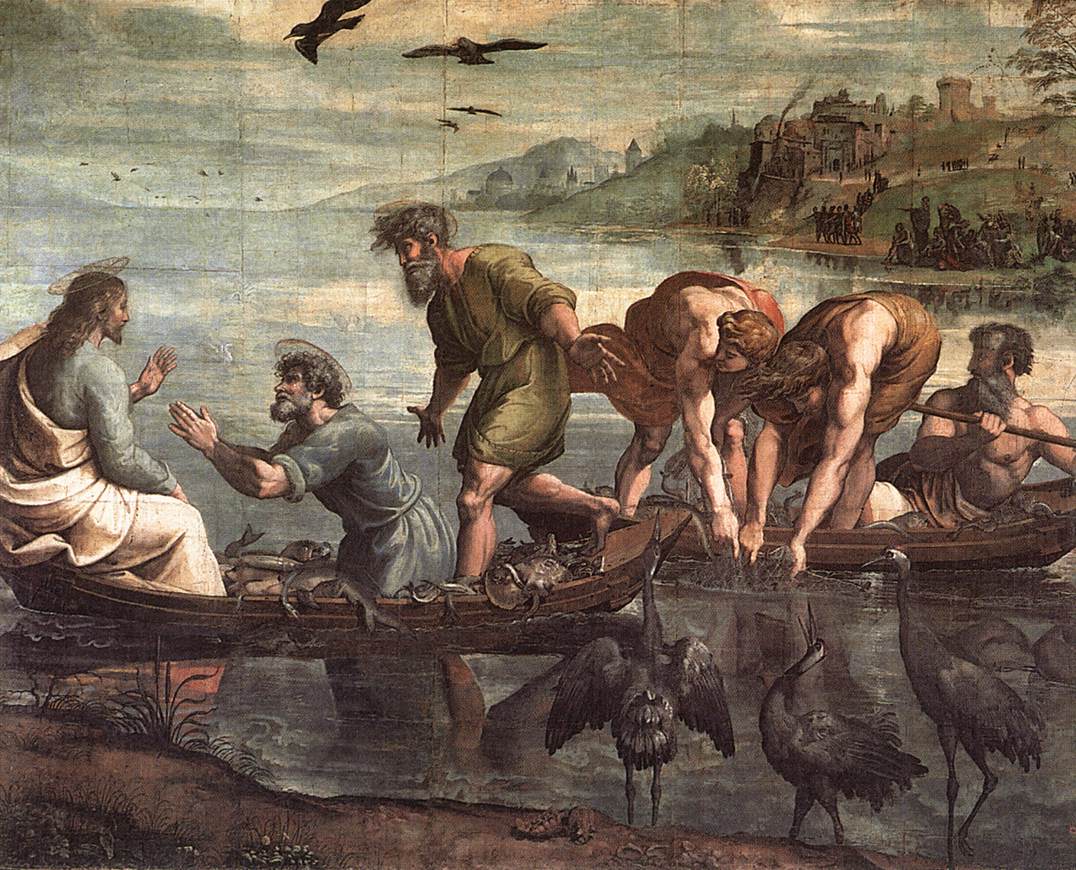
Raphael. Peter's response
8 When Simon Peter saw this he fell at the knees of Jesus saying, ‘Leave me, Lord; I am a sinful man.’ 9 For he and all his companions were completely awestruck at the catch they had made; 10 so also were James and John, sons of Zebedee, who were Simon’s partners. But Jesus said to Simon, ‘Do not be afraid; from now on it is people you will be catching.’ 11 Then, bringing their boats back to land they left everything and followed him.
Most Old Testament images of catching fish are like Paul’s quotation above: they are to do with God’s skill in catching the wicked. At some point in the Gospel tradition-it may be from Jesus, it may be from the process of handing on material-the meaning has become positive, as it is here in Luke. Fishing becomes a metaphor for preaching the good news (the bait) and catching people for the kingdom. If we think of what happens to fish we can see that’s it’s not the most obvious picture of evangelism.
There are clear identities between this story and the resurrection story in John 21. Perhaps the John version of an resurrection appearance of the Lord is the original, and Luke has transferred it back into the start of the Galilean ministry.
Its significance is clear: only Jesus knows where and how to catch people, and its certainly not in the shallows, but in the deep waters, which have a hint of danger. I can only testify that in a ministry of forty years it was only when somehow I’d been led to unexpected and risky places, that I ever “caught people” for Christ. Sitting on the church wall with a fishing line never worked.
The deep waters are also perhaps an image of the level at which the gospel must engage with people, in fact, the very level at which we were caught by the gospel in the first place.
 Emmock's Blog