
This blog follows the daily bible readings of the Catholic Church
Reading 1
Galatians 1:6-12
Brothers and sisters:
I am amazed that you are so quickly forsaking the one who called you by the grace of Christ for a different gospel (not that there is another). But there are some who are disturbing you and wish to pervert the Gospel of Christ. But even if we or an angel from heaven should preach to you a gospel other than the one that we preached to you, let that one be accursed! As we have said before, and now I say again, if anyone preaches to you a gospel other than the one that you received, let that one be accursed!
Am I now currying favour with human beings or God? Or am I seeking to please people? If I were still trying to please people, I would not be a slave of Christ.
Now I want you to know, brothers and sisters, that the Gospel preached by me is not of human origin. For I did not receive it from a human being, nor was I taught it, but it came through a revelation of Jesus Christ. 
Paul springs out of the traps quicker than a greyhound because he fears that the simple gospel of God’s love in Christ is being perverted in the name of something more complex, more pleasing to the religious spirit: a way of gaining God’s approval. For of course the gospel he’d preached was revolutionary in doing away with the whole religious quest to find a reliable way of pleasing the deity. If God loves us already what’s the point of religion? Answer: not much, and Christianity ought to pay more attention to this answer. The church moans about people losing the religious impulse, as if faith in God through Jesus were a religion. A genuine, rather than a fashionable, lack of religion, depends on the terrible truth that God loves us already, leaving no place for all the paraphernalia of managed salvation. A church always ready to be reformed is one which constantly returns to this simplicity, and the means of communicating it.
Luke 10:25-37
Gospel
There was a scholar of the law who stood up to test Jesus and said, “Teacher, what must I do to inherit eternal life?”
Jesus said to him, “What is written in the law? How do you read it?”
He said in reply, “You shall love the Lord, your God, with all your heart, with all your being, with all your strength, and with all your mind, and your neighbour as yourself.”
He replied to him, “You have answered correctly; do this and you will live.”
But because he wished to justify himself, he said to Jesus, “And who is my neighbour?”
Jesus replied, “A man fell victim to robbers as he went down from Jerusalem to Jericho. They stripped and beat him and went off leaving him half-dead. A priest happened to be going down that road, but when he saw him, he passed by on the opposite side. Likewise a Levite came to the place, and when he saw him, he passed by on the opposite side. But a Samaritan traveller who came upon him was moved with compassion at the sight. He approached the victim, poured oil and wine over his wounds and bandaged them. Then he lifted him up on his own animal, took him to an inn, and cared for him.
The next day he took out two silver coins and gave them to the innkeeper with the instruction, ‘Take care of him. If you spend more than what I have given you, I shall repay you on my way back.’ Which of these three, in your opinion,
was neighbour to the robbers’ victim?”
He answered, “The one who treated him with mercy.”
Jesus said to him, “Go and do likewise.”
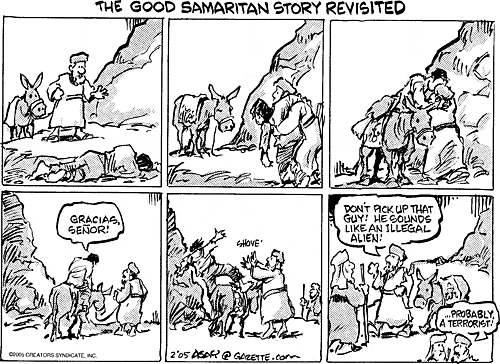
If, through Jesus, we believe God loves us, what are we to do? We are to love God and our neighbour. That seems clear enough. But the religious mind wants a definition of neighbour. Surely there’s some limit on our obligation? Jesus’s great story cunningly turns this question on its head. The questioner assumes the posture of the one who gives help. Jesus asks his listeners to put themselves in the position of someone in desperate need of help. Who is neighbour to this person? The answer is obvious: the one who shows him mercy. It doesn’t matter to the person dying at the roadside, whether he’s helped by the most or least orthodox of neighbours; the help is what counts. Jesus is saying, “Ditch the smart questions. Just get on with being a neighbour.”
Jesus’ impatience with the question arises from his deadly ability to diagnose a bad dose of religion. He cuts through centuries of debate about “loving your neighbour” with a sharp story that shows the nature of the disease: a desire to make God’s absolute command more manageable. Religion is managing human beings for God and God for human beings. It hasn’t much to do with Christian faith.
 Emmock's Blog