This blog follows the daily bible readings of the Catholic Church
Reading 1
Brothers and sisters:
Realize that it is those who have faith
who are children of Abraham.
Scripture, which saw in advance that God
would justify the Gentiles by faith,
foretold the good news to Abraham, saying,
Through you shall all the nations be blessed.
Consequently, those who have faith are blessed
along with Abraham who had faith.
For all who depend on works of the law are under a curse;
for it is written, Cursed be everyone
who does not persevere in doing all the things
written in the book of the law.
And that no one is justified before God by the law is clear,
for the one who is righteous by faith will live.
But the law does not depend on faith;
rather, the one who does these things will live by them.
Christ ransomed us from the curse of the law by becoming a curse for us,
for it is written, Cursed be everyone who hangs on a tree,
that the blessing of Abraham might be extended
to the Gentiles through Christ Jesus,
so that we might receive the promise of the Spirit through faith.
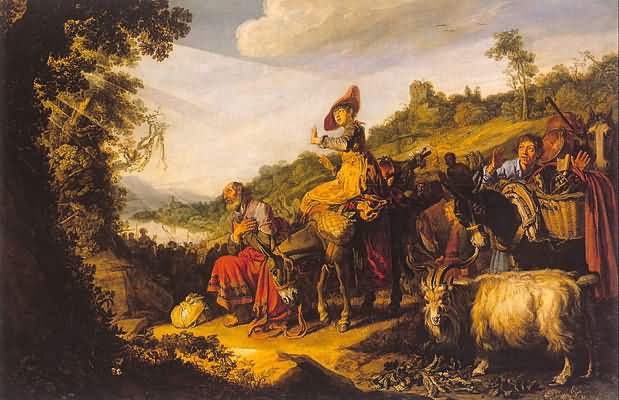
by faith Abraham journeyed....
Paul’s Christian faith leads him to a radical re-interpretation of Jewish religion. The patriarch Abraham is installed in pride of place over against Moses, since he is the exemplar of faith, the one who supremely “trusted” in God. Paul’s conclusion about the Law is that it is only a blessing to one who keeps it; and a curse to those who don’t. True life is given to those who have faith through Jesus, who was condemned by the Law, and is therefore united with all who are condemned by it. All who believe in him, regardless of ethnic origin, can have faith in God and receive life through the Spirit.
It’s an argument familiar to members of the reformed churches because it became a central part of reformation faith .It is not the dominant view in the Catholic or Orthodox traditions. It would not have made much sense to the Jewish Christians who kept the Torah, or to the author of the Letter of James. It’s not the whole truth about early Christian belief, and it creates problems for our interpretation of Judaism. In particular, it makes it difficult to interpret Jesus’ words about fulfilling rather than abolishing the Torah.
The magnificence of Paul’s thinking should not blind us to its occasional one-sidedness.
Gospel
When Jesus had driven out a demon, some of the crowd said:
“By the power of Beelzebul, the prince of demons,
he drives out demons.”
Others, to test him, asked him for a sign from heaven.
But he knew their thoughts and said to them,
“Every kingdom divided against itself will be laid waste
and house will fall against house.
And if Satan is divided against himself, how will his kingdom stand?
For you say that it is by Beelzebul that I drive out demons.
If I, then, drive out demons by Beelzebul,
by whom do your own people drive them out?
Therefore they will be your judges.
But if it is by the finger of God that I drive out demons,

The finger of God..
then the Kingdom of God has come upon you.
When a strong man fully armed guards his palace,
his possessions are safe.
But when one stronger than he attacks and overcomes him,
he takes away the armour on which he relied
and distributes the spoils.
Whoever is not with me is against me,
and whoever does not gather with me scatters.
“When an unclean spirit goes out of someone,
it roams through arid regions searching for rest
but, finding none, it says,
‘I shall return to my home from which I came.’
But upon returning, it finds it swept clean and put in order.
Then it goes and brings back seven other spirits
more wicked than itself who move in and dwell there,
and the last condition of that man is worse than the first.”
The key idea in this passage is of a territory or house which can be occupied and ruled by evil powers or by God’s goodness. The people accuse Jesus of being in league with the chief of the evil powers. He retorts that if Satan/ Beelzebul is healing people by casting out evil powers, his kingdom has a civil war going on. Jesus pours scorn on the idea that healing people can be evil.
If, however Jesus is acting in the power of God, then God is invading Satan’s territory and taking it over. Strong evil powers may guard the palace of Satan, but in God’s power Jesus is stronger and breaks in. Although the language of this dispute is not ours, it places healing at the centre of Jesus’ mission, and gives an unforgettable image of him throwing out evil powers, “by the finger of God”, that is, not by the mighty arm of God which isn’t needed: his pinkie’ll do the job.
Jesus’ “house” theology views the person as a house which has to have a tenant, either evil or good, either Satan or God. A person may be “healed” but if she doesn’t allow God’s goodness into her life, the evil will return, even more destructively than before. An untenanted house is inconceivable.
Bob Dylan sings, “It may be the devil or it may the Lord, but you gotta serve somebody.” Yes.
 Emmock's Blog