This blog follows the daily bible readings of the Catholic Church
Reading 1Galatians 4: 21-5:2 An Appeal from Allegory
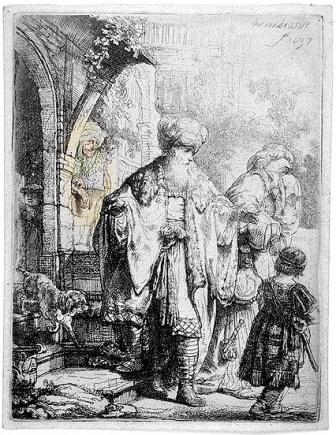
Abraham gets rid of Hagar and their child Ishmael
4:21 Tell me, you who want to be under the law, do you not understand the law? 4:22 For it is written that Abraham had two sons, one by the slave woman and the other by the free woman. 4:23 But one, the son by the slave woman, was born by natural descent, while the other, the son by the free woman, was born through the promise. 4:24 These things may be treated as an allegory, for these women represent two covenants. One is from Mount Sinai bearing children for slavery; this is Hagar. 4:25 Now Hagar represents Mount Sinai in Arabia and corresponds to the present Jerusalem, for she is in slavery with her children. 4:26 But the Jerusalem above is free,* and she is our mother. 4:27 For it is written:
“Rejoice, O barren woman who does not bear children;*
break forth and shout, you who have no birth pains,
because the children of the desolate woman are more numerous
than those of the woman who has a husband.”*
4:28 But you,* brothers and sisters, are children of the promise like Isaac. 4:29 But just as at that time the one born by natural descent persecuted the one born according to the Spirit, so it is now. 4:30 But what does the scripture say? “Throw out the slave woman and her son, for the son of the slave woman will not share the inheritance with the son of the free woman. 4:31 Therefore, brothers and sisters, we are not children of the slave woman but of the free woman. 5:1 For freedom Christ has set us free. Stand firm, then, and do not be subject again to the yoke of slavery.
Paul is using the story of Abraham’s two partners, Hagar his slave-girl, and Sarah his wife, with their respective children, as a complicated allegory of the Jewish Law and the Christian Gospel. All he really wants to say is that the law leads to slavish obedience and the gospel leads to faithful freedom. I think Paul was certainly right to stand against the imposition of Jewish Torah on Christian believers, and his emphasis of the freedom of faith is always salutary, but those who regret the absence of commandments in much Christian practice may question whether his comprehensive anti-legalism is altogether beneficial.
Gospel
While still more people gathered in the crowd, Jesus said to them,
“This generation is an evil generation;
it seeks a sign, but no sign will be given it,
except the sign of Jonah.
Just as Jonah became a sign to the Ninevites,
so will the Son of Man be to this generation.
At the judgment
the queen of the south will rise with the men of this generation
and she will condemn them,
because she came from the ends of the earth
to hear the wisdom of Solomon,
and there is something greater than Solomon here.
At the judgment the men of Nineveh will arise with this generation
and condemn it,
because at the preaching of Jonah they repented,
and there is something greater than Jonah here.”
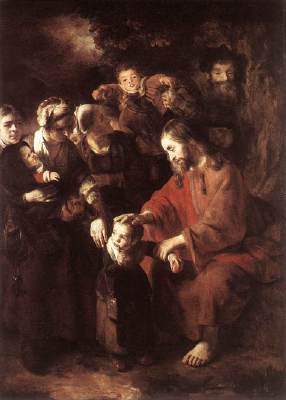
Something greater than Solomon
The “Son of Man” is a term borrowed from the book of Daniel and used by Jesus to refer to the corporate identity of himself-and-his-disciples, especially to their humble present and glorious future. “The Son of Man has nowhere to lay his head” but “you will see angels ascending and descending on the Son of Man.” Those who only see its humble present, without faith, may easily despise it, and think it of no account. Jesus’ warning is directed at people who estimate importance by celebrity, success, or power. Such people miss the secret of the kingdom, because it’s like a seed buried in the earth, which only later becomes the greatest of all trees.
Disciples can be comforted by these words, and perhaps deterred from seeking the kind of success that the world values. Faith is the art of being small.
 Emmock's Blog
“Faith is the art of being small.”
I like this; thank you.
-and part of the art is being supportive of others’ work. Thank you.