
This blog follows the daily bible readings of the Catholic Church
Reading 1, 2 Timothy 4:10-17b
10 As it is, Demas has deserted me for love of this life and gone to Thessalonica, Crescens has gone to Galatia and Titus to Dalmatia; 11 only Luke is with me. Bring Mark with you; I find him a useful helper in my work. 12 I have sent Tychicus to Ephesus. 13 When you come, bring the cloak I left with Carpus in Troas, and the scrolls, especially the parchment ones. 14 Alexander the coppersmith has done me a lot of harm; the Lord will repay him as his deeds deserve. 15 Be on your guard against him yourself, because he has been bitterly contesting everything that we say. 16 The first time I had to present my defence, no one came into court to support me. Every one of them deserted me — may they not be held accountable for it. 17 But the Lord stood by me and gave me power, so that through me the message might be fully proclaimed for all the gentiles to hear; and so I was saved from the lion’s mouth.
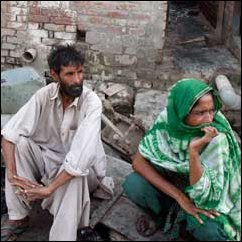
wrecked house of Christian couple in Gojra
Given that this letter is not by Paul, we can ask about the purpose of this apparently personal section of it. It seems that it’s part of building up an image of Paul as man and missionary which will be useful as inspiration within the churches. The qualities emphasised are: friendship, simplicity (he’s been doing without his cloak), resoluteness, readiness for suffering and trust in the Lord. We may be sure that these same qualities would be needed by members of churches which were under sporadic persecution. We should never desire persecution, but we should be aware of the offensiveness of the gospel to the rich, righteous, and powerful, and train ourselves accordingly. Today, we should pray for the persecuted churches in Iraq and Pakistan, whose members display the same courage as St. Paul.
Gospel, Luke 10:1-9
1 After this the Lord appointed seventy-two others and sent them out ahead of him in pairs, to all the towns and places he himself would be visiting.
2 And he said to them, ‘The harvest is rich but the labourers are few, so ask the Lord of the harvest to send labourers to do his harvesting.
3 Start off now, but look, I am sending you out like lambs among wolves.
4 Take no purse with you, no haversack, no sandals. Salute no one on the road.
5 Whatever house you enter, let your first words be, “Peace to this house!”
6 And if a man of peace lives there, your peace will go and rest on him; if not, it will come back to you.
7 Stay in the same house, taking what food and drink they have to offer, for the labourer deserves his wages; do not move from house to house.
8 Whenever you go into a town where they make you welcome, eat what is put before you.
9 Cure those in it who are sick, and say, “The kingdom of God is very near to you.”
Bits of this passage have occurred already in the Lectionary this year. This time I’d like to draw attention to the centrality of declaring “shalom”, peace. The number 72 is the Greek Old Testament number of nations in the world, so the universal nature of Jesus’ mission is hinted: he will bring peace to the nations. The lack of personal goods emphasises the dedicated nature of the messengers. They must not use the customary greeting “Shalom” casually on the road, because they are bearing news of God’s gift of shalom in Jesus, which they are to announce wherever they are give house room. These lambs trust that the wolves will also keep the peace. The nakedness and vulnerability of approach, the announcement of shalom, the healing of the sick are all signs of the kingdom of God. They should influence the church’s methods of mission today.
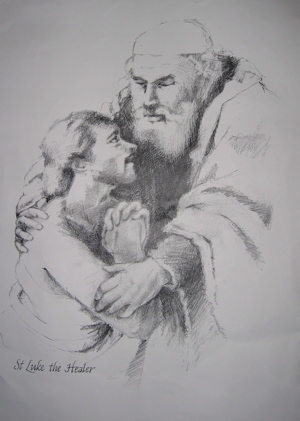
St. Luke, the healer
This is the feast day of St. Luke, the Gospel-writer and possibly writer of The Acts of the Apostles, who is traditionally identified with the Luke who is a companion of St. Paul. There are questions to be raised about these identifications, but certainly we should celebrate the third gospel, which gives us a rich portrait of Jesus, emphasising his ministry amongst the poor and preserving the memory of the ministry of women amongst the disciples.
 Emmock's Blog