
This blog follows the daily bible readings of the Catholic Church
Reading 1, Philippians 2:12-18
12 So, my dear friends, you have always been obedient; your obedience must not be limited to times when I am present. Now that I am absent it must be more in evidence, so work out your salvation in fear and trembling. 13 It is God who, for his own generous purpose, gives you the intention and the powers to act.
14 Let your behaviour be free of murmuring and complaining 15 so that you remain faultless and pure, unspoilt children of God surrounded by a deceitful and underhand brood, shining out among them like bright stars in the world, 16 proffering to it the Word of life. Then I shall have reason to be proud on the Day of Christ, for it will not be for nothing that I have run the race and toiled so hard.17 Indeed, even if my blood has to be poured as a libation over your sacrifice and the offering of your faith, then I shall be glad and join in your rejoicing-18 and in the same way, you must be glad and join in my rejoicing.
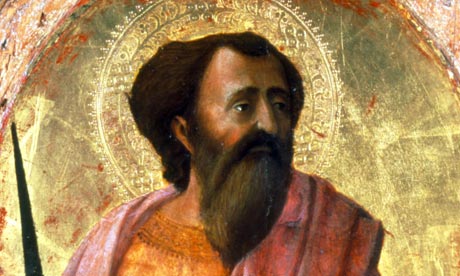
ancient image of St. Paul
Paul’s affection for his converts in Philippi generates some of his most accurate descriptions of the life of faith. “”work out your salvation in fear and trembling”-the gift of God is there but it requires energetic commitment and can never be taken for granted-“for is God who for his own generous purpose, gives you the intention and the powers to act”-even their freedom to be committed is a gift of God. The balance between God’s grace and human free will is beautifully kept.
Readers may wonder if Paul’s rhetoric about his own sacrifice is not a bit over the top; but careful consideration of the dangers and privations he takes for granted will suggest his words have substance. He walks the walk as well as talking the talk.
Gospel, Luke 14:25-33
25 Great crowds accompanied him on his way and he turned and spoke to them.
26 ‘Anyone who comes to me without hating father, mother, wife, children, brothers, sisters, yes and his own life too, cannot be my disciple.
27 No one who does not carry his cross and come after me can be my disciple.
28 ‘And indeed, which of you here, intending to build a tower, would not first sit down and work out the cost to see if he had enough to complete it?
29 Otherwise, if he laid the foundation and then found himself unable to finish the work, anyone who saw it would start making fun of him and saying,30 “Here is someone who started to build and was unable to finish.”
31 Or again, what king marching to war against another king would not first sit down and consider whether with ten thousand men he could stand up to the other who was advancing against him with twenty thousand? 32 If not, then while the other king was still a long way off, he would send envoys to sue for peace.
33 So in the same way, none of you can be my disciple without giving up all that he owns.

Aung San Suu Kyi -we are all her family
Every time Christian churches promote “family values” we should quote verse 26. Jesus was acutely aware that families were usually self-serving. His own experience seems to have been of a loving family who thought his public ministry was bringing them dishonour and wanted to stop him. He did not minimise the pain of putting family second to God’s kingdom. If he had, we would not trust him. Even more surely than his disciple Paul, he knew the cost of working for a new family of God’s children. I often remember Aung San Suu Kyi in Burma, under arrest for opposing injustice, who gave up a loving husband and children to do her duty. When Jesus asked people to count the cost, he was warning against pretence: better to say “no” than to be a fairweather disciple.
 Emmock's Blog