This blog follows the daily bible readings of the Catholic Church
Reading 1, Ezekiel 47:1-2, 8-9, 12
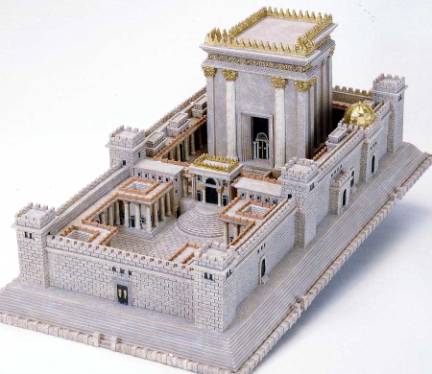
Model of the first Temple in Jerusalem
1 He brought me back to the entrance of the Temple, where a stream flowed eastwards from under the Temple threshold, for the Temple faced east. The water flowed from under the right side of the Temple, south of the altar.
2 He took me out by the north gate and led me right round outside as far as the outer east gate where the water flowed out on the right-hand side.
8 He said, ‘This water flows east down to the Arabah and to the sea; and flowing into the sea it makes its waters wholesome. 9 Wherever the river flows, all living creatures teeming in it will live. Fish will be very plentiful, for wherever the water goes it brings health, and life teems wherever the river flows.
12 Along the river, on either bank, will grow every kind of fruit tree with leaves that never wither and fruit that never fails; they will bear new fruit every month, because this water comes from the sanctuary. And their fruit will be good to eat and the leaves medicinal.’
Today’s readings are variations on the theme of the Temple. None of them are about a physical temple but all use the ancient image of God’s Holy Dwelling on Earth as their starting point.
Ezekiel envisages the holiness of God’s life creating fruitfulness in nature; and this process is a metaphor for the way God’s holiness flows out through his peoples’ faith and obedience, creating goodness in the world.
Jesus uses this imagery when he talks about “living water springing up into eternal life.”
Ezekiel wants to say that true worship is the source of fruitful living.
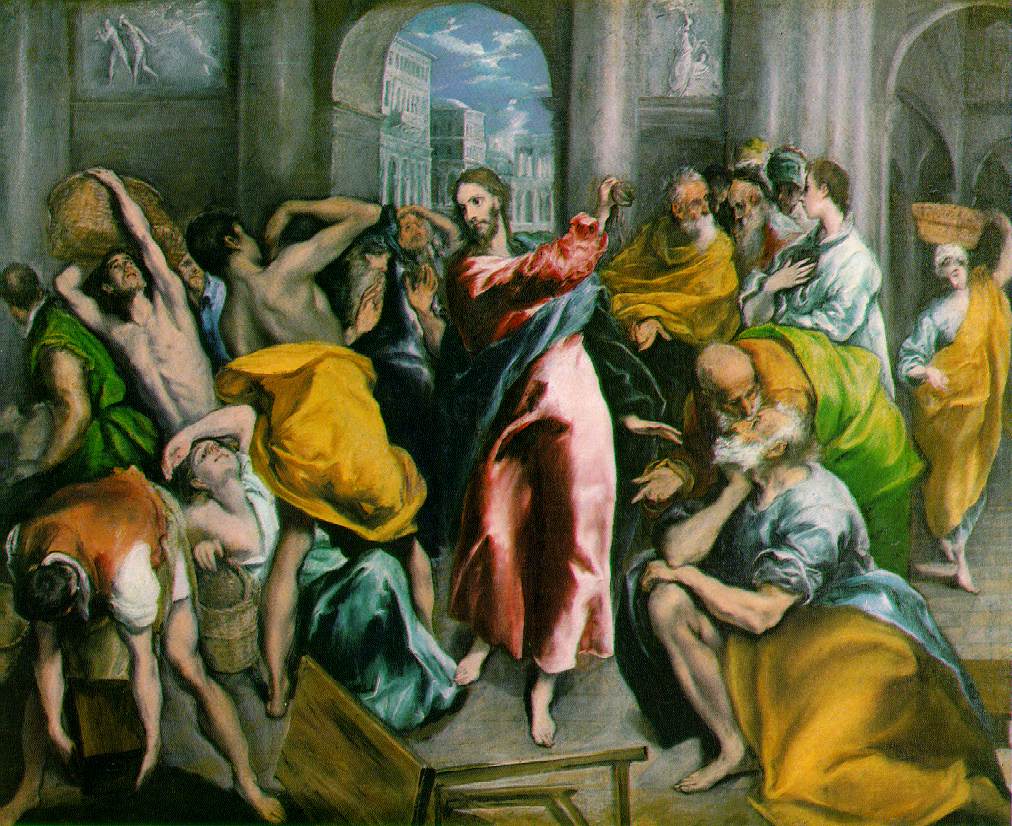
El Greco: Christ driving out the traders
Gospel, John 2:13-22
13 When the time of the Jewish Passover was near Jesus went up to Jerusalem, 14 and in the Temple he found people selling cattle and sheep and doves, and the money changers sitting there. 15 Making a whip out of cord, he drove them all out of the Temple, sheep and cattle as well, scattered the money changers’ coins, knocked their tables over 16 and said to the dove sellers, ‘Take all this out of here and stop using my Father’s house as a market.’
17 Then his disciples remembered the words of scripture: I am eaten up with zeal for your house.
18 The Jews intervened and said, ‘What sign can you show us that you should act like this?’
19 Jesus answered, ‘Destroy this Temple, and in three days I will raise it up.’
20 The Jews replied, ‘It has taken forty-six years to build this Temple: are you going to raise it up again in three days?’
21 But he was speaking of the Temple that was his body, 22 and when Jesus rose from the dead, his disciples remembered that he had said this, and they believed the scripture and what he had said.
As the other Gospel writers, John tells the story of Jesus clearing the temple of traders, but only John links this directly with Jesus’ saying about destroying the temple, and only John comments, “He was talking about the temple of his body.” As the language of the body as temple has become a modern joke, it’s necessary to say that John sees Jesus as the new temple, as THE place where God dwells, which cannot be destroyed by death. The language of “dwelling” is frequent and complex in John’s Gospel: disciples are to “dwell in Jesus” while God and Jesus “dwell” in them. Jesus “dwells” in the Father who “dwells” in him. In the Father’s house are many “dwelling places”. There is here a whole theology of dwelling, which I have elsewhere called Oikos theology after the Greek word for a house. (I have attached an example of oikos theology to this blog.) The central idea in all this is that a person is not self-contained but open to other lives for good or ill; and more astonishingly, that God is not a closed being, but holiness open to all.
Reading 2, 1 Corinthians 3:9c-11, 16-17
9 After all, we do share in God’s work; you are God’s farm, God’s building. 10 By the grace of God which was given to me, I laid the foundations like a trained master-builder, and someone else is building on them. Now each one must be careful how he does the building. 11 For nobody can lay down any other foundation than the one which is there already, namely Jesus Christ.
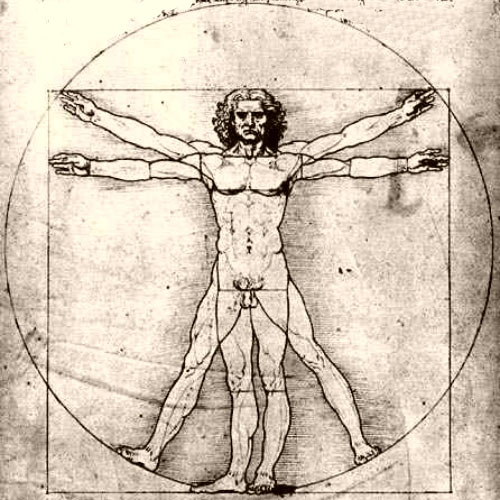
The temple of God
16 Do you not realise that you are a temple of God with the Spirit of God living in you? 17 If anybody should destroy the temple of God, God will destroy that person, because God’s temple is holy; and you are that temple.
Paul makes explicit the concept of the person as the temple of God. No longer is religion confined to holy shrines where God is supposed to dwell: each person may be this place. He defines the indwelling of God as the life of the Holy Spirit in the believer’s life. “Destroying the temple” that is, killing a person, becomes for Paul an act of sacrilege punished by God. It would be good to think of this imagery in respect of the use of the death penalty. It is right to see murder (and war!) as a crime against God; it is wrong to believe that we should punish it by committing the same offence.
APPENDIX
OIKOS THEOLOGY AND ECONOMY
The fundamental metaphor of Oikos Theology is that of universe, community and person as contested households: they can be houses of God who gives equal hospitality to all his creatures; or houses of the Enemy who favours ruthless competition amongst inhabitants and domination of one by another.
(Even writing down these phrases should make the theologian pause; for is not “ruthless competition amongst inhabitants” the engine of evolution and therefore the “way” of the Creator? The atheist evolutionist can describe its process without giving competition and mutual domination any moral value but the believer who ascribes the process to the wisdom of a creator will find it hard to disentangle the deity from evolutionary cruelty. It may be the recognition of this intractable problem that fuels the denial of evolution by fundamentalist Christians. The difficulty is real and cannot honestly be dodged by theologies that accept versions of Darwinism. How can the processes described by Darwin be called “very good”? How can the God who permitted the extinction of countless species also be the Father who cares about the fall of a sparrow?
The answers to these questions emerge from a rigorous doctrine of the Trinity: the Father who makes space for the universe by his own withdrawal; the Spirit who inhabits the processes of creation, enabling development and sharing the pain; the Son who bears the evils consequent on the Father’s withdrawal in his cross and opens up new heavens and new earth in his resurrection. )
Oikos the Greek word for house is the root of the English economy, ecology and ecumenism. With the Hebrew for house, Beth, it is a key word in the Bible, especially in the phrase, House of God, which designates the universe, the temple, the shrine, the faithful person as dwelling places of God; and on the other hand designates God as the dwelling place of all creatures. The unified theological story is that God comes to dwell with his creatures so that they may dwell with him.
What is a house of God? It is a part of the universe from which God the Father is absent, as a woman is absent from her own womb, giving space for new life; throughout which the Spirit of God is present as the persuasion of God’s love towards perfection; in which Jesus Christ is born as the first of God’s children.
In the theology of the Orthodox Church oeconomia is primarily used to describe the saving justice of the Trinity i.e. God’s household management. THE economy is the way God is and acts, creating, sustaining and transforming life. Christian people can understand God’s household management and use it as a model for their own economic behaviour. As against prevailing orthodoxies they refuse the rule of the market (seeing it as a form of idolatry) and insist that the house and its inhabitants come before its means of management. Anyone who thinks that idolatry is too strong an expression should look at the reports of the U.S Law Society about the number of wives divorcing husbands because the current financial crisis has reduced their earning power.
This leads me to the primary statement of Oikos economics:
1.0 The purpose of economic activity is the re-creation of the human household which is also God’s household. (Genesis 1: 28-31)
Re-creation primarily refers to the endlessly fertile activity of God who brings new worlds and new life into being every day. Human economy should aim to bring forth children in a nourishing ecosystem. The basic agents of growth are families rather than multinational companies but there is nothing here to inhibit and everything to encourage a venturesome economy with the purpose of re-creating life rather than mere wealth. Maybe the word, recreate, sounds too grandiose? The effects of launching a new company or national economic strategy can be new human activity, new relationships and so new life. Often these are seen as by-products of wealth-creation but in an oikos perspective it’s the other way round: wealth is the by-product of life-creation. Often theological criticism seems to carp at the adventure, risk and ambition of secular enterprises; Oikos theology suggests that when human enterprise is the mechanical reproduction of capital it is not nearly ambitious enough.
1.1 Any economic activity which is fundamentally destructive is also unwise. (Luke 12: 13-21) Of course many destructive activities can be profitable for some people in the short term but in the long term they will prove unwise. The way of creation can be discerned by study and constitutes wisdom. The hokma of the Bible, the Sophia of the Greeks, the tao of Asian philosophy, these traditions use the best science of their time and accompany it with profound meditation on natural process. Humanity has not invented wisdom but apprehends it in the life of the universe.
1.2 Any wise economic activity offers creative labour which expresses and develops human character. (Ecclesiasticus 38: 24-34) Creativity is a fundamental expression of human being as ecstatic, that is, as standing out from itself and becoming new. Such labour, however simple, is a human good to be sought out and cherished as a component of the good life.
1.3 All economic activity should produce justice and peace, the qualities which allow the inhabitants of the one household to live together. ( Isaiah1: 11-17) The fact that human beings share in creation is a sign that God does not do everything himself and that what has been done is not enough: the household of God is an ongoing project rather than a finished artefact. St Paul says we are co-workers with God in creating good. (Romans 8:28)
1.4 No economic system can ensure continual wellbeing. ( Ecclesiates 9:7-12) (“The best laid plans o’ mice and men/ gang aft agley” (Burns)) Any system that pretends it can do so is in the grip of an arrogant delusion that makes it dangerous. The biblical doctrine of creation begins with chaos (without form and void and darkness on the face of the deep) and shows how God’s Word brings order by including the void darkness in the rhythm of each day: “And there were evening and morning, the first day.” (Genesis 1:1-4). Chaos is not eliminated but given its place in the new order. Novelty, unpredictability, indeterminacy, waste and death are as much part of creation as law and light. If this sounds negative it’s good to remember that randomness is the cradle of new life. Economic systems must find a middle way between total control and utter carelessness. Wisdom literature is much taken up with this balance and reveals that there is no easy poise but only a skill in leaning now this way, now that way, without falling. The market fundamentalism of 1980-2008 is a crass certainty that absence of market control is virtuous.
1.5 The aim of economic activity should be common wealth i.e. the well-being of the whole household rather than individual or sectional wealth, for the Christian tradition is quite clear that the possession of wealth corrupts. (The Acts 2:42-47; Matthew 19: 16-26). This is different from those traditions which teach that attachment to wealth corrupts, that it is a question of attitude. This is a hard teaching and unlikely to find acceptance. What about famous philanthropists, people ask. My guess is that for every George Soros who finds his way into the kingdom there are thousands of cold-hearted miserly gits who don’t give a toss for their neighbour and deserve a few lifetimes in the big fire. In any case this teaching should lead us to use great caution in dealing with rich individuals and institutions: they may be corrupt; and in gathering wealth to ourselves, we may be corrupted.
1.6 Economic activity which does not serve the common good serves common evil. Jesus taught that we cannot serve God and Mammon=Posessions (Matthew 6:24). Bob Dylan sings that “you gotta serve somebody/ it may be the Devil or it may be the Lord/ but you gotta serve someone”. This is an unavoidable choice for individuals and corporations. The service of Mammon is slavery to the “rulers of this dark age” according to St. Paul: arrogance, greed, violence, restlessness. The “house” can be occupied by trans-personal forces of destruction.
1.7 Where debt brings people into slavery or degradation it should be cancelled. It seems likely that Jesus who worked in the building trade would want his bills paid. In a developed economy people will accrue debts for goods and services and ought to pay them. But there are situations in which the debt can destroy the debtor. If the creditor thinks he lives in a different house from the debtor this may have not much concern him. But if in truth they both live in the one house the spectacle of a brother’s need requires the generous cancellation of his debt. This is the argument used by those who wished the cancellation of the debts of poor nations: we live in the one world, we all benefit from each other’s welfare. Without doubt “forgiveness of debt” was a major metaphor of Jesus’ ministry. To what extent it was also a literal expectation is open to question. It is clear that lending money for profit was forbidden in the early church and for many centuries thereafter. Debt cancellation and the proscription of usury would undermine the basis of capitalist economies. (Matthew 5: 42; 6: 12; 18: 23-35)
2.0 Creative economy has always existed in the practice of those who live justly. Contrary to modern depictions of “primitive” life as nasty, brutish and short, there is evidence of very simple economies producing enough and to spare while offering considerable leisure time. (Jesus’ story of the feast that the rich have no time to attend while the poor respond gladly is a shrewd observation. Luke 14: 15-24) Problems arise with the ability to produce significant surplus-the issues of distribution, ownership and power.
2.1 Creative economy activity uses the market but gives priority to the welfare of human beings and the natural world. (The Acts: 4: 34-5)The market is not resistant to these concerns.
2.2 Creative economy depends on the willingness of workers to live modestly and to put surplus earnings at the disposal of the common good, as in the first Christian communities depicted in the book of The Acts of the Apostles (Acts 2:6). This askesis (discipline) is less foreign to contemporary earners than is sometimes thought: people are happy to live frugally for a purpose.
2.3 Creative economy refuses to be bound solely by local considerations and makes imaginative connections with people in other places, treating the world as one household. The aid organised by St Paul amongst the Greek churches for the poor of Jerusalem is an astonishing witness to this principle. (Corinthians 8:1-15)
2.4 Creative economy is actively opposed to destructive economy. The story of Jesus and Zacchaeus shows how the destructive economy of an oppressive power and its collaborators is undermined by the generous fraternal behaviour of Jesus so that justice is re-established in one household. (Luke 19: 1-10)
2.4 Creative economy recognises that the re-creation of the biosphere is as important as the recreation of human life and more important than the maintenance of rich people and their habits. The Biblical tradition notes a conflict between the good of the biosphere (Eden) and the good of human ingenuity (Genesis 3). The human pair is expelled from the garden because they are determined to know everything. Their successors use their knowledge to build a skyscraper that threatens heaven and is destroyed. Yet human knowledge and its technologies is the engine of history. The Bible is pessimistic about human arrogance and its consequences.
3.0 The earth is finite, as Christian theology has always said. (Wisdom 13: 1-9) There’s no such thing as a free lunch. Even if there’s a miracle the five loves and two fishes are consumed. Just as slavery was taken for granted in classical economy, so the availability of raw materials was taken for granted by Adam Smith, Ricardo, Marx, and Keynes. Now it is clear that these are finite and that some of them may be used up already.
3.1 In the linked crises of global resources and global warming most national governments whose concern is a small area of the world over a short period of time will behave with stupidity and the rest with gross stupidity.(Psalm 82) The world church should join with other world organisations to face the crises intelligently. The Bible contains a critique of the nation state as harming rather than housing its people. This remains relevant in a world of interdependent beings which requires management to be both more local and more global than nations. The church is well placed to act across national borders.
3.2 Christianity should not equate trust in God with confidence in the continuing ability of the earth to support human life. (Psalm 46) Human beings can destroy the earth as a human habitat and may do so. This would not invalidate an oikos theology which sees a future earth without Homo sapiens as still a house of God.
3.3 Biblical pessimism is justified when we ask if the nations are ready to cooperate in the profound changes necessary to keep the earth as a home for humanity. Clearly they are not. (Psalm 49:12-14) Far-reaching changes in human economies are probable as people adjust to higher temperatures and more profound changes will be required if global warming is to be stopped.
3.4 All the resources of nations should be mobilised towards preventing/ ameliorating eco-catastrophe. It is highly probable that nations will prepare for change by increasing the capability of their armed forces and weapons. Christian teaching mocks those who put their trust in destructive power. Christian people must stand firm against violence. (Isaiah 31: 1-3)
3.5 As at the time of the decay of the Roman Empire, Christian churches may now disperse into “the desert” to establish ways of living which do not depend on the dominant economies of the age. The desert Fathers and Mothers lived without slaves, without law, without violence, without large scale technologies, without wealth. Out of this monastic movement came human skills for a new age: self-reliance, strong community, frugality, vegetable and animal husbandry. The household management of monasteries provided models for societies. Eco-communities throughout the world, by reverting to a more basic type of economy may discover how to live with minimal damage to ecosystems and even maybe how to enhance them. Churches should not live in denial of eco-danger nor should they indulge in helpless panic. They could be witnesses, along with wise people everywhere, to the practicability of just economy and the possibility of a new beginning. In this way they may act as many Noah’s Arks for our time.
 Emmock's Blog