
This blog follows the daily bible readings of the Catholic Church
Reading 1, Isaiah 40:1-11
1 ‘Console my people, console them,’ says your God.
2 ‘Speak to the heart of Jerusalem and cry to her that her period of service is ended, that her guilt has been atoned for, that, from the hand of Yahweh, she has received double punishment for all her sins.’
3 A voice cries, ‘Prepare in the desert a way for Yahweh. Make a straight highway for our God across the wastelands.
4 Let every valley be filled in, every mountain and hill be levelled, every cliff become a plateau, every escarpment a plain;
5 then the glory of Yahweh will be revealed and all humanity will see it together, for the mouth of Yahweh has spoken.’
6 A voice said, ‘Cry aloud!’ and I said, ‘What shall I cry?’ -‘All humanity is grass and all its beauty like the wild flower’s. 7 The grass withers, the flower fades when the breath of Yahweh blows on them. (The grass is surely the people.)
8 The grass withers, the flower fades, but the word of our God remains for ever.’
9 Go up on a high mountain, messenger of Zion. Shout as loud as you can, messenger of Jerusalem! Shout fearlessly, say to the towns of Judah, ‘Here is your God.’
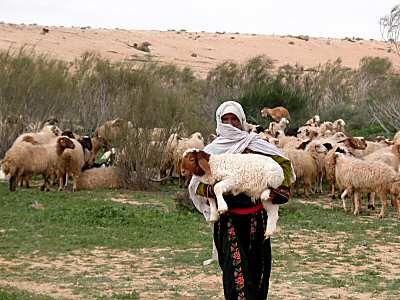
and carry them in his bosom
10 Here is Lord Yahweh coming with power, his arm maintains his authority, his reward is with him and his prize precedes him.
11 He is like a shepherd feeding his flock, gathering lambs in his arms, holding them against his breast and leading to their rest the mother ewes.
It’s a powerful experience reading the Hebrew Isaiah to turn from the downbeat ending of the First Prophet Isaiah, to the distinctive note of the Second, “Nachamu, nachamu amee, yomar elochechem (comfort, comfort my people, says your God) where God’s tenderness is mimed by a verb whose root meaning is “to gasp, to pant.” The prophet also establishes a distinctive rhythm, which should be evident in any competent translation, more measured than the swift and jagged rhythms of First Isaiah, which well suits the confident re-gathering of a scattered people promised by the prophet. The fundamental idea is astounding: God has been in exile with his people and is now returning to the holy city ahead of them. The king’s herald precedes him demanding a decent high way for the royal procession. When Isaiah is called to prophesy he can only deliver a conventional expression of the weakness of human beings but the mysterious voice tells him that God’s word is not weak; and that he, Isaiah, is being given the task of announcing news of God’s victorious return to the towns of Judah. Verse 11 comes after the announcement of God’s majestic power and is devastating in its direct characterisation of God’s care:
He shall feed his flock like a shepherd;
He shall gather the lambs in his arms;
He shall carry them in his bosom;
And gently lead those that are with young.
(This is basically the KJV. See what a mess the Jerusalem Bible above has made of it)
Language was stretched by the Hebrew prophets to fashion a speech about God and for God. Their creativity needs to be matched by every generation of those who believe in God.

lost
Gospel, Matthew 18:12-14
12 ‘Tell me. Suppose a man has a hundred sheep and one of them strays; will he not leave the ninety-nine on the hillside and go in search of the stray? 13 In truth I tell you, if he finds it, it gives him more joy than do the ninety-nine that did not stray at all. 14 Similarly, it is never the will of your Father in heaven that one of these little ones should be lost.
The motif of the God who meets his people in exile and brings them back home became determinative for the whole Hebrew Bible and is fundamental to the mission of Jesus. There is an underlying conviction in the Hebrew Bible that God brings the righteous, or at least, chastened and repentant people back to the land of promise, whereas Jesus made it explicit that God goes after the unrighteous and the lost. He became the living embodiment of God’s tenderness. This made Him notoriously “soft on sinners.”
If we ask how to experience God, we can rightly be instructed, “Get lost!
 Emmock's Blog