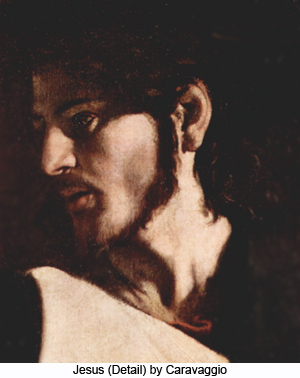
This blog follows the daily bible readings of the Catholic Church. Reading 1, Is 54:1-10
1 Shout for joy, barren one who has borne no children! Break into cries and shouts of joy, you who were never in labour! For the children of the forsaken one are more in number than the children of the wedded wife, says the Lord.2 Widen the space of your tent, extend the curtains of your home, do not hold back! Lengthen your ropes, make your tent-pegs firm, 3 for you will burst out to right and to left, your race will dispossess the nations and repopulate deserted towns.
4 Do not fear, you will not be put to shame again, do not worry, you will not be disgraced again; for you will forget the shame of your youth and no longer remember the dishonour of your widowhood. 5 For your Creator is your husband, the Lord of Hosts is his name, the Holy One of Israel is your redeemer, he is called God of the whole world. 6 Yes, the Lord has called you back like a forsaken, grief-stricken wife, like the repudiated wife of his youth, says your God. 7 I did forsake you for a brief moment, but in great compassion I shall take you back. 8 In a flood of anger, for a moment I hid my face from you. But in everlasting love I have taken pity on you, says the Lord, your redeemer. 9 For me it will be as in the days of Noah when I swore that Noah’s waters should never flood the world again. So now I swear never to be angry with you and never to rebuke you again.10 For the mountains may go away and the hills may totter, but my faithful love will never leave you, my covenant of peace will never totter, says the Lord who takes pity on you.
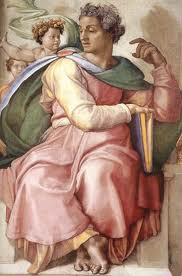
Isaiah -Michelangelo
If we forget that Isaiah has to create these words for God, we underestimate his labour as prophet. It may be that the words came to him as from someone else, but they are a product of his experience and vocabulary. The tenderness so evident in them is Isaiah’s as well as God’s. His imaginative identification with a first wife replaced by a younger model provides a startling picture of God the husband of Israel. He makes the Lord confess his momentary rejection of his true love. We know so little of “Second Isaiah” that we can’t guess the process in which these prophecies were produced-maybe more than one “author” was involved. But we can be astonished at the creation of this ample and passionate speech for Israel’s divine partner. These are words that everyone who reaches towards God wants to hear.
Gospel, Lk 7:24-30
24 When John’s messengers had gone he began to talk to the people about John,
25 ‘What did you go out into the desert to see? A reed swaying in the breeze? No! Then what did you go out to see? A man dressed in fine clothes? Look, those who go in magnificent clothes and live luxuriously are to be found at royal courts! 26 Then what did you go out to see? A prophet? Yes, I tell you, and much more than a prophet: 27 he is the one of whom scripture says: Look, I am going to send my messenger in front of you to prepare your way before you. 28 ‘I tell you, of all the children born to women, there is no one greater than John; yet the least in the kingdom of God is greater than he.’
29 All the people who heard him, and the tax collectors too, acknowledged God’s saving justice by accepting baptism from John; 30 but by refusing baptism from him the Pharisees and the lawyers thwarted God’s plan for them.

discerning the dawn
Jesus says that however great the prophetic promise it remained a promise; and that those who live in the fulfilment of the promise are greater because of what is happening amongst them. It is in his own ministry Jesus suggests, that the husband reinstates his rejected wife and with great compassion takes her back; it is in his cross that God will demonstrate his utter faithfulness to his bride. Although the fullness of kingdom’s day is not yet, already in Jesus those who have stayed awake discern the dawn. These passages sing an advent song.
 Emmock's Blog
“Isaiah has to create these words for God” – this is an astonishing phrase, and I am not sure what to say about it.
I understand, of course, that more than just dictation is going on here; and I think I understand (sort of) what you mean by this (something like – that although the impulse and direction to speak may come from God, it is still Isaiah who forms the words and phrases that are used [correct me if I am wrong]), but this is still – for me, at any rate – a really unfortunate way of conveying the thought. It takes higher criticism (or something) altogether too far for my taste.
Again thanks for your comment, Jeff. As usual it goes straight to the point. Yes, the phrase is deliberately provocative because I want to emphasise the human effort and cost of prophecy, just as I might want to emphasise the human effort and cost of being the Son of God. We are not of course. talking incarnation in Isaiah’s case, but still, in him, the word of God becomes a human word, spoken in human terms to human beings in an historical situation. It is God’s word, yes. But an unmediated word of God would be terrifying and incomprehensible; and mediation, (except in the case of Jesus?) involves God in human intelligence, emotion, experience-and error! When the prophet says, “This is the word of God” we have also to remember that this is the word of the prophet which may sometimes be mistaken. Karl Barth’s late essay on the “Humanity of God” is relevant to this issue.
Yes – provocative is the word, but I see what you mean.