
This blog provides a meditation on the Revised Common Lectionary along with a headline from world news:

Hena, accused of adultery and killed
“’ADULTERY’ GIRL DIES AFTER WHIPPING”
GALATIANS 5:16-24
16 Live by the Spirit, I say, and do not gratify the desires of the flesh. 17For what the flesh desires is opposed to the Spirit, and what the Spirit desires is opposed to the flesh; for these are opposed to each other, to prevent you from doing what you want. 18But if you are led by the Spirit, you are not subject to the law. 19Now the works of the flesh are obvious: fornication, impurity, licentiousness, 20idolatry, sorcery, enmities, strife, jealousy, anger, quarrels, dissensions, factions, 21envy, drunkenness, carousing, and things like these. I am warning you, as I warned you before: those who do such things will not inherit the kingdom of God.
22 By contrast, the fruit of the Spirit is love, joy, peace, patience, kindness, generosity, faithfulness, 23gentleness, and self-control. There is no law against such things. 24And those who belong to Christ Jesus have crucified the flesh with its passions and desires.
Paul makes much use of the contrast flesh and spirit. I was taught to interpret these terms as designating dimensions of human possibility: “flesh” as the possibility of being closed to God; “spirit” as the possibility of being open. Certainly we shouldn’t interpret them, as some in the Christian tradition have done, as Paul’s judgement on the body and its satisfactions, particularly sexual pleasure. It’s clear from the list of the works of the flesh that many of them are not what we would call bodily matters at all, idolatry and envy, for example. The fruits of the spirit should also be seen as expressions of the whole person rather than of the spiritual bit of a person. 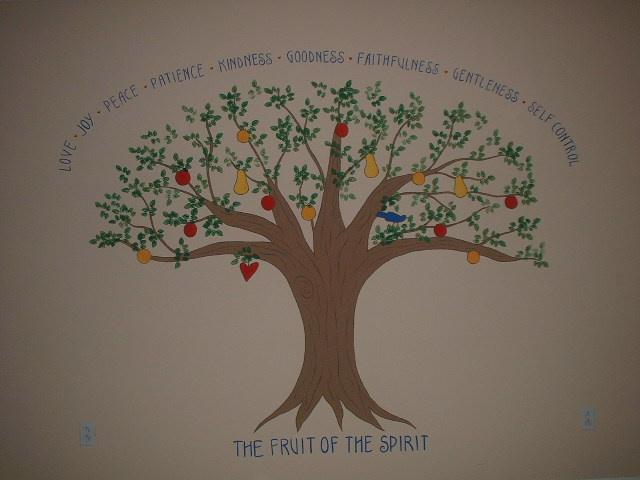
Nevertheless, the use of the word flesh (sarx in Greek) shows that Paul saw sin as intimately bound up with the material body which human beings share with animals. Being constituted as bodies, separate from one another and from God, permits or even encourages the self-ishness which is the root of other evils. Messiah Jesus has come in the flesh to show how life may be lived in the spirit; to allow his flesh to be crucified out of love for human beings and God; and to be raised to life in a transfigured body which no longer excludes but includes others. Christian believers are called to live in the spirit by allowing their separate selves to be crucified and sharing the life of the body of Christ. The sins of the “flesh” are called works, that is, actions determined by human will; whereas the good things of the spirit are called fruits, that is, actions which grow out of the partnership of the spirit.
- Paul’s thought in this regard is flexible and subtle, and deserves attention.
- Some may call his view of humanity pessimistic; I think I know enough about myself and a world in which teenage girls are beaten to death, to call it realistic.
Mark 9:2-13
2 Six days later, Jesus took with him Peter and James and John, and led them up a high mountain apart, by themselves. And he was transfigured before them, 3and his clothes became dazzling white, such as no one on earth could bleach them. 4And there appeared to them Elijah with Moses, who were talking with Jesus. 5Then Peter said to Jesus, ‘Rabbi, it is good for us to be here; let us make three dwellings, one for you, one for Moses, and one for Elijah.’ 6He did not know what to say, for they were terrified. 7Then a cloud overshadowed them, and from the cloud there came a voice, ‘This is my Son, the Beloved; listen to him!’ 8Suddenly when they looked around, they saw no one with them any more, but only Jesus.9 As they were coming down the mountain, he ordered them to tell no one about what they had seen, until after the Son of Man had risen from the dead. 10So they kept the matter to themselves, questioning what this rising from the dead could mean. 11Then they asked him, ‘Why do the scribes say that Elijah must come first?’ 12He said to them, ‘Elijah is indeed coming first to restore all things. How then is it written about the Son of Man, that he is to go through many sufferings and be treated with contempt? 13But I tell you that Elijah has come, and they did to him whatever they pleased, as it is written about him.’

Rafael shows the light cascading from Jesus to the epileptic boy below
Jesus was a material, bodily human being, with no “superhuman” attributes not possessed by other human beings. Mark narrates here a story about how the “whole Jesus- Son- of -God” was glimpsed by his inner circle of disciples in his earthly life. We do not fully know what it’s like to be in the bodily presence of someone whose identity is not exclusive but shared with others because he is utterly open to God and his neighbour. The story gives us an image of that splendour. Mark wants to insist that Jesus revealed such glory already in his earthly life, and not just in his resurrection. “Life in the Spirit” was seen in the human Jesus and in him too are seen the fruits of the Spirit, as he descends the mountain to heal an epileptic boy.
The overwhelming beauty of Jesus’ divine goodness is not a common theme in my church today, but it is a gospel theme and should be more valued.
 Emmock's Blog