This blog provides a meditation on the Revised Common Lectionary along with a headline from world news:
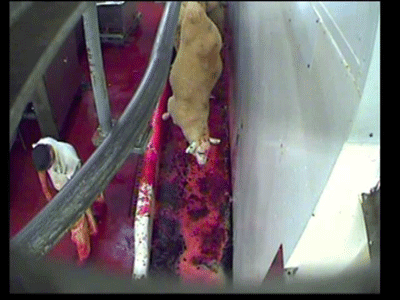
CCTV EXPOSES CRUELTY IN BRITISH ABATTOIRS
all the one suffering
Galatians 5:25-6:10
25If we live by the Spirit, let us also be guided by the Spirit. 26Let us not become conceited, competing against one another, envying one another. My friends, if anyone is detected in a transgression, you who have received the Spirit should restore such a one in a spirit of gentleness. Take care that you yourselves are not tempted. 2Bear one another’s burdens, and in this way you will fulfil the law of Christ. 3For if those who are nothing think they are something, they deceive themselves. 4All must test their own work; then that work, rather than their neighbour’s work, will become a cause for pride. 5For all must carry their own loads. 6 Those who are taught the word must share in all good things with their teacher. 7 Do not be deceived; God is not mocked, for you reap whatever you sow. 8If you sow to your own flesh, you will reap corruption from the flesh; but if you sow to the Spirit, you will reap eternal life from the Spirit. 9So let us not grow weary in doing what is right, for we will reap at harvest time, if we do not give up. 10So then, whenever we have an opportunity, let us work for the good of all, and especially for those of the family of faith.
Paul has two proverbial phrases that apply to the life of a Christian community: bear one another’s burdens; and, carry your own load. How can these both be true? (Proverbial phrases are often contradictory-look before you leap / he who hesitates is lost!) Paul places them with an unerring hand. In the shared life (koinoinia) of the Assembly, no one should be left alone with something that weighs them down. Problems, disasters, griefs, temptations, should be mutually carried. On the other hand, when it comes to testing one’s behaviour, no-one can claim his neighbours’ good deeds as his own: one’s life does not cease to be one’s personal responsibility because one’s neighbours are generous. The deftness with which Paul gives this advice, shows how familiar he had become with the ethics of the shared life, a quality of communal living which was new on the earth then and which challenges everyone since.
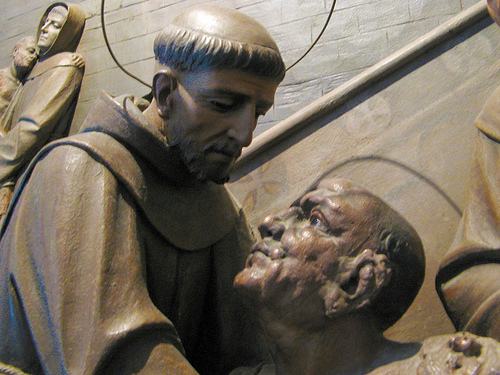
Francis and the leper. Bear one anothers burdens
The headline? At a time of great human suffering does the suffering of animals in abattoirs matter? Yes, because all suffering is the one suffering (“all creation groans” Romans 8), and all cruelty is the one cruelty.
Mark 9:14-29
14 When they came to the disciples, they saw a great crowd around them, and some scribes arguing with them. 15When the whole crowd saw him, they were immediately overcome with awe, and they ran forward to greet him. 16He asked them, ‘What are you arguing about with them?’ 17Someone from the crowd answered him, ‘Teacher, I brought you my son; he has a spirit that makes him unable to speak; 18and whenever it seizes him, it dashes him down; and he foams and grinds his teeth and becomes rigid; and I asked your disciples to cast it out, but they could not do so.’ 19He answered them, ‘You faithless generation, how much longer must I be among you? How much longer must I put up with you? Bring him to me.’ 20And they brought the boy to him. When the spirit saw him, immediately it threw the boy into convulsions, and he fell on the ground and rolled about, foaming at the mouth. 21Jesus asked the father, ‘How long has this been happening to him?’ And he said, ‘From childhood. 22It has often cast him into the fire and into the water, to destroy him; but if you are able to do anything, have pity on us and help us.’ 23Jesus said to him, ‘If you are able!—All things can be done for the one who believes.’ 24Immediately the father of the child cried out, ‘I believe; help my unbelief!’ 25When Jesus saw that a crowd came running together, he rebuked the unclean spirit, saying to it, ‘You spirit that keep this boy from speaking and hearing, I command you, come out of him, and never enter him again!’ 26After crying out and convulsing him terribly, it came out, and the boy was like a corpse, so that most of them said, ‘He is dead.’ 27But Jesus took him by the hand and lifted him up, and he was able to stand. 28When he had entered the house, his disciples asked him privately, ‘Why could we not cast it out?’ 29He said to them, ‘This kind can come out only through prayer.’
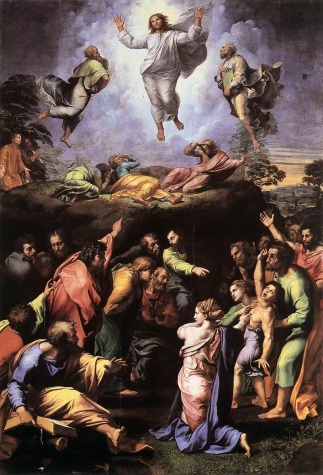
The power of the shared life of Jesus includes the sick boy
Jesus’ believed his life was shared with God and with God’s creatures. Mark has told the story of the transfiguration in which the glory of that life has for a moment been evident to his inner circle of disciples. But it is precisely the glory of the shared life of God. This is shown again in the incident which follows the transfiguration, the healing of the epileptic boy. For Jesus, faith is trust in the sharing of God’s life. His outburst about faithlessness is aimed equally at the father and his disciples. The father comes demanding life for his boy, not offering to help share that life with others, while the disciples have committed themselves to sharing it but don’t really trust it themselves. Jesus insists that the shared life cannot just be a gift. He corrects the father’s “if you are able” with his own, “no, if YOU are able!” The father himself must trust the reality of God’s sharing. Jesus demand draws from the father the terrible and honest cry, “I believe; help my unbelief.” Jesus’ skill as a healer provides that help. This is a model of healing. The sick person deserves to be part of a community where trust in the shared life of God is real and people bear one another’s burdens. Then the skilled healers can do their job.
 Emmock's Blog