
This blog provides a meditation on the Revised Common Lectionary along with a headline from world news
BRITISH IRAQI MAN TORTURED IN IRAQI JAIL

Ramze Ahmed-Tortured
(This headline reminds us that in spite of what T. Blair or D. Rumsfeld say, the invasion of Iraq only succeeded in replacing a well-organised tyranny with a disorganised one, at enormous human cost. Please add your voice to Amnesty’s campaign on behalf of Mr. Ramze Ahmed)
2 Timothy 1-13
You then, my child, be strong in the grace that is in Christ Jesus; 2and what you have heard from me through many witnesses entrust to faithful people who will be able to teach others as well. 3Share in suffering like a good soldier of Christ Jesus. 4No one serving in the army gets entangled in everyday affairs; the soldier’s aim is to please the enlisting officer. 5And in the case of an athlete, no one is crowned without competing according to the rules. 6It is the farmer who does the work who ought to have the first share of the crops. 7Think over what I say, for the Lord will give you understanding in all things.
8 Remember Jesus Christ, raised from the dead, a descendant of David—that is my gospel, 9for which I suffer hardship, even to the point of being chained like a criminal. But the word of God is not chained. 10Therefore I endure everything for the sake of the elect, so that they may also obtain the salvation that is in Christ Jesus, with eternal glory. 11The saying is sure:
If we have died with him, we will also live with him;
12 if we endure, we will also reign with him;
if we deny him, he will also deny us;
13 if we are faithless, he remains faithful—
for he cannot deny himself.
Readers of yesterday’s blog will know that like most scholars I see 2 Timothy as a pseudonymous writing, probably produced by a disciple of Paul some time after his death. The examples of the soldier and the athlete are taken from Paul’s authentic letters, but used without much imagination. The writer has however grasped the example of Paul as an apostle who suffered with his Lord, and he articulates the duty of costly witness to Jesus in words which may have been traditional in the “Pauline” churches. They mirror the teachings of Jesus himself that those who endure will be saved and those who deny will be denied. But they add the wonderful words, “If we are faithless, he remains faithful, for he cannot deny himself.” These words must reflect the experience of people who have been unfaithful but know, through the church community, that Jesus has not rejected them. Even if they seem to contradict the words of Jesus given in the gospel, (Matthew 10.33) and appear in a minor letter written in Paul’s name, they are surely to be treasured as a word of God.
Mark 10:1-16
10He left that place and went to the region of Judea and beyond the Jordan. And crowds again gathered around him; and, as was his custom, he again taught them.
2 Some Pharisees came, and to test him they asked, ‘Is it lawful for a man to divorce his wife?’ 3He answered them, ‘What did Moses command you?’ 4They said, ‘Moses allowed a man to write a certificate of dismissal and to divorce her.’ 5But Jesus said to them, ‘Because of your hardness of heart he wrote this commandment for you. 6But from the beginning of creation, “God made them male and female.” 7“For this reason a man shall leave his father and mother and be joined to his wife, 8and the two shall become one flesh.” So they are no longer two, but one flesh. 9Therefore what God has joined together, let no one separate.’
10 Then in the house the disciples asked him again about this matter. 11He said to them, ‘Whoever divorces his wife and marries another commits adultery against her; 12and if she divorces her husband and marries another, she commits adultery.’
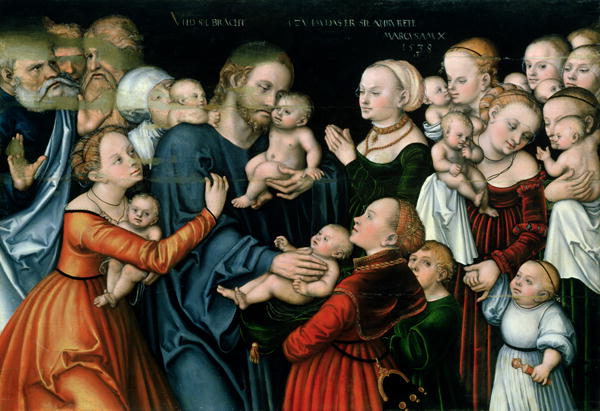
Jesus and children-Lucas Cranach
13 People were bringing little children to him in order that he might touch them; and the disciples spoke sternly to them. 14But when Jesus saw this, he was indignant and said to them, ‘Let the little children come to me; do not stop them; for it is to such as these that the kingdom of God belongs. 15Truly I tell you, whoever does not receive the kingdom of God as a little child will never enter it.’ 16And he took them up in his arms, laid his hands on them, and blessed them.
Here we have one of the most neglected of Jesus’ instructions and one of the most observed. In all churches we are good at bringing children to Jesus (whether or not we baptise them!). In most churches, except the Roman Catholic, we have neglected the Markan form of Jesus’ command in favour of its Matthaean form (which adds: “for any reason except sexual misconduct”); and in many churches, we have altogether ignored it, accepting divorce as an inevitable part of ordinary social life, as indeed Jesus’ original listeners did.

a normal part of social life
The placing together of the two instructions by Mark may give a clue as to how he their saw their meaning. Children and women in Jesus’ society had a lower status than men. We could see Jesus rejection of divorce as protecting women from injustice. On the other hand we can reflect that receiving the kingdom as little children is equivalent (and taken by John’s Gospel as such) to being “born again or born from above” that is, to a complete refashioning of life by the Holy Spirit. Perhaps Mark linked that new life and the rejection of divorce. Only those who have become like children in the kingdom of God will understand the utterly binding nature of married love. But here also we have to add, “If we are faithless, He is faithful for He cannot deny himself.”
 Emmock's Blog