
This blog provides a meditation on the Weekday Lectionary of the Episcopal Church along with a headline from world news
IRISH PEOPLE PREPARE FOR ELECTION: Ireland needs an honest church to minister to its people: this may not be the Catholic Church.
1 Timothy 2
2First of all, then, I urge that supplications, prayers, intercessions, and thanksgivings should be made for everyone, 2for kings and all who are in high positions, so that we may lead a quiet and peaceable life in all godliness and dignity. 3This is right and is acceptable in the sight of God our Saviour, 4who desires everyone to be saved and to come to the knowledge of the truth. 5For
there is one God;
there is also one mediator between God and humankind,
Christ Jesus, himself human,
6 who gave himself a ransom for all
—this was attested at the right time. 7For this I was appointed a herald and an apostle (I am telling the truth, I am not lying), a teacher of the Gentiles in faith and truth.
8 I desire, then, that in every place the men should pray, lifting up holy hands without anger or argument; 9also that the women should dress themselves modestly and decently in suitable clothing, not with their hair braided, or with gold, pearls, or expensive clothes, 10but with good works, as is proper for women who profess reverence for God. 11Let a woman learn in silence with full submission. 12I permit no woman to teach or to have authority over a man; she is to keep silent. 13For Adam was formed first, then Eve; 14and Adam was not deceived, but the woman was deceived and became a transgressor. 15Yet she will be saved through childbearing, provided they continue in faith and love and holiness, with modesty.
boy's own club1
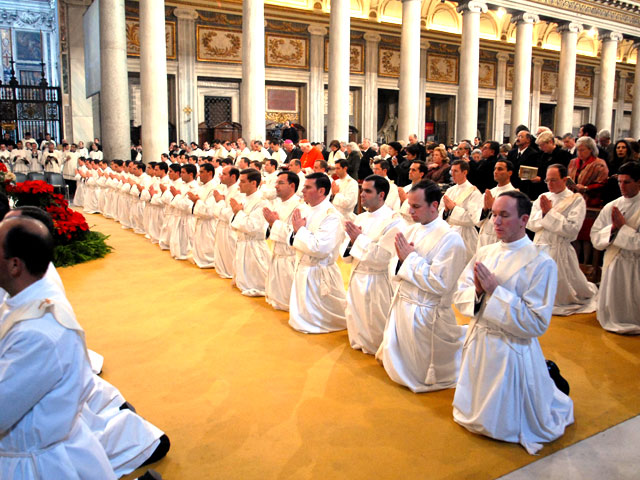
The political and social conventionalism of this writer who uses Paul’s name shows that he is no wholly entitled to do so. At his best, Paul clearly recognised that the shared life of the Christian community dissolved the social roles of his society: “there is neither Jew nor Gentile, slave nor free, male nor female, for all are one in Messiah Jesus.” Paul also saw the church as a new international society which would challenge the “ruling powers” of the Roman Empire. This writer simply accepts and justifies the social and political structures in which his church exists. There is some appeal in his programme-let’s just get on with quiet faith- unless of course you happened to be a woman or a slave. His interpretation of Genesis, which became standard at times in the church, is sheer prejudice masquerading as biblical truth. Genesis emphasises that both sexes are created in the image of God; and it presents Adam’s shoddy part in the tree of knowledge fiasco as just as sinful (if not as bold) as Eve’s. Most churches, but not the Catholic Church, have looked this passage in the eye, and said, “this is not the word of God, except as a warning of how mistaken Christians can be!” The boy’s own club of clergy which existed in my own church when I was ordained had the usual defects of male organisations: ritualism and childishness. It has been replaced, since the ordination of women, with a much more realistic and adult fellowship. Women like men are saved through God’s kindness in Jesus and not “through childbearing”. It would be good to by-pass such passages in silence, but we are asked to share in the Spirit’s spring-cleaning of the scriptures as we are able.

boy's own club 2
Mark 11:12-26
Jesus Curses the Fig Tree
12 On the following day, when they came from Bethany, he was hungry. 13Seeing in the distance a fig tree in leaf, he went to see whether perhaps he would find anything on it. When he came to it, he found nothing but leaves, for it was not the season for figs. 14He said to it, ‘May no one ever eat fruit from you again.’ And his disciples heard it.
15 Then they came to Jerusalem. And he entered the temple and began to drive out those who were selling and those who were buying in the temple, and he overturned the tables of the money-changers and the seats of those who sold doves; 16and he would not allow anyone to carry anything through the temple. 17He was teaching and saying, ‘Is it not written,
“My house shall be called a house of prayer for all the nations”?

no fruit
But you have made it a den of robbers.’
18And when the chief priests and the scribes heard it, they kept looking for a way to kill him; for they were afraid of him, because the whole crowd was spellbound by his teaching. 19And when evening came, Jesus and his disciples went out of the city.20 In the morning as they passed by, they saw the fig tree withered away to its roots. 21Then Peter remembered and said to him, ‘Rabbi, look! The fig tree that you cursed has withered.’ 22Jesus answered them, ‘Have faith in God. 23Truly I tell you, if you say to this mountain, “Be taken up and thrown into the sea”, and if you do not doubt in your heart, but believe that what you say will come to pass, it will be done for you. 24So I tell you, whatever you ask for in prayer, believe that you have received it, and it will be yours. 25 ‘Whenever you stand praying, forgive, if you have anything against anyone; so that your Father in heaven may also forgive you your trespasses.’
It seems to me that Mark wants his reader to see the cursing of the fig-tree (image of Israel) as related directly to Jesus’ actions in the Temple. His words emphasise that the time of the Gentiles, that is, the time of the Messiah, has come and the traders should no more usurp the court of the Gentiles as a shopping mall. Israel and its Temple have produced no fruit for their Lord and will therefore wither away. The mountain which can be thrown in the sea is Mount Zion. Jesus wants his people to move beyond the rituals and trappings of religion to genuine prayer in which forgiveness may be offered and received.
In a time of relative decline for mainstream churches, passages like this are important as there is always a danger of something smelly-a Toronto Blessing, say, or a Tridentine Mass for carefully selected recipients-usurping the place of genuine faith because they are good selling lines in the religious supermarket. Caveat emptor-let the buyer beware!
 Emmock's Blog