
This blog provides a meditation on the Episcopal daily readings along with a hadline from world news:
POP STARS “ EMBARRASSED” TO HAVE PERFORMED FOR GHADDAFI 
(but not enough to donate their fees to charity)
2 Corinthians 12:11-21
11 I have been a fool! You forced me to it. Indeed you should have been the ones commending me, for I am not at all inferior to these super-apostles, even though I am nothing. 12The signs of a true apostle were performed among you with utmost patience, signs and wonders and mighty works. 13How have you been worse off than the other churches, except that I myself did not burden you? Forgive me this wrong!
14 Here I am, ready to come to you this third time. And I will not be a burden, because I do not want what is yours but you; for children ought not to lay up for their parents, but parents for their children. 15I will most gladly spend and be spent for you. If I love you more, am I to be loved less? 16Let it be assumed that I did not burden you. Nevertheless (you say) since I was crafty, I took you in by deceit. 17Did I take advantage of you through any of those whom I sent to you? 18I urged Titus to go, and sent the brother with him. Titus did not take advantage of you, did he? Did we not conduct ourselves with the same spirit? Did we not take the same steps?
19 Have you been thinking all along that we have been defending ourselves before you? We are speaking in Christ before God. Everything we do, beloved, is for the sake of building you up. 20For I fear that when I come, I may find you not as I wish, and that you may find me not as you wish; I fear that there may perhaps be quarrelling, jealousy, anger, selfishness, slander, gossip, conceit, and disorder. 21I fear that when I come again, my God may humble me before you, and that I may have to mourn over many who previously sinned and have not repented of the impurity, sexual immorality, and licentiousness that they have practised.
Paul appeals to the Corinthians to remember his ministry amongst them and to acknowledge his standing as a true apostle. I pointed out in a previous blog how Paul’s apostolic status depended on his own witness and his missionary success because he was not of the “twelve” nor appointed by them. The Corinthians attack on his status was shrewd in that it attacked his weakest point. Paul’s main argument is to turn this round to his advantage: his weakness is the weakness of Christ; but in more ordinary terms he contends that he has done what an apostle should do-proclaimed the gospel, loved his converts, worked to build them up as a community.
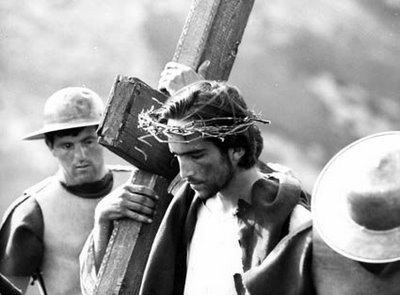
the weakness of Christ
He also issues a sober reminder that the issue between them is only secondarily his status. Their toleration of irregular sexual relationships is the primary issue. Or so he says, because it’s reasonably firm ground on which to take a stand. But as we can see if we review the whole Corinthian correspondence, the real issue was a more complex one about “knowledge” (which puffs up) as opposed to faith (which unites with the crucified Christ).
The outcome seems to have been that Paul won the battle-the Corinthians sought reconciliation with him-but he may have lost the war, as it was unlikely that his radical version of the gospel could long survive his own absence or indeed his death. The emerging Gentile church owed much to Paul’s ecumenical vision but its theology was not his. Nevertheless, whenever the church has engaged seriously with Paul’s gospel, it has revived and reformed its faith.
Luke 9:2-6
2and he sent them out to proclaim the kingdom of God and to heal. 3He said to them, ‘Take nothing for your journey, no staff, nor bag, nor bread, nor money—not even an extra tunic. 4Whatever house you enter, stay there, and leave from there. 5Wherever they do not welcome you, as you are leaving that town shake the dust off your feet as a testimony against them.’ 6They departed and went through the villages, bringing the good news and curing diseases everywhere.
I’ve selected this text from yesterday’s special readings for John and Charles Wesley, the founders of Methodism.
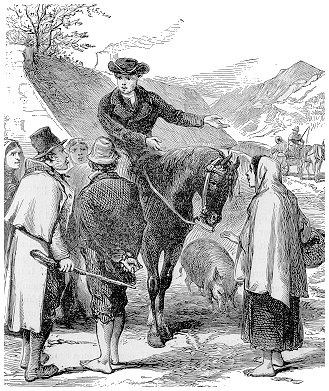
Wesley on tour
John especially covered the whole of England and Wales on horseback–and even ventured into Scotland- preaching a gospel of deliverance from sin and guilt which answered the needs of many people. The best story I know of the Wesleyan revival concerns the lay preacher who in front of John Wesley preached from the parable of the Talents in Luke on the words, “Lord I was afraid because I knew Thou wast an austere man.” Mistaking the word “austere” (which he didn’t know) for “oyster” (which he did) he spoke of how the oyster fisherman dives at great danger into the deep and returns to the surface bearing the object of his search in his cut and bleeding hands. He applied this image to Christ’s descent into the world to seek sinners. The impact of his sermon was such that twelve people were converted. When someone asked Wesley what he thought of the sermon, he laughed and said, “Never mind, he got twelve oysters for God tonight!”
Scholarship is not all-important in communicating the gospel.
Paul and the Wesleys preached for sincere conversion, a turning round of life. We may feel that the reported conversions of Mariah Carey and Beyonce to the cause of Libyan democracy fall short of this ideal. The repentance of the London School of Economics is even more forced. But nothing beats the bare-faced impertinence of USA and UK politicians who were Ghaddafi’s main supporters now denouncing him as if the record of their oily(!) posturing did not exist.
 Emmock's Blog