This blog provides a meditation on the Episcopal daily readings along with a headline from world news:
NUCLEAR PLANT STAFF READY FOR ULTIMATE SACRIFICE 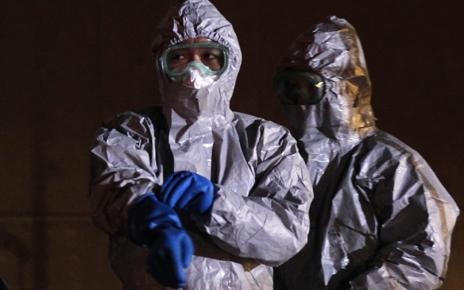
Hebrews 4:11-16
11Let us therefore make every effort to enter that rest, so that no one may fall through such disobedience as theirs.
12 Indeed, the word of God is living and active, sharper than any two-edged sword, piercing until it divides soul from spirit, joints from marrow; it is able to judge the thoughts and intentions of the heart. 13And before him no creature is hidden, but all are naked and laid bare to the eyes of the one to whom we must render an account.
14 Since, then, we have a great high priest who has passed through the heavens, Jesus, the Son of God, let us hold fast to our confession. 15For we do not have a high priest who is unable to sympathize with our weaknesses, but we have one who in every respect has been tested as we are, yet without sin. 16Let us therefore approach the throne of grace with boldness, so that we may receive mercy and find grace to help in time of need.
This is a brief blog today due to many other commitments.
- V. 11 continues the theme of God’s peace into which people may enter now, in the midst of life; and at the time of their deaths; and into which the whole of creation may enter as the purpose of its existence.
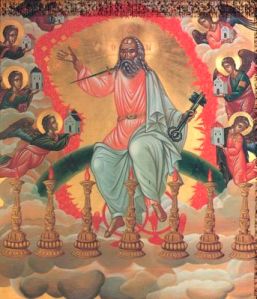
Orthodox icon of Jesus the Word
- The description of the word reminds the reader of the vision of Jesus in the first chapter of the book of the Revelation in which a sharp two-edged sword issues from his mouth. The word which Jesus speaks, the word which Jesus is, cuts through all deception and self-deception to reveal the truth. None of us wants this exposure but it is the pre- condition of our forgiveness. Politicians have lately adopted the word “transparency” as an ideal of public service. Our true transparency is not in our hands but in God’s from whom no creature is hidden.
- This exposure of truth pushes us to the “throne of grace” –the place where we receive the mercy of God through our high priest who understands hard testing because he has experienced it- without giving in to it. Even in forgiveness Jesus keeps an element of rigour. We may say that the staff at the doomed nuclear reactors in Japan are meeting hard testing with something of Jesus’ spirit.
John 3:22-36
Jesus and John the Baptist
22 After this Jesus and his disciples went into the Judean countryside, and he spent some time there with them and baptized. 23John also was baptizing at Aenon near Salim because water was abundant there; and people kept coming and were being baptized— 24John, of course, had not yet been thrown into prison.
25 Now a discussion about purification arose between John’s disciples and a Jew 26They came to John and said to him, ‘Rabbi, the one who was with you across the Jordan, to whom you testified, here he is baptizing, and all are going to him.’ 27John answered, ‘No one can receive anything except what has been given from heaven. 28You yourselves are my witnesses that I said, “I am not the Messiah, but I have been sent ahead of him.” 29He who has the bride is the bridegroom. The friend of the bridegroom, who stands and hears him, rejoices greatly at the bridegroom’s voice. For this reason my joy has been fulfilled. 30He must increase, but I must decrease.’
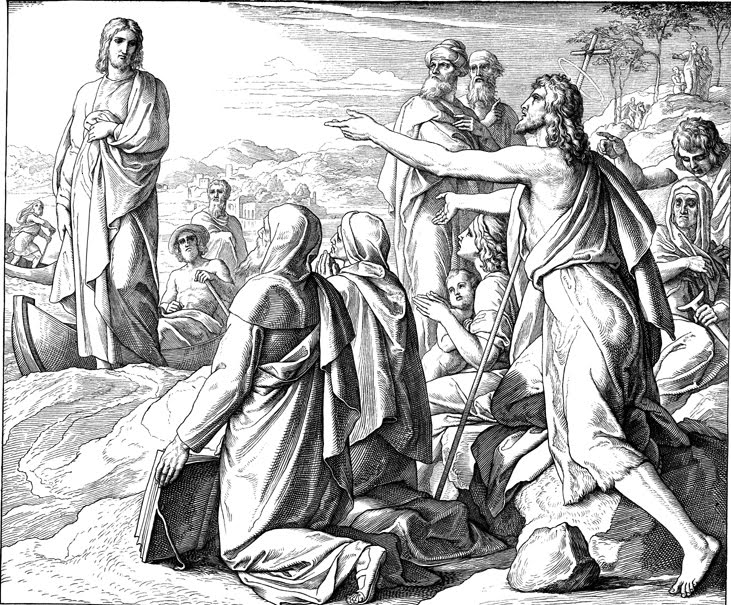
John the Baptist points to Jesus
31 The one who comes from above is above all; the one who is of the earth belongs to the earth and speaks about earthly things. The one who comes from heaven is above all. 32He testifies to what he has seen and heard, yet no one accepts his testimony. 33Whoever has accepted his testimony has certified this, that God is true. 34He whom God has sent speaks the words of God, for he gives the Spirit without measure. 35The Father loves the Son and has placed all things in his hands. 36Whoever believes in the Son has eternal life; whoever disobeys the Son will not see life, but must endure God’s wrath.
This passage reflects an ancient quarrel between the disciples of John the Baptist and the disciples of Jesus. All gospels are at pains to emphasise that John himself witnessed to Jesus’ superiority. Doubtless at the time of the first churches, some people still thought John was the greater. This gospel makes a distinction between the inspired but earthly messenger of God, and the heavenly Messiah and Son of God who comes “from God”. Only the one who comes from God brings the gift of eternal life. The gospels want to honour John but they insist that only Jesus bears the gift of God’s life for the world. In a multi-faith society Christian believers should give honour to other prophets and teachers where it is due, while insisting on the uniqueness of Jesus and the gift he brings.
 Emmock's Blog