
This blog provides a meditation on the Episcopal daily readings along with a headline from world news:
POLISH GIANT CHRIST STATUE SYMBOL OF POWER OR LOVE? 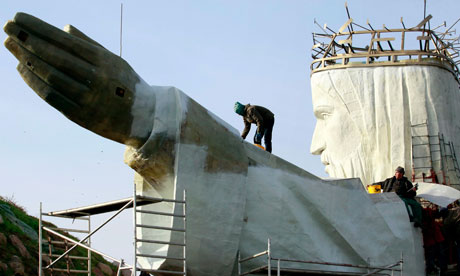
Jeremiah 18:1-11
18The word that came to Jeremiah from the Lord: 2‘Come, go down to the potter’s house, and there I will let you hear my words.’ 3So I went down to the potter’s house, and there he was working at his wheel. 4The vessel he was making of clay was spoiled in the potter’s hand, and he reworked it into another vessel, as seemed good to him.
5 Then the word of the Lord came to me: 6Can I not do with you, O house of Israel, just as this potter has done? says the Lord. Just like the clay in the potter’s hand, so are you in my hand, O house of Israel. 7At one moment I may declare concerning a nation or a kingdom, that I will pluck up and break down and destroy it, 8but if that nation, concerning which I have spoken, turns from its evil, I will change my mind about the disaster that I intended to bring on it. 9And at another moment I may declare concerning a nation or a kingdom that I will build and plant it, 10but if it does evil in my sight, not listening to my voice, then I will change my mind about the good that I had intended to do to it. 11Now, therefore, say to the people of Judah and the inhabitants of Jerusalem: Thus says the Lord: Look, I am a potter shaping evil against you and devising a plan against you. Turn now, all of you from your evil way, and amend your ways and your doings.
 Behind this vivid metaphor lies the foundational belief of Jeremiah’s theology: that Israel with be rewarded for faith and justice; and punished for idolatry and injustice. I do not believe this. Certainly there is boldness in the belief. Jeremiah had to see the imperialist thugs of Babylon as instruments of God’s righteous anger against Israel. But I do not believe this kind of thing either. In my own short lifetime I’ve seen pitiless tyrants live and die in comfort (Stalin, Mao), decent nations swallowed up by aggressive neighbours (Tibet) small nations persecuted by great ones (Czechoslovakia/ USSR; Cuba/ USA); and poor countries exploited by rich ones (everywhere). Jeremiah’s belief in divine justice exercised in this world just doesn’t seem to hold up. Not only so but even in the Bible itself a deeper theology is found in the Third Isaiah, who depicts the great nations saying of Israel, “she was bruised for our iniquities.” No longer is Israel punished by God for her own crimes but she takes upon herself the guilt of the nations. This is the theology which influenced Jesus. The picture of God as the celestial potter who fashions the fates of nations according to his will is beguiling, but (in my opinion) the truth is harder.
John 6:27-40
27Do not work for the food that perishes, but for the food that endures for eternal life, which the Son of Man will give you. For it is on him that God the Father has set his seal.’ 28Then they said to him, ‘What must we do to perform the works of God?’ 29Jesus answered them, ‘This is the work of God, that you believe in him whom he has sent.’ 30So they said to him, ‘What sign are you going to give us then, so that we may see it and believe you? What work are you performing? 31Our ancestors ate the manna in the wilderness; as it is written, “He gave them bread from heaven to eat.” ’ 32Then Jesus said to them, ‘Very truly, I tell you, it was not Moses who gave you the bread from heaven, but it is my Father who gives you the true bread from heaven. 33For the bread of God is that which comes down from heaven and gives life to the world.’ 34They said to him, ‘Sir, give us this bread always.’
35 Jesus said to them, ‘I am the bread of life. Whoever comes to me will never be hungry, and whoever believes in me will never be thirsty.

Van Gogh's Potato Eaters: the bread of life
Central to John’s gospel is trust in the life of God as a shared life. It is offered to humanity through Jesus and therefore involves Jesus in offering his own life on the cross. This life is Jesus himself, his ministry, his teaching, his death, his rising again. People cannot as it were appropriate God’s gift of life and by-pass Jesus in his awkward humanity: he is the bread of life of which the old story of the manna is a mere foretaste. God in Jesus accepts the iron logic of his own offer of life, that it can and will be rejected; and that this rejection will involve his own suffering. That is why the bread of life is also the bread of “holy communion”-the sharing of Jesus’ death.
The triumph of John’s gospel is its grasp of this great theology which presents the unsuccessful ministry and unfortunate death of a Galilean Rabbi as the cosmic drama of God’s very life offered to humanity.
At the same time the ordinariness of the gift should be noted: Jesus is the bread of life, not the pate de foie gras; he is the water of life not the champagne. As Paul says, it’s “the life I now live” which is lived by faith in the son of God. Here and now, Jesus is the bread of life; here and now we share the life of God. Enjoyment of this supreme gift demands a daily discipline of faith which appreciates every detail of the sharing.
 Emmock's Blog
I have to laugh at your audacity sometimes Mike. It is refreshing.
So, you don’t believe what Jeremiah believed? I would admit, with you, that we do not see these things happening the way he figured they did back then. But I still think he was right. My understanding is that with the coming of the Spirit we have seen a watershed in history, where God works much differently today than he did then. Today he works in and through weakness and suffering; that was not the case then.
So I am able to ‘believe’ what Jeremiah believed, but understand that a different paradigm is being used by God today. What do you think?
I must admit that as I wrote about Jeremiah, I thought,”Jeff’s not going to agree with this!”
Of course, we don’t really know how God acts, we only know how people of faith bear witness to his acts. And Jeremiah’s witness is surely better than mine? Still, there’s not a lot of time between Jeremiah and Isaiah 39-55, only the experience of exile in Babylon, and that has pushed a new prophet to look more deeply at what it means to be God’s Servant, and to understand that the suffering of the righteous may be God-given and redemptive. That’s enough to destroy the equation of righteousness=material blessing and independence; sin= poverty and defeat. So I would see Jeremiah as making a vital contribution to the developing understanding of God’s justice. Against people who thought God didn’t care, he insisted that God demanded faithfulness of worship and obedience to commandments. But he did so at the cost of his own welfare and perhaps ultimately of his life, so that he may have been one of models Isaiah used to build an image of the suffering servant of God. Although the classical (American) doctrine of progressive revelation is flawed, I think a modified version of it is necessary for understanding scripture.
I am still holding to my view, but I will agree that a modified version of progressive revelation is needed. Plus, I’ll admit that my own understanding of some of this stuff is sometimes pretty basic and ‘on the surface.’
No matter. Reading you, I am getting progressively more enlightened.