
This blog provides a meditation on the Episcopal daily readings along with a headline from world news:
GBAGBO A FINE CHRISTIAN MAN SAY USA CHRISTIAN RIGHT

Cote D'Ivoire
Jeremiah 23:1-8
23Woe to the shepherds who destroy and scatter the sheep of my pasture! says the Lord. 2Therefore, thus says the Lord, the God of Israel, concerning the shepherds who shepherd my people: It is you who have scattered my flock, and have driven them away, and you have not attended to them. So I will attend to you for your evil doings, says the Lord. 3Then I myself will gather the remnant of my flock out of all the lands where I have driven them, and I will bring them back to their fold, and they shall be fruitful and multiply. 4I will raise up shepherds over them who will shepherd them, and they shall not fear any longer, or be dismayed, nor shall any be missing, says the Lord. The Righteous Branch of David
5 The days are surely coming, says the Lord, when I will raise up for David a righteous Branch, and he shall reign as king and deal wisely, and shall execute justice and righteousness in the land. 6In his days Judah will be saved and Israel will live in safety. And this is the name by which he will be called: ‘The Lord is our righteousness.’
This must qualify as a messianic prophecy: a successor of King David will bring righteousness and justice to the people and will rule them in peace. His work however follows on the Lord’s own work, rejecting the false shepherds (kings) and personally shepherding his flock back from exile. It is especially this personal ministry the Lord which Jesus takes as a model, when he says, “I am the good shepherd.” Because Christian believers have declared Jesus as Messiah, thus denying the political dimensions of Messianic prophecy, they have also postponed the fulfilment of the dream of complete justice on the earth to a time beyond time, the Kingdom of God. Certainly this has protected the church from anointing any particular politics as messianic; and from the worst excesses of Zionism; but it has also left a space in which different theologians, Augustine, Aquinus, Calvin, Barth, Gutierrez, have argued the relationship between the City of God and the Earthly City. Their work has been beneficial to the church’s social and political concerns. Jeremiah would encourage us to hope that any good ruler could be called, “The Lord is our righteousness”, that is, that he/she/they would openly avow a source of justice beyond their own interest. I doubt if that’s what been avowed by Christian leader Laurent Gbagbo in Cote D’Ivoire. Indeed he may be one of the shepherds of whom the Lord says, “It is you who have scattered my flock.”
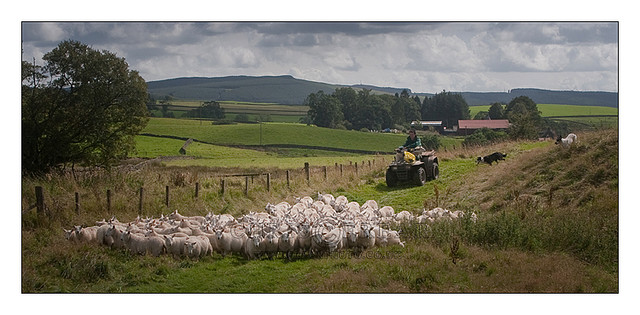
Gathering the flock
John 6:52-5952 The Jews then disputed among themselves, saying, ‘How can this man give us his flesh to eat?’ 53So Jesus said to them, ‘Very truly, I tell you, unless you eat the flesh of the Son of Man and drink his blood, you have no life in you. 54Those who eat my flesh and drink my blood have eternal life, and I will raise them up on the last day; 55for my flesh is true food and my blood is true drink. 56Those who eat my flesh and drink my blood abide in me, and I in them. 57Just as the living Father sent me, and I live because of the Father, so whoever eats me will live because of me. 58This is the bread that came down from heaven, not like that which your ancestors ate, and they died. But the one who eats this bread will live for ever.’ 59He said these things while he was teaching in the synagogue at Capernaum.
It’s important to state that “eating the flesh and drinking the blood of Jesus” is not simply the ritual of Holy Communion. It is to feed on the humanity of Jesus, his words and deeds, his nature and his suffering. I don’t mean to diminish the sacrament but simply to insist that it doesn’t work by itself and only conveys the real presence of Christ to those who are committed to his humanity. Again John’s report of Jesus’ words emphasises the true meaning of communion as shared life. When we are willing that Christ should share our lives, he allows us to share his. This abiding, this “living in the same house as God” is at once mystical and intensely practical: living in the one house requires the mutual concern of all residents. This shared life cannot be destroyed, John tells us, because it is God’s life, which does not “end at his skin” like biological life, but is open in love to all creatures. Those who “feed” on Jesus will share this life.
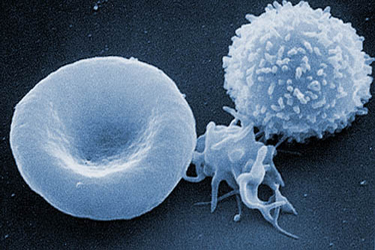
biological life: a white blood cell
Jesus would have agreed with Richard Dawkins that biological life with its material nourishment is limited by death; and that even the “selfish gene” may die as a species becomes extinct. But he would have insisted that human life is not bound to this closure but can be open, in human trust, love, goodness and self-sacrifice, to the eternal life of the Creator.
 Emmock's Blog