This blog provides a meditation on the daily readings of the Episcopal Church along with a headline from world news:
REFUGEE BOAT CAPSIZES OFF LAMPEDUSA
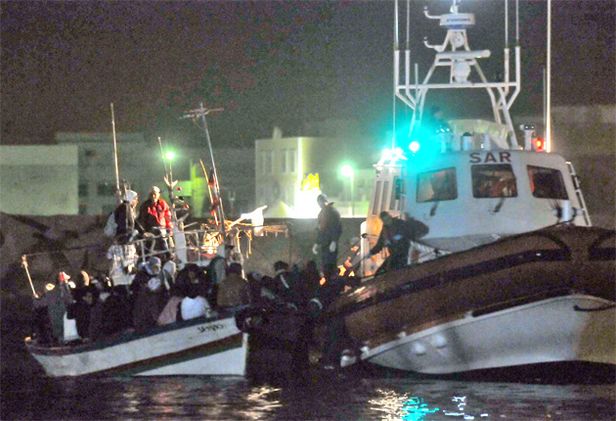
refugee vessel turned back
Jeremiah 25:32-38
32 Thus says the Lord of hosts:
See, disaster is spreading
from nation to nation,
and a great tempest is stirring
from the farthest parts of the earth!
33 Those slain by the Lord on that day shall extend from one end of the earth to the other. They shall not be lamented, or gathered, or buried; they shall become dung on the surface of the ground.
34 Wail, you shepherds, and cry out;
roll in ashes, you lords of the flock,
for the days of your slaughter have come—and your dispersions,
and you shall fall like a choice vessel.
35 Flight shall fail the shepherds,
and there shall be no escape for the lords of the flock.
36 Hark! the cry of the shepherds,
and the wail of the lords of the flock!
For the Lord is despoiling their pasture,
37 and the peaceful folds are devastated,
because of the fierce anger of the Lord.
38 Like a lion he has left his covert;
for their land has become a waste
because of the cruel sword,
and because of his fierce anger.
Jeremiah is threatening the Lord’s destruction on those who believed that the Lord would protect his own people from disaster. His prophecy is directed against power and complacency, that is, against China or the USA rather than Haiti or Cuba. I’ve noted before that if believers are to attribute “love” to God, then “anger” is a possibility also. Can there be love without anger? Jeremiah thought that the Lord’s anger spilled over into violent punishment. In Christ, I do not think so, even if there are utterances of Christ which might support the notion of a punishing God.
are there human emotions on the face of God?
My interpretation is that the love of God does not permit him to overrule the decisions of human beings by force majeur; which means that human beings are left with the consequences of their evil in time and eternity unless they turn to God. This is not a more comforting doctrine than Jeremiah’s.
John 10:1-18
10‘Very truly, I tell you, anyone who does not enter the sheepfold by the gate but climbs in by another way is a thief and a bandit. 2The one who enters by the gate is the shepherd of the sheep. 3The gatekeeper opens the gate for him, and the sheep hear his voice. He calls his own sheep by name and leads them out. 4When he has brought out all his own, he goes ahead of them, and the sheep follow him because they know his voice. 5They will not follow a stranger, but they will run from him because they do not know the voice of strangers.’ 6Jesus used this figure of speech with them, but they did not understand what he was saying to them.
7 So again Jesus said to them, ‘Very truly, I tell you, I am the gate for the sheep. 8All who came before me are thieves and bandits; but the sheep did not listen to them. 9I am the gate. Whoever enters by me will be saved, and will come in and go out and find pasture. 10The thief comes only to steal and kill and destroy. I came that they may have life, and have it abundantly.
11 ‘I am the good shepherd. The good shepherd lays down his life for the sheep. 12The hired hand, who is not the shepherd and does not own the sheep, sees the wolf coming and leaves the sheep and runs away—and the wolf snatches them and scatters them. 13The hired hand runs away because a hired hand does not care for the sheep. 14I am the good shepherd. I know my own and my own know me, 15just as the Father knows me and I know the Father. And I lay down my life for the sheep. 16I have other sheep that do not belong to this fold. I must bring them also, and they will listen to my voice. So there will be one flock, one shepherd. 17For this reason the Father loves me, because I lay down my life in order to take it up again. 18No one takes it from me, but I lay it down of my own accord. I have power to lay it down, and I have power to take it up again. I have received this command from my Father.’
Jesus uses two metaphors here: he is the good shepherd and the gate of the sheepfold. I’ve been thinking of refugees this week, the poor souls from Africa drowned off Lampedusa in an overcrowded boat and the millions of others trying to find asylum in a violent and uncaring world. For them, the gate is often shut. They have no passports or visas or any rights other than their naked humanity.
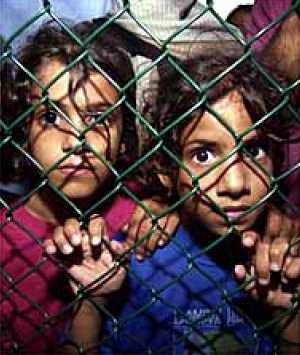
Jesus is the gate
Jesus is the gate. He keeps only violent persons out of the fold; for the rest, he is the way in. Of course, John means the words to refer to the “community of Christ” but as the passage tells us, there is only one flock. Those who follow Jesus Christ must in his name become a gate rather wall for their needy brothers and sisters. Immigration is a contentious issue and the Christian Church in all developed countries be arguing for the most generous policy possible.
The picture of the shepherd is usually interpreted in a sentimental way. We should remember that “shepherd” is the bible code- word for ruler. In God’s kingdom, the good ruler cares for the people, defending them from harm even at the cost of his/her own life, which is never taken by the enemy but laid down in fierce love. Those in the kingdom are reminded that they are not the only citizens-there are others who will be admitted to make one kingdom for all. Again we should note that although the primary reference may be to the “community of Christ” it is as much a political as a spiritual entity in the thought of the New Testament. Sure, it is not one of the “nations ruled by the powers-that-be” but it is an earthly colony of heaven for all that. The neat Lutheran distinction of the “two kingdoms” is a cop-out of the church’s responsibility to offer a real alternative to the way of the world. When Jesus tells Pilate that his kingdom is “not OF this world” he doesn’t mean it’s not IN the world, but rather that its ORIGIN is God.
The political dimension of John’s gospel is not often enough explored.
 Emmock's Blog