
This blog provides a meditation on the Episcopal daily readings along with a headline from world news:
Buddhist monks refuse “re-education” by China 
Jeremiah 31:31-34
31 The days are surely coming, says the Lord, when I will make a new covenant with the house of Israel and the house of Judah. 32It will not be like the covenant that I made with their ancestors when I took them by the hand to bring them out of the land of Egypt—a covenant that they broke, though I was their husband, says the Lord. 33But this is the covenant that I will make with the house of Israel after those days, says the Lord: I will put my law within them, and I will write it on their hearts; and I will be their God, and they shall be my people. 34No longer shall they teach one another, or say to each other, ‘Know the Lord’, for they shall all know me, from the least of them to the greatest, says the Lord; for I will forgive their iniquity, and remember their sin no more.

I will write my Law upon their heart
John 12:44-50
44 Then Jesus cried aloud: ‘Whoever believes in me believes not in me but in him who sent me. 45And whoever sees me sees him who sent me. 46I have come as light into the world, so that everyone who believes in me should not remain in the darkness. 47I do not judge anyone who hears my words and does not keep them, for I came not to judge the world, but to save the world. 48The one who rejects me and does not receive my word has a judge; on the last day the word that I have spoken will serve as judge, 49for I have not spoken on my own, but the Father who sent me has himself given me a commandment about what to say and what to speak. 50And I know that his commandment is eternal life. What I speak, therefore, I speak just as the Father has told me.’
A personal relationship with God is at the heart of both of these passages: in Jeremiah’s case, the Torah takes up its dwelling in the heart; in John’s case, a believing relationship to Jesus is a also relationship with the Father. Fundamental Christianity used to make the relationship of faith the basis of religion. Now, sadly, fundamental teaching makes a believing relationship with the Bible the basis. This strategy is probably idolatrous-it bows down to something other than God-and it falls under the devastating criticism once offered of Scottish Presbyterianism by the writer Edwin Muir, “The Word-made-flesh made word again.”
Of course there are dangers in the “personal relationship” model of faith: of sentimental chumminess; of theological incoherence; of over-simplification; of indefiniteness. These must be resisted. But the knowledge of God in the heart is a precious gift and a marvellous persuasion against dogmatic frigidity. I’ve been re-reading Tennyson’s in Memoriam in which the heart’s knowledge is the saving thing:
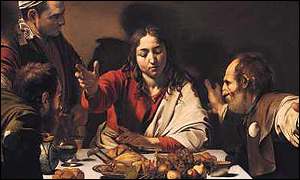
Their hearts tell them it is Jesus, risen from death
“If e’er when faith had fall’n asleep
I heard a voice, Believe no more,
And heard an ever-breaking shore
That tumbled in the godless deep
A warmth about the heart would melt
The freezing reason’s colder part;
And like a man in wrath the heart
Rose up and answered, I have felt.”
Yes, there are dangers here, but also great strength, such as is being shown by the Buddhist monks against Chinese denial of their faith.
 Emmock's Blog