
This blog provides a meditation on the Episcopal daily readings along with a headline from world news: 
“I believe Allah made me as I am and I refuse to believe Allah makes mistakes” Lesbian dissident in Syria.
1 John 3:1-10
31See what love the Father has given us, that we should be called children of God; and that is what we are. The reason the world does not know us is that it did not know him. 2Beloved, we are God’s children now; what we will be has not yet been revealed. What we do know is this: when he is revealed, we will be like him, for we will see him as he is. 3And all who have this hope in him purify themselves, just as he is pure.
4 Everyone who commits sin is guilty of lawlessness; sin is lawlessness. 5You know that he was revealed to take away sins, and in him there is no sin. 6No one who abides in him sins; no one who sins has either seen him or known him. 7Little children, let no one deceive you. Everyone who does what is right is righteous, just as he is righteous. 8Everyone who commits sin is a child of the devil; for the devil has been sinning from the beginning. The Son of God was revealed for this purpose, to destroy the works of the devil. 9Those who have been born of God do not sin, because God’s seed abides in them; they cannot sin, because they have been born of God. 10The children of God and the children of the devil are revealed in this way: all who do not do what is right are not from God, nor are those who do not love their brothers and sisters.

purified in baptism
This passage is focused on purity, which was originally a ritual concept (those who deal with holy things must be holy) but in the Jewish tradition it always had moral force as well. This writer argues that if we are children of God like Jesus and hope to be like him in the “day of revelation” then we must begin our purification in this life. Perhaps faced with some kind of religious enthusiasm which proclaimed that sins didn’t matter if we belong to Jesus, he insists that Jesus came to destroy sin and evil. He goes so far as to say that those “who are born of God” can’t sin. This contradicts his own teaching that “if we say we have no sin we are liars and strangers to the truth, but if we confess our sin he is just to forgive our sin and cleanse from all unrighteousness” (I John1). Some have argued that the John community believed in the forgiveness of sin prior to conversion but not after it. That seems an almost impossible doctrine to hold. The writer’s real intention may be found in the teaching, “No one who abides in him sins” which may suggest that those who sin have to step out of the life they share with Christ in order to sin. That teaching would be theologically and psychologically perceptive.
Luke 3:15-22
15 As the people were filled with expectation, and all were questioning in their hearts concerning John, whether he might be the Messiah,16John answered all of them by saying, ‘I baptize you with water; but one who is more powerful than I is coming; I am not worthy to untie the thong of his sandals. He will baptize you with the Holy Spirit and fire. 17His winnowing-fork is in his hand, to clear his threshing-floor and to gather the wheat into his granary; but the chaff he will burn with unquenchable fire.’
18 So, with many other exhortations, he proclaimed the good news to the people. 19But Herod the ruler, who had been rebuked by him because of Herodias, his brother’s wife, and because of all the evil things that Herod had done, 20added to them all by shutting up John in prison.
21 Now when all the people were baptized, and when Jesus also had been baptized and was praying, the heaven was opened, 22and the Holy Spirit descended upon him in bodily form like a dove. And a voice came from heaven, ‘You are my Son, the Beloved; with you I am well pleased.’
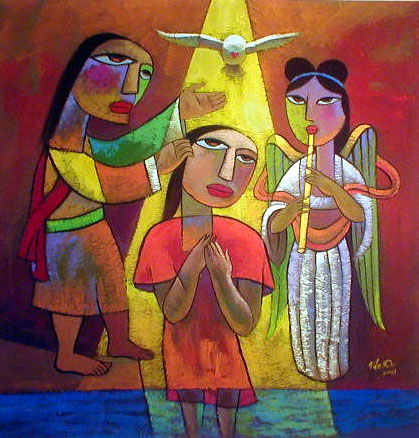
baptism of the beloved son
John the Baptist is depicted by Luke as the prophet of the coming Messiah who demands that the people purify themselves in justice. Jesus is depicted as the beloved son of God in the grace of the Spirit. In Luke’s gospel however, those who are gathered as the community of God’s Son, are stranger than the “sinless” of the community addressed in the letter of John, including a variety of social outcasts, who nevertheless in Jesus experience God’s delight: “with you I am well pleased.” Jesus is the blessed one who transfers blessings to others. Henri Nouwen amongst others has explored what it is to live as God’s Beloved. (Henri Nouwen: “The Life of the Beloved-Spiritual living in a secular world”). I’m not sure about his approach; I am sure that this is a great and neglected theme in Christian thinking.
 Emmock's Blog