
This blog provides a meditation on the Episcopal daily readings along with a headline from world news:
CHURCHES BURNED IN CAIRO

persecution of a minority
I John 3.19-4.6
19And by this we will know that we are from the truth and will reassure our hearts before him 20whenever our hearts condemn us; for God is greater than our hearts, and he knows everything. 21Beloved, if our hearts do not condemn us, we have boldness before God; 22and we receive from him whatever we ask, because we obey his commandments and do what pleases him. 23 And this is his commandment, that we should believe in the name of his Son Jesus Christ and love one another, just as he has commanded us. 24All who obey his commandments abide in him, and he abides in them. And by this we know that he abides in us, by the Spirit that he has given us.
4Beloved, do not believe every spirit, but test the spirits to see whether they are from God; for many false prophets have gone out into the world. 2By this you know the Spirit of God: every spirit that confesses that Jesus Christ has come in the flesh is from God, 3and every spirit that does not confess Jesus is not from God. And this is the spirit of the antichrist, of which you have heard that it is coming; and now it is already in the world. 4Little children, you are from God, and have conquered them; for the one who is in you is greater than the one who is in the world. 5They are from the world; therefore what they say is from the world, and the world listens to them. 6We are from God. Whoever knows God listens to us, and whoever is not from God does not listen to us. From this we know the spirit of truth and the spirit of error.
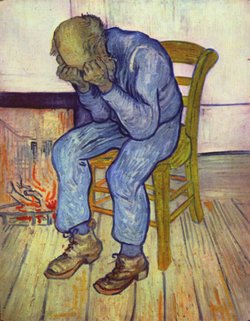
when our heart condemns us
A great truth in this passage is that when our hearts condemn us, God is greater than our hearts. It’s not that God may overlook wrongdoing but rather that he knows more about sinners than they do themselves. “Who made the heart, ’tis He alone/ decidedly can try us./ he knows each chord its various tone/ each spring its various bias” (Robert Burns) or even better, these words found in the margin of a 14th century English MS: “He abideth patiently; he forgiveth easily; he understandeth mercifully; he forgetteth utterly.”
The other great utterance in this passage is “every spirit that confesses that Jesus Christ has come in the flesh is from God.” Most truly evil heresies spring from moving away from the actual Jesus, incarnate, crucified and risen, to some IDEA about Jesus, God, religion or morals, which usurps his place. The IDEAS of Nazi Christianity or Apartheid Christianity or pan-Slavic Christianity or Opus Dei Christianity or Leafy-suburb-comfy Christianity or even Fundamentalist USA Obama-hating, burger –sizzling, red-necked Christianity, share one thing: an ability to give the body-swerve to the Jesus of the Gospels. If people stick with the Christ who came in the flesh they won’t go too far wrong.
Luke 4:14-30
14 Then Jesus, filled with the power of the Spirit, returned to Galilee, and a report about him spread through all the surrounding country. 15He began to teach in their synagogues and was praised by everyone.
16 When he came to Nazareth, where he had been brought up, he went to the synagogue on the sabbath day, as was his custom. He stood up to read, 17and the scroll of the prophet Isaiah was given to him. He unrolled the scroll and found the place where it was written:
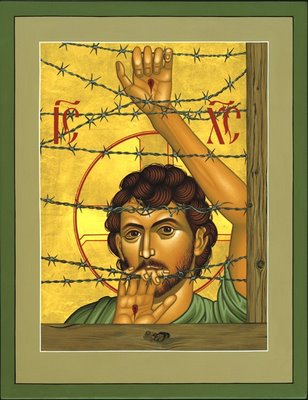
to let the oppressed go free
18 ‘The Spirit of the Lord is upon me,
because he has anointed me
to bring good news to the poor.
He has sent me to proclaim release to the captives
and recovery of sight to the blind,
to let the oppressed go free,
19 to proclaim the year of the Lord’s favour.’
20And he rolled up the scroll, gave it back to the attendant, and sat down. The eyes of all in the synagogue were fixed on him. 21Then he began to say to them, ‘Today this scripture has been fulfilled in your hearing.’ 22All spoke well of him and were amazed at the gracious words that came from his mouth. They said, ‘Is not this Joseph’s son?’ 23He said to them, ‘Doubtless you will quote to me this proverb, “Doctor, cure yourself!” And you will say, “Do here also in your home town the things that we have heard you did at Capernaum.” ’ 24And he said, ‘Truly I tell you, no prophet is accepted in the prophet’s home town. 25But the truth is, there were many widows in Israel in the time of Elijah, when the heaven was shut up for three years and six months, and there was a severe famine over all the land; 26yet Elijah was sent to none of them except to a widow at Zarephath in Sidon. 27There were also many lepers in Israel in the time of the prophet Elisha, and none of them was cleansed except Naaman the Syrian.’ 28When they heard this, all in the synagogue were filled with rage. 29They got up, drove him out of the town, and led him to the brow of the hill on which their town was built, so that they might hurl him off the cliff. 30But he passed through the midst of them and went on his way.
This is a tricky story. The reader should ask at what point and for what reason his fellow Nazarenes turn against Jesus. It’s not clear how we get from “all spoke well…” to Jesus’ offensive reply. The author suggests that they show unbelief by demanding that Jesus should perform miracles in their midst, but he doesn’t make this evident. The narrative in Mark which Luke has used makes it clear that the point of disbelief is that villagers think they know Jesus and his origins and are unwilling to accord him greater importance than themselves: they are “scandalized” by him. Luke on the other hand, thinks that the villagers are typical of Jewish unbelief in that they want the Messiah to do things for them (as he’s meant to) whereas Jesus speaks of a prophetic mission to outsiders. This mission has been characterised in the (inaccurate) quotation from Isaiah chapter 60, which names the poor, the prisoners and the blind as the recipients of the good news and reactivates the expectation of God’s Jubilee Year, (the year of the Lord’s favour) which means restoration of land, cancellation of debt, freeing of slaves. The language of debt cancellation is so deeply embedded in the Jesus tradition that we may think it comes from Jesus himself, in which case he must have spent time with the Jubilee rules in Leviticus chapter 25, which are the most radical provisions of the Bible for social justice. Precisely what Jesus meant by “cancellation of debts” is unknown but certainly we should not limit it to moral debts as the Christian tradition has been all too ready to do. Luke himself provided a picture of debt cancellation in action in his portraits of the first Christian community in Jerusalem (Acts 2.42; 4.32) which show Jesus’ mission fulfilled in his followers. Christian mission is for bidden or barely tolerated in many Moslem societies today. It would be a betrayal of its democratic revolution if Egypt adds its name to the list.
 Emmock's Blog