This blog provides a meditation on the Episcopal daily readings along with a headline from world news:
Queen fosters reconciliation of Britain and Ireland 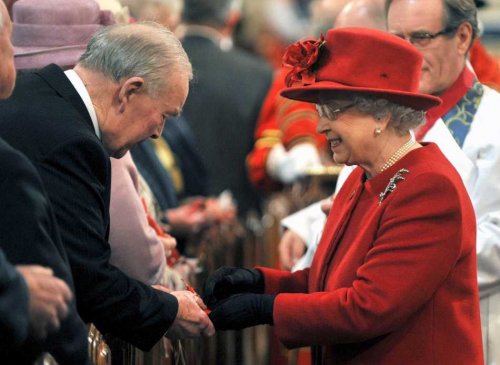
Colossians 2:8-23
8 See to it that no one takes you captive through philosophy and empty deceit, according to human tradition, according to the elemental spirits of the universe, and not according to Christ. 9For in him the whole fullness of deity dwells bodily, 10and you have come to fullness in him, who is the head of every ruler and authority. 11In him also you were circumcised with a spiritual circumcision, by putting off the body of the flesh in the circumcision of Christ; 12when you were buried with him in baptism, you were also raised with him through faith in the power of God, who raised him from the dead. 13And when you were dead in trespasses and the uncircumcision of your flesh, God made you alive together with him, when he forgave us all our trespasses, 14erasing the record of debt that stood against us with its legal demands. He set this aside, nailing it to the cross. 15He disarmed the rulers and authorities and made a public example of them, triumphing over them in it.
16 Therefore do not let anyone condemn you in matters of food and drink or of observing festivals, new moons, or sabbaths. 17These are only a shadow of what is to come, but the substance belongs to Christ. 18Do not let anyone disqualify you, insisting on self-abasement and worship of angels, dwelling on visions puffed up without cause by a human way of thinking, 19and not holding fast to the head, from whom the whole body, nourished and held together by its ligaments and sinews, grows with a growth that is from God.
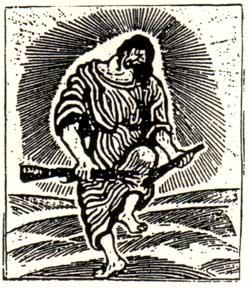
The disarming Christ
The figurative language here is very powerful and can be interpreted in a number of ways. The whole passage warns against “religious practices” that is, against what we might today describe as “spirituality”. These are human, all too human, in that they lead the believer into substitutes for God. All “worldly human” aspects of the self, including such religious aspects, have been removed and consigned to “death” in baptism; and the believer has been raised up with Christ into a new life.
“Forgiving trespasses”, “erasing the record of debt”, “disarming the rulers and authorities”, are all descriptions of what God has done in the life and death of Christ. In Christ’s self-giving God makes real his forgiving love, rejects the role of creditor and thereby takes away the legitimacy of all other powers who adopt that role. The violence of the imagery mimes the forcefulness of God’s rejection of his power as creditor: he nails it to the cross.
This is an extraordinary wholesale rubbishing of all religion based on guilt and moral blackmail along with all marketable forms of self-justification; and of all cultural and political tyrannies that claim the right to crucify. The structure of society and indeed of the cosmos is being rethought from the perspective of the cross. This letter may or may not come from Paul’s hand, but it’s a mighty piece of theology.
Luke 6:39-49
39 He also told them a parable: ‘Can a blind person guide a blind person? Will not both fall into a pit? 40A disciple is not above the teacher, but everyone who is fully qualified will be like the teacher. 41Why do you see the speck in your neighbour’s eye, but do not notice the log in your own eye? 42Or how can you say to your neighbour, “Friend, let me take out the speck in your eye”, when you yourself do not see the log in your own eye? You hypocrite, first take the log out of your own eye, and then you will see clearly to take the speck out of your neighbour’s eye. 
43 ‘No good tree bears bad fruit, nor again does a bad tree bear good fruit; 44for each tree is known by its own fruit. Figs are not gathered from thorns, nor are grapes picked from a bramble bush. 45The good person out of the good treasure of the heart produces good, and the evil person out of evil treasure produces evil; for it is out of the abundance of the heart that the mouth speaks.
46 ‘Why do you call me “Lord, Lord”, and do not do what I tell you? 47I will show you what someone is like who comes to me, hears my words, and acts on them. 48That one is like a man building a house, who dug deeply and laid the foundation on rock; when a flood arose, the river burst against that house but could not shake it, because it had been well built. 49But the one who hears and does not act is like a man who built a house on the ground without a foundation. When the river burst against it, immediately it fell, and great was the ruin of that house.’
Jesus’ teaching here is about integrity. Standing in judgement on others while ignoring our own faults is hypocrisy, the opposite of integrity. Good deeds are not accidental; they come from good people as evidence of integrity. Even enthusiastic religious faith (Lord, Lord!) without this integrity is doomed. It’s like building a house without a foundation. (-notice that Luke doesn’t commit Matthew’s howler of thinking you can’t build on sand. Think of the pyramids-)
As always, Jesus’ words examine me. Yes, I’m quite good at spotting the faults of others; can I see my own? Yes, I do wrong, so what does that say about my heart? Yes, I’ve been building my faith for many years, but have I spent all this time on a superstructure which is not grounded in obedience? Jesus is not trying to bring me down. He’s roughing me up, shaking me out of complacency and keeping me on the road with him.
 Emmock's Blog