
This blog provides a meditation on the Episcopal daily readings along with a headline from world news:
CAMERON RESISTS DEMANDS TO CUT UK AID BUDGET 
James 1:19-27.
19 You must understand this, my beloved: let everyone be quick to listen, slow to speak, slow to anger; 20for your anger does not produce God’s righteousness. 21Therefore rid yourselves of all sordidness and rank growth of wickedness, and welcome with meekness the implanted word that has the power to save your souls.
22 But be doers of the word, and not merely hearers who deceive themselves. 23For if any are hearers of the word and not doers, they are like those who look at themselves in a mirror; 24for they look at themselves and, on going away, immediately forget what they were like. 25But those who look into the perfect law, the law of liberty, and persevere, being not hearers who forget but doers who act—they will be blessed in their doing.
26 If any think they are religious, and do not bridle their tongues but deceive their hearts, their religion is worthless. 27Religion that is pure and undefiled before God, the Father, is this: to care for orphans and widows in their distress, and to keep oneself unstained by the world.

Kathe Kollwitz: widows and orphans
Anxiety over my appearance has been with me from teenage years and makes me take a careful look in the mirror before I leave the house. I’m critical enough not to forget easily what I see there. Hearers of the word, James says, take a look at themselves in the truthful mirror of God’s law and soon forget what they’ve seen. But those who also “do” the word see the truth about their lives and are changed by their obedience. One sign of such obedience is a well-bridled tongue, just as one sign of disobedience is a loose tongue. He’s hard to ignore, this man James, because he’s so specific. Luther, a loose-and-golden-tongued man, called this an “epistle of straw” possibly because it reminded him of his faults.
Nor would James’ definition of true religion have met the great reformer’s approval as it prioritises reserve towards worldly concerns and a commitment to the least important and neediest of people. Nobody should take James’ definition as the whole truth, but any sort of religion that doesn’t include these elements is probably unbalanced. David Cameron, the UK Prime Minister is not my favourite politician but he deserves commendation for refusing to reduce the UK Overseas Aid in the face of criticism from the gutter press.
Luke 11:1-13
The Lord’s Prayer
11He was praying in a certain place, and after he had finished, one of his disciples said to him, ‘Lord, teach us to pray, as John taught his disciples.’ 2He said to them, ‘When you pray, say:
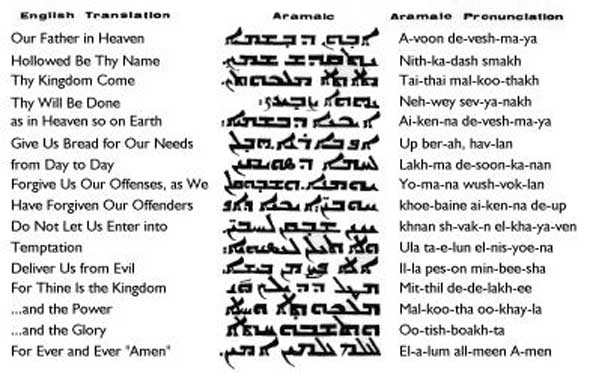
The prayer in Jesus language, Aramaic. Click to enlarge
Father, hallowed be your name.
Your kingdom come.
3 Give us each day our daily bread.
4 And forgive us our sins,
for we ourselves forgive everyone indebted to us.
And do not bring us to the time of trial.’
5 And he said to them, ‘Suppose one of you has a friend, and you go to him at midnight and say to him, “Friend, lend me three loaves of bread; 6for a friend of mine has arrived, and I have nothing to set before him.” 7And he answers from within, “Do not bother me; the door has already been locked, and my children are with me in bed; I cannot get up and give you anything.” 8I tell you, even though he will not get up and give him anything because he is his friend, at least because of his persistence he will get up and give him whatever he needs.
9 ‘So I say to you, Ask, and it will be given to you; search, and you will find; knock, and the door will be opened for you. 10For everyone who asks receives, and everyone who searches finds, and for everyone who knocks, the door will be opened. 11Is there anyone among you who, if your child asks for a fish, will give a snake instead of a fish? 12Or if the child asks for an egg, will give a scorpion? 13If you then, who are evil, know how to give good gifts to your children, how much more will the heavenly Father give the Holy Spirit to those who ask him!’
The Lord’s Prayer is a precious gift to humanity. The human being approaches God as Father and prays for two things that are the concern of God: that God’s character (name) should be honoured (in the world) and that God’s rule should be exercised (in the world). The meaning of the honouring of the name and the exercise of God’s rule are then spelt out in the next two petitions: that food (and all God’s provisions) will be shared so that all have enough; and that God’s overwhelming generosity in forgiving sins will be matched by peoples’ generosity towards each other.
The answer to the prayer is the gift of the Holy Spirit by which the petitioners are made children of God like Jesus, together with whom the final petition is offered in the knowledge of human frailty. (“If it be your will, let this cup pass”)
Commentators have wondered about Luke’s apparent substitution of “the Holy Spirit” for Matthew’s “good gifts” in verse 13. The answer is that for Luke the Holy Spirit is not some nebulous entity but rather the sharing of all God’s gifts. Although the doctrine of the Open Trinity is not worked out until much later in Christian history, Father, Son and Holy Spirit are active in this prayer and invite the petitioners into their life.
 Emmock's Blog