
This blog provides a meditation on the Episcopal daily readings along with a headline from world news:
WORLD FOOD SYSTEM BUST SAYS OXFAM

malnourished child
James 5:13-18
13 Are any among you suffering? They should pray. Are any cheerful? They should sing songs of praise. 14Are any among you sick? They should call for the elders of the church and have them pray over them, anointing them with oil in the name of the Lord. 15The prayer of faith will save the sick, and the Lord will raise them up; and anyone who has committed sins will be forgiven. 16Therefore confess your sins to one another, and pray for one another, so that you may be healed. The prayer of the righteous is powerful and effective. 17Elijah was a human being like us, and he prayed fervently that it might not rain, and for three years and six months it did not rain on the earth. 18Then he prayed again, and the heaven gave rain and the earth yielded its harvest.
What a winsome picture of the shared life of a Christian community-prayers for the suffering and the sick, including the regular anointing by the elders of the church hymns of praise to give thanks for health and happiness! These are all expressions of trust in the goodness of God who forgives sins. The reader senses a community life of modesty, common sense and faith. Coping with the ups and downs of life together, expressing trust in God and each other, there’s not much more required of a true church.
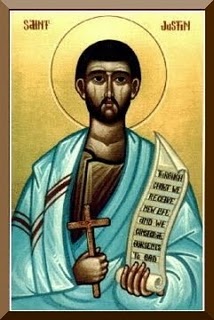
St. Justin Martyr
On this day churches remember Justin Martyr, a Christian scholar of the second century AD, who found in the ordinary goodness and faith of Christian communities the inspiration for his conversion, seeing Christianity as the culmination of the Greek philosophical tradition. Plato had searched for it but ordinary Christians had found it. He thought that if Jews and Gentiles took their own traditions seriously they would see how they pointed to Jesus Christ, the Word of God. In his goodness of life as well as in his ability to combine respect for the beliefs of others with resolute confidence in his own, he has much to teach believers today. And oh yes, when accused of being a Christian he cheerfully acknowledged it and was killed on 1st June 167 A.D.
Luke 12:22-31
22 He said to his disciples, ‘Therefore I tell you, do not worry about your life, what you will eat, or about your body, what you will wear. 23For life is more than food, and the body more than clothing. 24Consider the ravens: they neither sow nor reap, they have neither storehouse nor barn, and yet God feeds them. Of how much more value are you than the birds! 25And can any of you by worrying add a single hour to your span of life? 26If then you are not able to do so small a thing as that, why do you worry about the rest? 27Consider the lilies, how they grow: they neither toil nor spin; yet I tell you, even Solomon in all his glory was not clothed like one of these. 28But if God so clothes the grass of the field, which is alive today and tomorrow is thrown into the oven, how much more will he clothe you—you of little faith! 29And do not keep striving for what you are to eat and what you are to drink, and do not keep worrying. 30For it is the nations of the world that strive after all these things, and your Father knows that you need them. 31Instead, strive for his kingdom, and these things will be given to you as well.
Most of these words also appear in the same order in Matthew’s gospel. Indeed the two gospels share a great deal of material, some of which they both draw from Mark’s gospel (so we can see how they both use and edit Mark), but there is another tranche of common material which is not found in Mark. Where does it come from? Not from any document we possess, so scholars have proposed the existence of a collection of the sayings of Jesus, used in early church communities, and available to the authors of Matthew and Luke. This hypothetical document or oral tradition is called Q (German Quelle= source).
I accept this detective work and like to imagine the small groups of believers who initially memorised huge chunks of Jesus’ teaching because it was so precious to them, and later perhaps, wrote it down. These are amongst the most profound words ever spoken, yet they are dulled by familiarity.

Solomon in all his glory was not arrayed like one of these
Jesus speaks of the earth as a home for the life of plants, birds and human beings. There is enough food for all, so why are human beings so anxious about securing their own supply? In fact he doesn’t say “there is enough”, he says, “your heavenly father feeds them,” because he believes in the active goodness of the one who is beyond the earth. Of course he knew about famines just as we do, but he knew God had given enough for all. If some go without, that’s the fault of people who have neglected to share.
It is typical of Jesus that he says God gives more than enough: the colour of flowers is their means of attracting insects but is also beautiful. Communities of human beings who live by these words will know how to solve the world’s food crisis (see today’s Oxfam Report) but their lives too will share the extravagant loveliness of wild flowers.
 Emmock's Blog