USA REACHES OUT TO TALIBAN 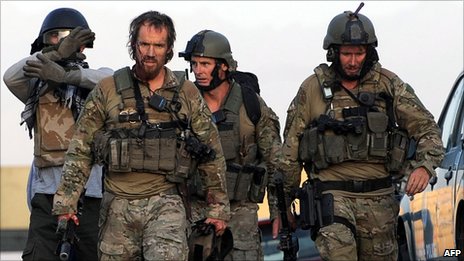
This blog provides a meditation on the Episcopal daily readings along with a headline from world news.
1 Samuel 14:16-30
16 Saul’s lookouts in Gibeah of Benjamin were watching as the multitude was surging back and forth. 17Then Saul said to the troops that were with him, ‘Call the roll and see who has gone from us.’ When they had called the roll, Jonathan and his armour-bearer were not there. 18Saul said to Ahijah, ‘Bring the ark of God here.’ For at that time the ark of God went with the Israelites. 19While Saul was talking to the priest, the tumult in the camp of the Philistines increased more and more; and Saul said to the priest, ‘Withdraw your hand.’ 20Then Saul and all the people who were with him rallied and went into the battle; and every sword was against the other, so that there was very great confusion. 21Now the Hebrews who previously had been with the Philistines and had gone up with them into the camp turned and joined the Israelites who were with Saul and Jonathan. 22Likewise, when all the Israelites who had gone into hiding in the hill country of Ephraim heard that the Philistines were fleeing, they too followed closely after them in the battle. 23So the Lord gave Israel the victory that day.The battle passed beyond Beth-aven, and the troops with Saul numbered altogether about ten thousand men. The battle spread out over the hill country of Ephraim.
24 Now Saul committed a very rash act on that day. He had laid an oath on the troops, saying, ‘Cursed be anyone who eats food before it is evening and I have been avenged on my enemies.’ So none of the troops tasted food. 25All the troops came upon a honeycomb; and there was honey on the ground. 26When the troops came upon the honeycomb, the honey was dripping out; but they did not put their hands to their mouths, for they feared the oath. 27But Jonathan had not heard his father charge the troops with the oath; so he extended the staff that was in his hand, and dipped the tip of it in the honeycomb, and put his hand to his mouth; and his eyes brightened. 28Then one of the soldiers said, ‘Your father strictly charged the troops with an oath, saying, “Cursed be anyone who eats food this day.” And so the troops are faint.’ 29Then Jonathan said, ‘My father has troubled the land; see how my eyes have brightened because I tasted a little of this honey. 30How much better if today the troops had eaten freely of the spoil taken from their enemies; for now the slaughter among the Philistines has not been great.’
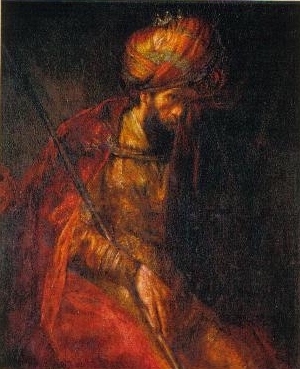
Rembrandt: King Saul
Saul can’t get anything right altogether. He defeats the enemy but spoils the victory by his foolish ban on eating. Perhaps the implication is that Saul is relying on God to give victory regardless of his soldiers’ energy levels. This would be an instance of “putting God to the test” and therefore lacking the humility of faith. Saul should know that God’s warriors need fed like any others. God acts through, not instead of, his servants. We see that Saul doesn’t understand God, but we want to add in his defence that God doesn’t seem to understand Saul.
Luke 23:32-43
32 Two others also, who were criminals, were led away to be put to death with him. 33When they came to the place that is called The Skull, they crucified Jesus there with the criminals, one on his right and one on his left. [[ 34Then Jesus said, ‘Father, forgive them; for they do not know what they are doing.’]] And they cast lots to divide his clothing. 35And the people stood by, watching; but the leaders scoffed at him, saying, ‘He saved others; let him save himself if he is the Messiah of God, his chosen one!’ 36The soldiers also mocked him, coming up and offering him sour wine, 37and saying, ‘If you are the King of the Jews, save yourself!’ 38There was also an inscription over him, ‘This is the King of the Jews.’
39 One of the criminals who were hanged there kept deriding him and saying, ‘Are you not the Messiah? Save yourself and us!’ 40But the other rebuked him, saying, ‘Do you not fear God, since you are under the same sentence of condemnation? 41And we indeed have been condemned justly, for we are getting what we deserve for our deeds, but this man has done nothing wrong.’ 42Then he said, ‘Jesus, remember me when you come into your kingdom.’ 43He replied, ‘Truly I tell you, today you will be with me in Paradise.’
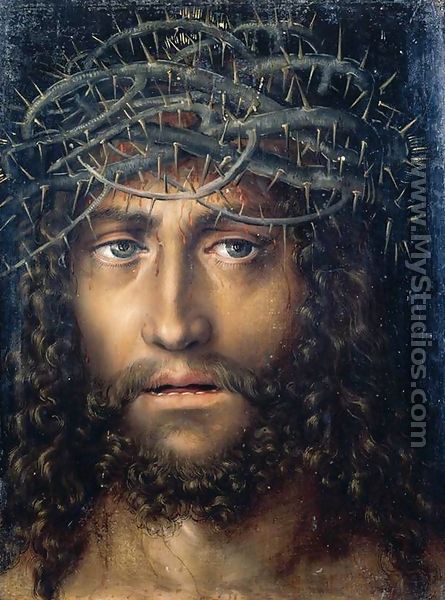
Christ the King (Cranach)
The brackets in the text remind us that there are many good early manuscripts of this passage which do not contain Jesus’ most famous words. It may be that they were excised by copyists who thought such forgiveness went too far, especially towards the Jewish leaders. In any case it’s clear that the prayer for forgiveness is of a piece with Jesus’ utter resistance to the evil that has come upon him. He gives absolutely no space in his being to the violence and hatred with which he is treated. This is his kingship, his reign, in the midst of evil. The “good thief” gets it wrong when he thinks of Jesus ultimately coming into his kingdom. Jesus’ kingdom is there and then on the cross, and that’s why in his kingly assurance he can promise paradise today.
The titulus reads “This is the King of the Jews” an indication that the Romans saw him as a messianic leader. The bloody history of Israel’s kings is ultimately redeemed by the only one to get it right. Christian politics starts with the cross.
 Emmock's Blog