
U.S. SOLDIERS RETURN: IS THRERE LIFE AFTER DEATH AND KILLING? 
This blog provides a meditation on the Episcopal daily readings along with a headline from world news.
Samuel 15:24-35
24 Saul said to Samuel, ‘I have sinned; for I have transgressed the commandment of the Lord and your words, because I feared the people and obeyed their voice. 25Now therefore, I pray, pardon my sin, and return with me, so that I may worship the Lord.’ 26Samuel said to Saul, ‘I will not return with you; for you have rejected the word of the Lord, and the Lord has rejected you from being king over Israel.’ 27As Samuel turned to go away, Saul caught hold of the hem of his robe, and it tore. 28And Samuel said to him, ‘The Lord has torn the kingdom of Israel from you this very day, and has given it to a neighbour of yours, who is better than you. 29Moreover, the Glory of Israel will not recant or change his mind; for he is not a mortal, that he should change his mind.’ 30Then Saul said, ‘I have sinned; yet honour me now before the elders of my people and before Israel, and return with me, so that I may worship the Lord your God.’ 31So Samuel turned back after Saul; and Saul worshipped the Lord.
32 Then Samuel said, ‘Bring Agag king of the Amalekites here to me.’ And Agag came to him haltingly. Agag said, ‘Surely this is the bitterness of death.’ 33But Samuel said,
‘As your sword has made women childless,
so your mother shall be childless among women.’
And Samuel hewed Agag in pieces before the Lord in Gilgal.
34 Then Samuel went to Ramah; and Saul went up to his house in Gibeah of Saul. 35Samuel did not see Saul again until the day of his death, but Samuel grieved over Saul. And the Lord was sorry that he had made Saul king over Israel.
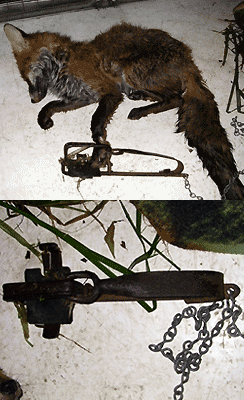
just one fox
This is a sad story. Samuel will not yield in his judgment-the judgment he believes is the Lord’s-and Saul can’t find forgiveness for not carrying out properly the ethnic cleansing which Samuel has commanded in the Lord’s name. Samuel says that Saul’s legitimacy is over, the Lord has already rejected him in favour of David, and he will not change his mind. But verse 35 does indicate that the Lord thinks he blundered in choosing Saul and now regrets it. This recognition by the author of a certain rashness in the Lord’s behaviour is interesting-it is also seen at the end of the story if the flood: “The Lord repented”, and promised never again to destroy the world. In fact once we start to think about it, rashness is a feature of the God of Israel who creates humanity in his own image then realises that he has created disobedience. From then on, sinful humans are always a step ahead of their creator, who has to clear the mess and limit the damage, as he seems to do with his rejection of Saul. How can this terrible comedy be a true depiction of God? Yet it is the supreme achievement of Jewish faith not to run away from this insight. It is a contradiction that’ s resolved for Christian faith in the cross of Jesus, where God is revealed as sharing the suffering that is part of his/her plan. But those who have looked at a fox caught in a trap or a child dying of hunger may feel that even the passion of God can’t justify the plan.
Luke 23: 56-24:11
56Then they returned, and prepared spices and ointments.
On the sabbath they rested according to the commandment.
24But on the first day of the week, at early dawn, they came to the tomb, taking the spices that they had prepared. 2They found the stone rolled away from the tomb, 3but when they went in, they did not find the body. 4While they were perplexed about this, suddenly two men in dazzling clothes stood beside them. 5The women were terrified and bowed their faces to the ground, but the men said to them, ‘Why do you look for the living among the dead? He is not here, but has risen. 6Remember how he told you, while he was still in Galilee, 7that the Son of Man must be handed over to sinners, and be crucified, and on the third day rise again.’ 8Then they remembered his words, 9and returning from the tomb, they told all this to the eleven and to all the rest. 10Now it was Mary Magdalene, Joanna, Mary the mother of James, and the other women with them who told this to the apostles. 11But these words seemed to them an idle tale, and they did not believe them.
“THE END” BY WILFRID OWEN
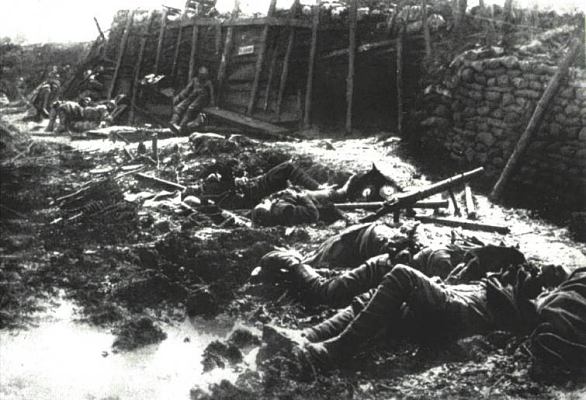
shall life renew these bodies?
After the blast of lightning from the east,
The flourish of loud clouds, the Chariot throne,
After the drums of time have rolled and ceased
And from the bronze west long retreat is blown,
Shall Life renew these bodies? Of a truth
All death will he annul, all tears assuage?
Or fill these void veins full again with youth
And wash with an immortal water age?
When I do ask white Age, he saith not so, —
“My head hangs weighed with snow.”
And when I hearken to the Earth she saith
“My fiery heart sinks aching. It is death.
Mine ancient scars shall not be glorified
Nor my titanic tears the seas be dried.”
I place Owen’s poem, written during the Great War, to link up with my remarks on the Old Testament passage and to give full context for the message of resurrection. The context is there in the bible, it is the crucifixion of Jesus, but that has been taken by Christian piety so far from the ordinary history of human destructiveness, that the sheer unlikelihood of the resurrection is diminished. I don’t mean the unlikelihood of a single miracle, but rather that of its being a sign of God’s victory over evil and death. The women are afraid but judge the message to be an idle tale. Faith in the resurrection, as Luke tells us, requires an utterly devastating change. Eyes that have been focussed on death must learn to see life. “Why look for the living amongst the dead?” We are to find the saving Christ in the midst of the destructive life of the world, suffering, challenging, changing it, and establishing that tiny margin of hope which is nevertheless the promise that God will wipe away all the tears from all the eyes.
 Emmock's Blog