NEW GAZA AID SHIP SETS SAIL 
This blog provides a meditation on the Episcopal daily readings along with a headline from world news:
1 Samuel 16:1-13
16The Lord said to Samuel, ‘How long will you grieve over Saul? I have rejected him from being king over Israel. Fill your horn with oil and set out; I will send you to Jesse the Bethlehemite, for I have provided for myself a king among his sons.’ 2Samuel said, ‘How can I go? If Saul hears of it, he will kill me.’ And the Lord said, ‘Take a heifer with you, and say, “I have come to sacrifice to the Lord.” 3Invite Jesse to the sacrifice, and I will show you what you shall do; and you shall anoint for me the one whom I name to you.’ 4Samuel did what the Lord commanded, and came to Bethlehem. The elders of the city came to meet him trembling, and said, ‘Do you come peaceably?’ 5He said, ‘Peaceably; I have come to sacrifice to the Lord; sanctify yourselves and come with me to the sacrifice.’ And he sanctified Jesse and his sons and invited them to the sacrifice.
6 When they came, he looked on Eliab and thought, ‘Surely the Lord’s anointed is now before the Lord.’ 7But the Lord said to Samuel, ‘Do not look on his appearance or on the height of his stature, because I have rejected him; for the Lord does not see as mortals see; they look on the outward appearance, but the Lord looks on the heart.’ 8Then Jesse called Abinadab, and made him pass before Samuel. He said, ‘Neither has the Lord chosen this one.’ 9Then Jesse made Shammah pass by. And he said, ‘Neither has the Lord chosen this one.’ 10Jesse made seven of his sons pass before Samuel, and Samuel said to Jesse, ‘The Lord has not chosen any of these.’ 11Samuel said to Jesse, ‘Are all your sons here?’ And he said, ‘There remains yet the youngest, but he is keeping the sheep.’ And Samuel said to Jesse, ‘Send and bring him; for we will not sit down until he comes here.’ 12He sent and brought him in. Now he was ruddy, and had beautiful eyes, and was handsome. The Lord said, ‘Rise and anoint him; for this is the one.’ 13Then Samuel took the horn of oil, and anointed him in the presence of his brothers; and the spirit of the Lord came mightily upon David from that day forward. Samuel then set out and went to Ramah.
the inscrutability of God
This splendid folktale about the choosing of David nevertheless remembers that the great prophet was initially reluctant to replace Saul, not only because what he was being asked to do was treason, but also because God had formerly asked his help in choosing Saul. The Lord is said to be able to see the heart, but if so, why couldn’t he see that Saul’s heart was not to his liking? The apparent capriciousness of the Lord and the contribution of his personal likes and dislikes to the history of Israel’s kings is not an accidental element in the books of Samuel. The Lord’s “favour” is depicted as something which does not always coincide with human preference or reason. The narrative of the Books of Kings is different as it portrays God’s favour resting on those Kings who keep the Law and do not worship false Gods.
Should the modern reader dismiss the portrait of God in Samuel as primitive? I think not as it preserves the troubling inscrutability of a God who is after all not human with greater vivacity than Karl Barth who in modern times expressed a similar theology. The difficulty lies in depicting a God who is greater than human ideas of goodness and justice, but not less.
Luke 24:12-35
12But Peter got up and ran to the tomb; stooping and looking in, he saw the linen cloths by themselves; then he went home, amazed at what had happened.
13 Now on that same day two of them were going to a village called Emmaus, about seven miles from Jerusalem, 14and talking with each other about all these things that had happened. 15While they were talking and discussing, Jesus himself came near and went with them, 16but their eyes were kept from recognizing him. 17And he said to them, ‘What are you discussing with each other while you walk along?’ They stood still, looking sad. 18Then one of them, whose name was Cleopas, answered him, ‘Are you the only stranger in Jerusalem who does not know the things that have taken place there in these days?’ 19He asked them, ‘What things?’ They replied, ‘The things about Jesus of Nazareth, who was a prophet mighty in deed and word before God and all the people, 20and how our chief priests and leaders handed him over to be condemned to death and crucified him. 21But we had hoped that he was the one to redeem Israel. Yes, and besides all this, it is now the third day since these things took place. 22Moreover, some women of our group astounded us. They were at the tomb early this morning, 23and when they did not find his body there, they came back and told us that they had indeed seen a vision of angels who said that he was alive. 24Some of those who were with us went to the tomb and found it just as the women had said; but they did not see him.’ 25Then he said to them, ‘Oh, how foolish you are, and how slow of heart to believe all that the prophets have declared! 26Was it not necessary that the Messiah should suffer these things and then enter into his glory?’ 27Then beginning with Moses and all the prophets, he interpreted to them the things about himself in all the scriptures.
28 As they came near the village to which they were going, he walked ahead as if he were going on. 29But they urged him strongly, saying, ‘Stay with us, because it is almost evening and the day is now nearly over.’ So he went in to stay with them. 30When he was at the table with them, he took bread, blessed and broke it, and gave it to them. 31Then their eyes were opened, and they recognized him; and he vanished from their sight. 32They said to each other, ‘Were not our hearts burning within us while he was talking to us on the road, while he was opening the scriptures to us?’ 33That same hour they got up and returned to Jerusalem; and they found the eleven and their companions gathered together. 34They were saying, ‘The Lord has risen indeed, and he has appeared to Simon!’ 35Then they told what had happened on the road, and how he had been made known to them in the breaking of the bread. 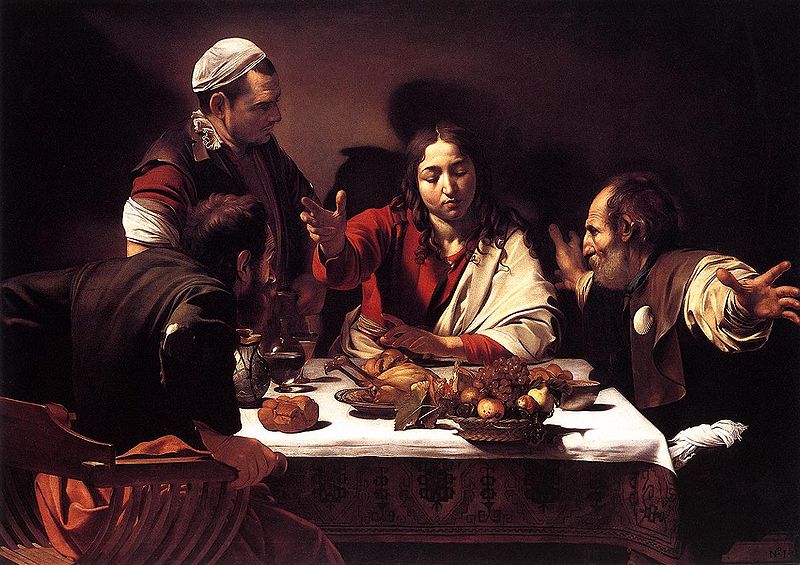
This great and cunning story tells us the risen Christ is to be found through:
- Openness to the stranger
- The “things about Jesus of Nazareth” the memory of Jesus’ ministry
- Then study of the scripture as a witness to Christ
- The blessing, breaking and sharing of bread.
This is the fact of the resurrection: Jesus is risen and this is the new mode of his being. He “appears” to Peter and the eleven but he lives in the open community of his followers as they listen to scripture and share each other’s lives. Caravaggio’s great painting well presents both the ordinariness and the wonder of resurrection.
Jan Hus,(1371-1414) whom reformed churches remember today, was a priest in Bohemia who was burnt as a heretic by the Roman church because he emphasised the importance of Scripture, the celebration of communion with bread and wine, and the non-divine origin of the papacy. He was above all concerned that the living Christ should be found in the church community.
 Emmock's Blog