
“NEWS OF THE WORLD LEAVES GAP ONLY BIBLE CAN FILL”- MINISTER 
This blog provides a meditation on the Episcopal daily readings along with a headline from world news
1 Samuel 18:5-16,27-30
5David went out and was successful wherever Saul sent him; as a result, Saul set him over the army. And all the people, even the servants of Saul, approved.
6 As they were coming home, when David returned from killing the Philistine, the women came out of all the towns of Israel, singing and dancing, to meet King Saul, with tambourines, with songs of joy, and with musical instruments. 7And the women sang to one another as they made merry,
‘Saul has killed his thousands,
and David his tens of thousands.’
8Saul was very angry, for this saying displeased him. He said, ‘They have ascribed to David tens of thousands, and to me they have ascribed thousands; what more can he have but the kingdom?’ 9So Saul eyed David from that day on.
10 The next day an evil spirit from God rushed upon Saul, and he raved within his house, while David was playing the lyre, as he did day by day. Saul had his spear in his hand; 11and Saul threw the spear, for he thought, ‘I will pin David to the wall.’ But David eluded him twice.
12 Saul was afraid of David, because the Lord was with him but had departed from Saul. 13So Saul removed him from his presence, and made him a commander of a thousand; and David marched out and came in, leading the army. 14David had success in all his undertakings; for the Lord was with him. 15When Saul saw that he had great success, he stood in awe of him. 16But all Israel and Judah loved David; for it was he who marched out and came in leading them. 27David rose and went, along with his men, and killed one hundred of the Philistines; and David brought their foreskins, which were given in full number to the king, that he might become the king’s son-in-law. Saul gave him his daughter Michal as a wife. 28But when Saul realized that the Lord was with David, and that Saul’s daughter Michal loved him, 29Saul was still more afraid of David. So Saul was David’s enemy from that time forward. 30 Then the commanders of the Philistines came out to battle; and as often as they came out, David had more success than all the servants of Saul, so that his fame became very great.
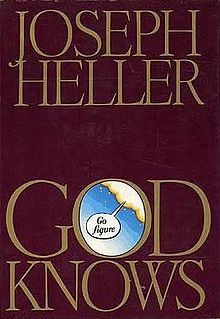
One of the best books about David and God
The “News of the World” newspaper, famous for its salacious scoops, has just closed in the UK after revelations about its delightful habit of hacking peoples’ phones. The narrative of David’s life in the books of Samuel, while more profound, is full of NoW style scoops about the private life of the Israeli royals: has there ever been a more intriguing bride-price than the 100 Philistine foreskins noted here? The unsparing author recounts the decline into madness of Saul and the seemingly effortless rise of David due, we are told, to the Lord’s favour.
I’ve just read Jose Saramago’s last book, “Cain” in which he makes an angry mockery of the Lord’s character as revealed by the Old Testament. Still it’s clear that the Lord, with his baffling amorality and impetuous anger, is one of the great characters in this novel, and that in spite of himself, the author is drawn to Him.
The elements of contradiction, amorality, unpredictability, favouritism and rage which make the Old Testament Lord so interesting are precisely those missing from modern Christian theology which is determinedly pc about God. This is because so much theology is “realist”, that is, it thinks it is describing God much as Richard Dawkins thinks he’s describing evolution, whereas the Biblical authors only thought they were re-telling the best human stories about God. This pc-ness extends even to Christian portrayal of Jesus, so that his anger, unpredictability and Jewishness are airbrushed from serious consideration. After all, He’s God, isn’t He?
The books of Samuel can remind us of the challenges inherent in giving a human picture of the One-Who-Is-Not-Human and maintaining the scandal that standing on holy ground may be bad for your health.
Mark 1:29-45
29 As soon as they left the synagogue, they entered the house of Simon and Andrew, with James and John. 30Now Simon’s mother-in-law was in bed with a fever, and they told him about her at once. 31He came and took her by the hand and lifted her up. Then the fever left her, and she began to serve them.
32 That evening, at sunset, they brought to him all who were sick or possessed with demons. 33And the whole city was gathered around the door. 34And he cured many who were sick with various diseases, and cast out many demons; and he would not permit the demons to speak, because they knew him.
35 In the morning, while it was still very dark, he got up and went out to a deserted place, and there he prayed. 36And Simon and his companions hunted for him. 37When they found him, they said to him, ‘Everyone is searching for you.’ 38He answered, ‘Let us go on to the neighbouring towns, so that I may proclaim the message there also; for that is what I came out to do.’ 39And he went throughout Galilee, proclaiming the message in their synagogues and casting out demons.
40 A leper came to him begging him, and kneeling he said to him, ‘If you choose, you can make me clean.’ 41Moved with pity, Jesus stretched out his hand and touched him, and said to him, ‘I do choose. Be made clean!’ 42Immediately the leprosy left him, and he was made clean. 43After sternly warning him he sent him away at once, 44saying to him, ‘See that you say nothing to anyone; but go, show yourself to the priest, and offer for your cleansing what Moses commanded, as a testimony to them.’ 45But he went out and began to proclaim it freely, and to spread the word, so that Jesus could no longer go into a town openly, but stayed out in the country; and people came to him from every quarter.
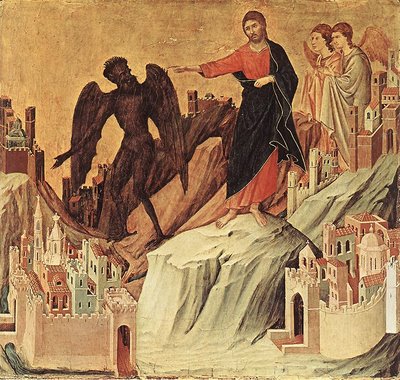
Jesus' war on Satan
The airbrushing of Jesus began very early. Mark probably used a word meaning “roused to anger” in verse 41, but a majority of the early copyists thought this was not reverential and changed it to “moved by pity”. Mark’s depiction of Jesus stands alongside the Books of Samuel for artistry and theological insight in storytelling. Because his grammar and syntax are less than classical, Mark went unappreciated in Biblical interpretation for much of Christina history. Only in modern and perhaps especially, post-modern times, has his work been more fully understood.
On the Sabbath day Jesus goes to the synagogue and heals a man with an evil spirit. His “holy war” however, continues in the most intimate and delicate of household situations when he heals Simon’s mother-in-law of a fever which has deprived her of the dignity of service. For Mark the synagogue and Simon’s family home are “houses of the strong man, the Satan”, whom Jesus “binds.” No wonder the whole city is drawn to that house (but only after the Sabbath has ended!) to be freed from the evil spirits that afflict them. This doesn’t sound much like the decent Jesus of liberal theology or the self-promoting self-proclaiming saviour-judge beloved by conservatives.
It’s entirely appropriate the Jesus the Jihadist should be “roused to anger” by what the Satan has done to the Leper, who is excluded from the community and all human contact. He rouses himself for battle and strikes- by touching the leper with the hand of love and smashing through the barrier which the Satan has erected.
The source of Jesus’ battle strength is revealed by Mark as his mysterious relationship in prayer with the One-Who-Is-Not-Human and cannot be described.
 Emmock's Blog