PRAYERS FOR THE PEOPLE OF NORWAY 
May the Eternal Love and Peace be with the wounded and grieving people of Norway.
God, who sets before us good and evil, life and death, help us so to discern the beginnings of evil in ourselves and others, that we may prevent its growth and sow the seeds of goodness and life, through Jesus Christ, who died to forgive and lives to conquer evil and death. Amen.
This blog provides a meditation on the Episcopal daily readings along with a headline from world news
Thi2 Samuel 1:1-16
1After the death of Saul, when David had returned from defeating the Amalekites, David remained two days in Ziklag. 2On the third day, a man came from Saul’s camp, with his clothes torn and dirt on his head. When he came to David, he fell to the ground and did obeisance. 3David said to him, ‘Where have you come from?’ He said to him, ‘I have escaped from the camp of Israel.’ 4David said to him, ‘How did things go? Tell me!’ He answered, ‘The army fled from the battle, but also many of the army fell and died; and Saul and his son Jonathan also died.’ 5Then David asked the young man who was reporting to him, ‘How do you know that Saul and his son Jonathan died?’ 6The young man reporting to him said, ‘I happened to be on Mount Gilboa; and there was Saul leaning on his spear, while the chariots and the horsemen drew close to him. 7When he looked behind him, he saw me, and called to me. I answered, “Here, sir.” 8And he said to me, “Who are you?” I answered him, “I am an Amalekite.” 9He said to me, “Come, stand over me and kill me; for convulsions have seized me, and yet my life still lingers.” 10So I stood over him, and killed him, for I knew that he could not live after he had fallen. I took the crown that was on his head and the armlet that was on his arm, and I have brought them here to my lord.’
11 Then David took hold of his clothes and tore them; and all the men who were with him did the same. 12They mourned and wept, and fasted until evening for Saul and for his son Jonathan, and for the army of the Lord and for the house of Israel, because they had fallen by the sword. 13David said to the young man who had reported to him, ‘Where do you come from?’ He answered, ‘I am the son of a resident alien, an Amalekite.’ 14David said to him, ‘Were you not afraid to lift your hand to destroy the Lord’s anointed?’ 15Then David called one of the young men and said, ‘Come here and strike him down.’ So he struck him down and he died. 16David said to him, ‘Your blood be on your head; for your own mouth has testified against you, saying, “I have killed the Lord’s anointed.” ’

blasphemy wrapped in a flag
The reader remembers that Saul has been cursed by God for failing to wipe out the Amalekites. Perhaps he chose an Amalekite to end his life because he thought it was fitting, or even because he knew his killer would bear a curse. In any case, the innocent Amalekite who imagines that he may be bringing good news-after all Saul had tried to kill David- finds he’s made a terrible mistake: whatever David feels-and certainly he would have grieved for Jonathan-he knows he must mourn for the king and all the Israeli dead, to increase his chances of public acceptance as Saul’s successor. The Amalekite dies so that David can demonstrate his dedication to Israel. Patriotic piety is often a cover for personal ambition. All manner of self-serving manoeuvres can be wrapped in the flag.
Mark 6:1-13
6He left that place and came to his home town, and his disciples followed him. 2On the sabbath he began to teach in the synagogue, and many who heard him were astounded. They said, ‘Where did this man get all this? What is this wisdom that has been given to him? What deeds of power are being done by his hands! 3Is not this the carpenter, the son of Mary and brother of James and Joses and Judas and Simon, and are not his sisters here with us?’ And they took offence at him. 4Then Jesus said to them, ‘Prophets are not without honour, except in their home town, and among their own kin, and in their own house.’ 5And he could do no deed of power there, except that he laid his hands on a few sick people and cured them. 6And he was amazed at their unbelief.
Then he went about among the villages teaching. 7He called the twelve and began to send them out two by two, and gave them authority over the unclean spirits. 8He ordered them to take nothing for their journey except a staff; no bread, no bag, no money in their belts; 9but to wear sandals and not to put on two tunics. 10He said to them, ‘Wherever you enter a house, stay there until you leave the place. 11If any place will not welcome you and they refuse to hear you, as you leave, shake off the dust that is on your feet as a testimony against them.’ 12So they went out and proclaimed that all should repent. 13They cast out many demons, and anointed with oil many who were sick and cured them.
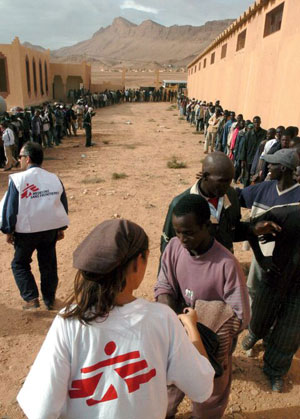
in a hurry to heal -medicins sans frontieres
Mark has shown the reader the difference between the natural home ofamily and neighbours and the new home for all people which is God’s kingdom. This passage records Jesus’ rejection by his home town. There is a hint that Jesus sees such people as rejecting their place in God’s Israel. The gesture of shaking the dust off the shoes was performed by pious Israelites returning from Gentile soil.
The true family of Jesus, represented by the twelve, is shown stripped for action as urgent messengers of God’s Rule over evil and disease. This urgency which is everywhere in Mark’s gospel, is a sign that Jesus’ mission inaugurates a crisis in history which demands decision and action.
I sometimes wonder if I demonstrate the unbelief of Jesus’ familiars-“of course I know Jesus!”-rather than the urgency of his disciples to challenge evil and mend hurt.
 Emmock's Blog