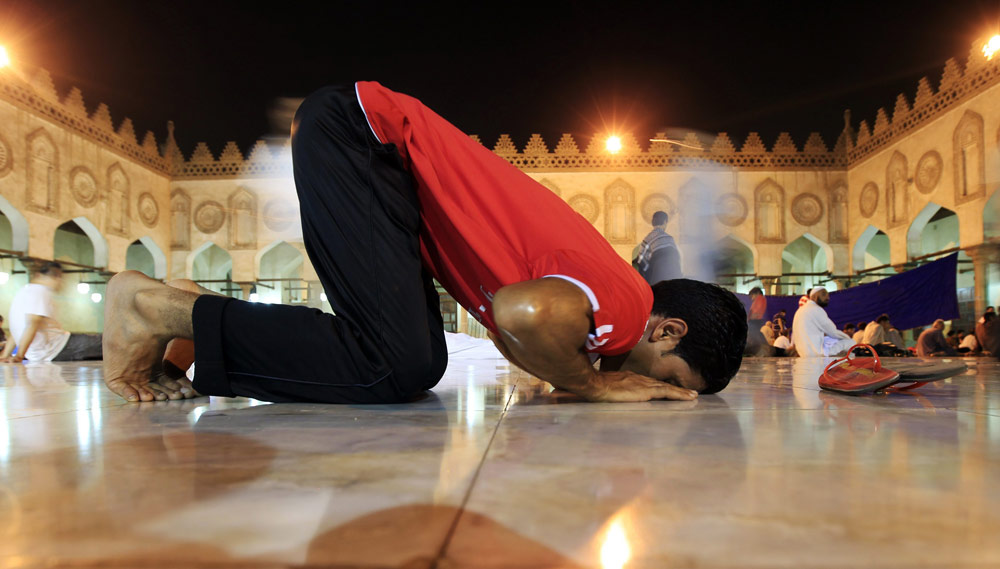
RAMADAN BEGINS WITH PRAYER
 This blog provides a meditation on the Episcopal daily readings along with a headline from world news.
Mark 8:22-33
22 They came to Bethsaida. Some people brought a blind man to him and begged him to touch him. 23He took the blind man by the hand and led him out of the village; and when he had put saliva on his eyes and laid his hands on him, he asked him, ‘Can you see anything?’ 24And the man looked up and said, ‘I can see people, but they look like trees, walking.’ 25Then Jesus laid his hands on his eyes again; and he looked intently and his sight was restored, and he saw everything clearly. 26Then he sent him away to his home, saying, ‘Do not even go into the village.’
27 Jesus went on with his disciples to the villages of Caesarea Philippi; and on the way he asked his disciples, ‘Who do people say that I am?’ 28And they answered him, ‘John the Baptist; and others, Elijah; and still others, one of the prophets.’ 29He asked them, ‘But who do you say that I am?’ Peter answered him, ‘You are the Messiah.’ 30And he sternly ordered them not to tell anyone about him.
31 Then he began to teach them that the Son of Man must undergo great suffering, and be rejected by the elders, the chief priests, and the scribes, and be killed, and after three days rise again. 32He said all this quite openly. And Peter took him aside and began to rebuke him. 33But turning and looking at his disciples, he rebuked Peter and said, ‘Get behind me, Satan! For you are setting your mind not on divine things but on human things.’
I somehow managed to get the lectionary passages for today and yesterday mixed up. Apologies to readers who are also using the daily readings of the Episcopal Church (http://satucket.com/lectionary)

"Only a suffering God can help" Dietrich Bonhoeffer
Today therefore I’m commenting on the New Testament reading for yesterday.
Scholars have traditionally noted that the incident at Caesarea Philippi is the “hinge” of Mark’s gospel. Before it, the author initiates the reader into the mystery of Jesus by means of his words and actions; after it, his suffering becomes more and more important, culminating in his death. There is truth in this division, but, as I’ve tried to point out, the crucified Jesus is present in the first “part” of the gospel (his presence in religiously taboo areas, his arousing of deadly opposition from religious leaders, his solitary prayer) and the Jesus who acts with the power of resurrection is present in the second “part” (in the transfiguration and the subsequent healing of the epileptic boy, and so on).
Pairing the Caesarea story with the healing of the blind man, as the lectionary does here, is illuminating. Jesus, acting in the power of resurrection, is still dependent on material process and human response. At first the man is only partially healed, and sees confusedly. Finally he can see clearly. Jesus instructs him not to report the healing but to go straight home.
In the Caesarea incident, Mark wants us to imagine the whole ministry of Jesus as an act of healing the blind. Most “people” can see something in him, but their perception is vague and confused. “Some say, ‘John the Baptist’ others, ‘Elijah’ others again, ‘one of the prophets’” Have the disciples been healed of their blindness? Most are unsure but Peter answers on their behalf, “You are the Christ” which is both right and wrong as we shall see. Nevertheless Jesus confirms his faith and instructs them not to report it to anyone.
Then he goes on to complete his act of healing their blindness. The Messiah, he reveals, will not be a triumphant conqueror feted by all Israel, but a failure, rejected by the nation’s leaders and killed. Simon speaks out of their common blindness and rebukes Jesus, “This is not the right way to be a Messiah.” Jesus’ stinging reply does not put Peter only in his place, but also The Satan, the “strong man” whose house Jesus has plundered by his healings, setting people free from his rule. Just as with the blind man, Jesus’ healing of disciples’ blindness is limited by their response. They have not completely taken leave of The Satan and their perception is still flawed.
Mark doesn’t waste a word or a story. At every point in his spare narrative he focuses on his great theme of Jesus Crucified and Risen, in battle against the power of evil that destroys lives, revealing the unimaginable and almost unspeakable nature of the beloved Son of God.
Mark meant these passages for his church community. In our churches today we have to learn patiently how to read him, how to allow his dark and subtle story to diagnose our blindness and to open our eyes to the reality of God.
At the end of Jose Saramago’s dark parable, “Blindness” the only person not to lose her physical sight in an epidemic of blindness, says,“I don’t think we did go blind, I think we are blind, Blind but seeing, Blind people who can see, but do not see”
 Emmock's Blog