JUSTICE COMES TO POWERFUL PEOPLE IN EGYPT 
This blog provides a meditation on the Episcopal daily readings along with a headline from world news
2 Samuel 11:1-27
11In the spring of the year, the time when kings go out to battle, David sent Joab with his officers and all Israel with him; they ravaged the Ammonites, and besieged Rabbah. But David remained at Jerusalem.
2 It happened, late one afternoon, when David rose from his couch and was walking about on the roof of the king’s house, that he saw from the roof a woman bathing; the woman was very beautiful. 3David sent someone to inquire about the woman. It was reported, ‘This is Bathsheba daughter of Eliam, the wife of Uriah the Hittite.’ 4So David sent messengers to fetch her, and she came to him, and he lay with her. (Now she was purifying herself after her period.) Then she returned to her house. 5The woman conceived; and she sent and told David, ‘I am pregnant.’
6 So David sent word to Joab, ‘Send me Uriah the Hittite.’ And Joab sent Uriah to David. 7When Uriah came to him, David asked how Joab and the people fared, and how the war was going. 8Then David said to Uriah, ‘Go down to your house, and wash your feet.’ Uriah went out of the king’s house, and there followed him a present from the king. 9But Uriah slept at the entrance of the king’s house with all the servants of his lord, and did not go down to his house. 10When they told David, ‘Uriah did not go down to his house’, David said to Uriah, ‘You have just come from a journey. Why did you not go down to your house?’ 11Uriah said to David, ‘The ark and Israel and Judah remain in booths;* and my lord Joab and the servants of my lord are camping in the open field; shall I then go to my house, to eat and to drink, and to lie with my wife? As you live, and as your soul lives, I will not do such a thing.’ 12Then David said to Uriah, ‘Remain here today also, and tomorrow I will send you back.’ So Uriah remained in Jerusalem that day. On the next day, 13David invited him to eat and drink in his presence and made him drunk; and in the evening he went out to lie on his couch with the servants of his lord, but he did not go down to his house.
14 In the morning David wrote a letter to Joab, and sent it by the hand of Uriah. 15In the letter he wrote, ‘Set Uriah in the forefront of the hardest fighting, and then draw back from him, so that he may be struck down and die.’ 16As Joab was besieging the city, he assigned Uriah to the place where he knew there were valiant warriors. 17The men of the city came out and fought with Joab; and some of the servants of David among the people fell. Uriah the Hittite was killed as well. 18Then Joab sent and told David all the news about the fighting; 19and he instructed the messenger, ‘When you have finished telling the king all the news about the fighting, 20then, if the king’s anger rises, and if he says to you, “Why did you go so near the city to fight? Did you not know that they would shoot from the wall? 21Who killed Abimelech son of Jerubbaal?* Did not a woman throw an upper millstone on him from the wall, so that he died at Thebez? Why did you go so near the wall?” then you shall say, “Your servant Uriah the Hittite is dead too.” ’
 22 So the messenger went, and came and told David all that Joab had sent him to tell. 23The messenger said to David, ‘The men gained an advantage over us, and came out against us in the field; but we drove them back to the entrance of the gate. 24Then the archers shot at your servants from the wall; some of the king’s servants are dead; and your servant Uriah the Hittite is dead also.’ 25David said to the messenger, ‘Thus you shall say to Joab, “Do not let this matter trouble you, for the sword devours now one and now another; press your attack on the city, and overthrow it.” And encourage him.’
26 When the wife of Uriah heard that her husband was dead, she made lamentation for him. 27When the mourning was over, David sent and brought her to his house, and she became his wife, and bore him a son.
But the thing that David had done displeased the Lord.
Here again in this story we see the great skill of the author. Yes, most stories about kings like David are about battles and this is given a passing mention-“the time when kings go out to battle”-a wonderful characterisation of the casual brutality of kings: they go out to kill as regularly as the farmer sows the seed. But this story is going to be about a less heroic side of David’s life. He sees a woman bathing and no sooner sees her than desires her; no sooner desires her than sends for her; no sooner sends for her than lies with her. What choice did the woman have in that society? Well, she could have refused the king, although that would have taken great courage. But already we may wonder what sort of woman does her intimate bathing where she can be overlooked by the palace residents. We guess that David’s relationship with Bathsheba would have been a one afternoon stand if she’d not become pregnant as a result of it. The issue is complicated by the absence of Uriah on battle duty which prohibited him from sex. The contrast between the faithful soldier and the faithless king is brilliantly sketched, as is the speed with which David arrives at the final solution. His use of Joab, his enforcer, is pointed up by Joab’s subtle reminder to him, via the messenger, that he knows what’s going on. Bathsheba’s feelings remain opaque to the reader: she mourns her husband but she comes to David. This is not an edifying story but one which sucks the reader into the intimate life of a monarch: he can do as he pleases.
Then almost casually the author adds, “But the thing that David had done displeased the Lord” Now where did the Lord come from? It seemed that the story was simply about human motives and character, but now the Lord appears as an active character in the story, although His influence on events is channelled through human beings and worldly events (as we shall see). It appears that human life is autonomous, and indeed there has been no superhuman restraint on the behaviour of the human beings in the story, but it has all taken place within the purview of One who judges good and evil, justice and injustice. Indeed we might say that the Lord’s relationship to the events is a bit like that of the reader: He follows and is passionately interested in the human story; but unlike the reader and more like the author, He can determine the plot, although like any good author, he gives his characters the freedom to be themselves. Such a relationship to ultimate goodness is what constitutes the rich humanity of the men and women in this story, and I believe, in the world.
Simone Weil was a profound and loopy person who said some things so well they cannot be said better, for example:
“There is a reality outside the world, that is to say, outside space and time, outside any sphere whatsoever that is accessible to human faculties… that is the unique source of all the good that can exist in this world: that is to say: all beauty, truth, justice, order; and all human behaviour that is mindful of obligations. Those whose attention and love are turned towards that reality are the sole intermediary through which good can descend from there and come amongst men and women.”
The author of Samuel is pointing his readers towards this faith.
Mark 9:2-13
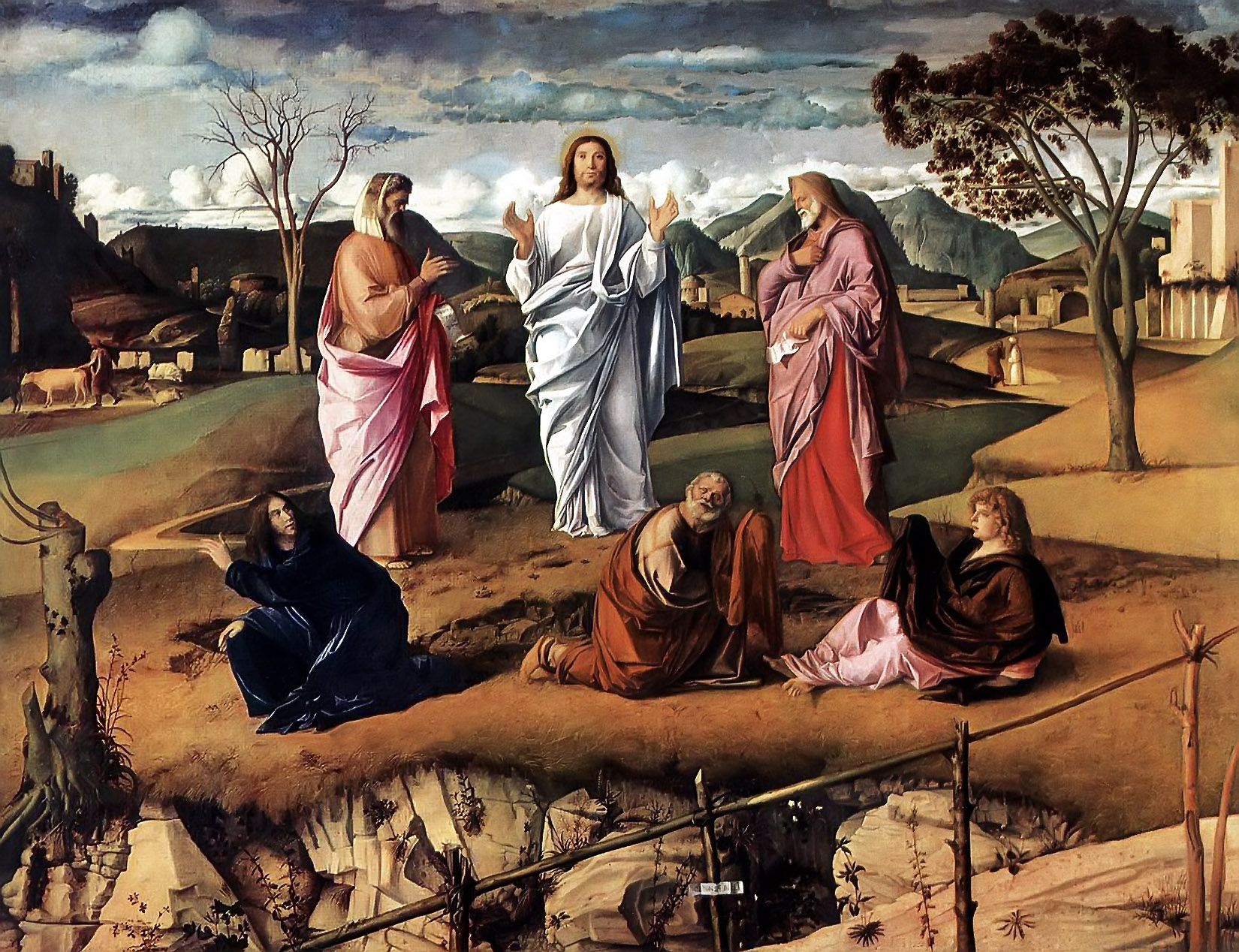
2 Six days later, Jesus took with him Peter and James and John, and led them up a high mountain apart, by themselves. And he was transfigured before them, 3and his clothes became dazzling white, such as no one on earth could bleach them. 4And there appeared to them Elijah with Moses, who were talking with Jesus. 5Then Peter said to Jesus, ‘Rabbi, it is good for us to be here; let us make three dwellings, one for you, one for Moses, and one for Elijah.’ 6He did not know what to say, for they were terrified. 7Then a cloud overshadowed them, and from the cloud there came a voice, ‘This is my Son, the Beloved; listen to him!’ 8Suddenly when they looked around, they saw no one with them any more, but only Jesus.
9 As they were coming down the mountain, he ordered them to tell no one about what they had seen, until after the Son of Man had risen from the dead. 10So they kept the matter to themselves, questioning what this rising from the dead could mean. 11Then they asked him, ‘Why do the scribes say that Elijah must come first?’ 12He said to them, ‘Elijah is indeed coming first to restore all things. How then is it written about the Son of Man, that he is to go through many sufferings and be treated with contempt? 13But I tell you that Elijah has come, and they did to him whatever they pleased, as it is written about him.’
the mountain is near the chasm
Before Mark takes the reader along Jesus’ road to the cross, he gives a glimpse of Jesus who lives in the beauty of resurrection and transmits its power to men and women and, as we shall see inn the next story, children. This is the Jesus whom the church knows who was already known to the disciples in “the days of his flesh”. From the cloud of God’s presence the voice reveals the mystery of the one about to suffer: he is the beloved of God, the Son, the true Israel, the Messiah, the new Moses, who will be preceded by the return of Elijah.
After such a revelation, Jesus keeps their feet on the ground by telling them the executed John the Baptist has been his Elijah, foretelling a similar fate for himself.
Simone Weil notes also that those who love and transmit a goodness which is not of this world, cannot be understood by worldly people and will be hated by worldly powers, and will therefore suffer.
Modern Christianity has been shy of talking about suffering, perhaps because it seems miserable in face of the opportunities offered by worldly living. There is an urgent need for a form of Christian faith which integrates the call to suffer with the gift of abundant life.
 Emmock's Blog