
POPE TOO EXPENSIVE FOR SPAIN 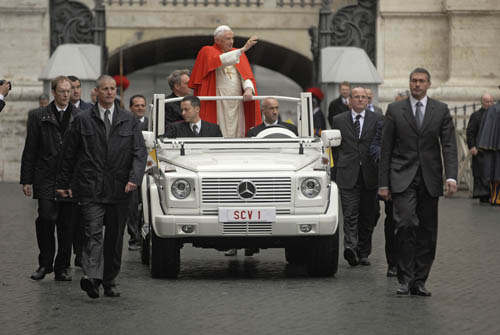
This blog provides a meditation on the Episcopal daily readings along with a headline from world news
2 Samuel 14:21-33
21 Then the king said to Joab, ‘Very well, I grant this; go, bring back the young man Absalom.’ 22Joab prostrated himself with his face to the ground and did obeisance, and blessed the king; and Joab said, ‘Today your servant knows that I have found favour in your sight, my lord the king, in that the king has granted the request of his servant.’ 23So Joab set off, went to Geshur, and brought Absalom to Jerusalem. 24The king said, ‘Let him go to his own house; he is not to come into my presence.’ So Absalom went to his own house, and did not come into the king’s presence.
25 Now in all Israel there was no one to be praised so much for his beauty as Absalom; from the sole of his foot to the crown of his head there was no blemish in him. 26When he cut the hair of his head (for at the end of every year he used to cut it; when it was heavy on him, he cut it), he weighed the hair of his head, two hundred shekels by the king’s weight. 27There were born to Absalom three sons, and one daughter whose name was Tamar; she was a beautiful woman.
28 So Absalom lived two full years in Jerusalem without coming into the king’s presence. 29Then Absalom sent for Joab to send him to the king; but Joab would not come to him. He sent a second time, but Joab would not come. 30Then he said to his servants, ‘Look, Joab’s field is next to mine, and he has barley there; go and set it on fire.’ So Absalom’s servants set the field on fire. 31Then Joab rose and went to Absalom at his house, and said to him, ‘Why have your servants set my field on fire?’ 32Absalom answered Joab, ‘Look, I sent word to you: Come here, that I may send you to the king with the question, “Why have I come from Geshur? It would be better for me to be there still.” Now let me go into the king’s presence; if there is guilt in me, let him kill me!’ 33Then Joab went to the king and told him; and he summoned Absalom. So he came to the king and prostrated himself with his face to the ground before the king; and the king kissed Absalom.

royal family looks after its own
David tries to pretend that he has not done what he has done: to allow Absalom who has murdered Amnon to return from exile. His motive is affection for Absalom but both his judgement of character and his commitment to justice are poor and will bring trouble upon him. Reconciliation between the king and his son is achieved by ignoring the cause of their estrangement. Traits of character, which in David are largely kept in their place-the ability to kill and the desire for power-are given greater scope in Absalom. The shrewd reader knows that the shrewd narrator is saying that Absalom is dangerous. He knows that David’s “arms-length” policy is a pretence and calls his bluff. David gives in.
Mark 10:17-31
17 As he was setting out on a journey, a man ran up and knelt before him, and asked him, ‘Good Teacher, what must I do to inherit eternal life?’ 18Jesus said to him, ‘Why do you call me good? No one is good but God alone. 19You know the commandments: “You shall not murder; You shall not commit adultery; You shall not steal; You shall not bear false witness; You shall not defraud; Honour your father and mother.” ’ 20He said to him, ‘Teacher, I have kept all these since my youth.’ 21Jesus, looking at him, loved him and said, ‘You lack one thing; go, sell what you own, and give the money to the poor, and you will have treasure in heaven; then come, follow me.’ 22When he heard this, he was shocked and went away grieving, for he had many possessions.
23 Then Jesus looked around and said to his disciples, ‘How hard it will be for those who have wealth to enter the kingdom of God!’ 24And the disciples were perplexed at these words. But Jesus said to them again, ‘Children, how hard it is to enter the kingdom of God! 25It is easier for a camel to go through the eye of a needle than for someone who is rich to enter the kingdom of God.’ 26They were greatly astounded and said to one another, ‘Then who can be saved?’ 27Jesus looked at them and said, ‘For mortals it is impossible, but not for God; for God all things are possible.’
28 Peter began to say to him, ‘Look, we have left everything and followed you.’ 29Jesus said, ‘Truly I tell you, there is no one who has left house or brothers or sisters or mother or father or children or fields, for my sake and for the sake of the good news, 30who will not receive a hundredfold now in this age—houses, brothers and sisters, mothers and children, and fields, with persecutions—and in the age to come eternal life. 31But many who are first will be last, and the last will be first.’

kills more than riots
Here’s a decent man who can buy anything that takes his fancy. Jesus says he lacks something. That shouldn’t be a problem, he can purchase whatever Jesus thinks is missing. But, no, he can’t, for if discipleship of Jesus means giving up his wealth, he prefers the wealth. It’s clear from what follows that Jesus sees the possession of wealth as in itself dangerous to the soul. It’s not just a question of how the wealth is used; possession is already a danger.
There’s no doubt that there’s a whole class of rich people in England, which has earnestly promoted monetary wealth as the one true target for life and its creation as the only aim of government; which now, in the face of riots, is babbling about morality and restraint. The behaviour of the teenage mobs is savage, but it’s interesting that their combined endeavours have failed to kill even a fraction of the lives lost in the normal operation of the Oil Industry. Not only does rampant capitalism fail to nourish humane values, it doesn’t even work, as our chaotic economies prove.
To save the souls of rich people from the dependence on wealth that kills the soul, we should tax all incomes over £250000 per annum at 80% so that we can create work for the unemployed and provide care for the sick and needy. This policy would simultaneously offer justice to the state and salvation to the rich…..
Those who follow Jesus already know that the real riches of life are in the shared life of just communities, even if they also share in what worldly powers do to such communities. They are also promised eternal life in God’s kingdom.
 Emmock's Blog